















































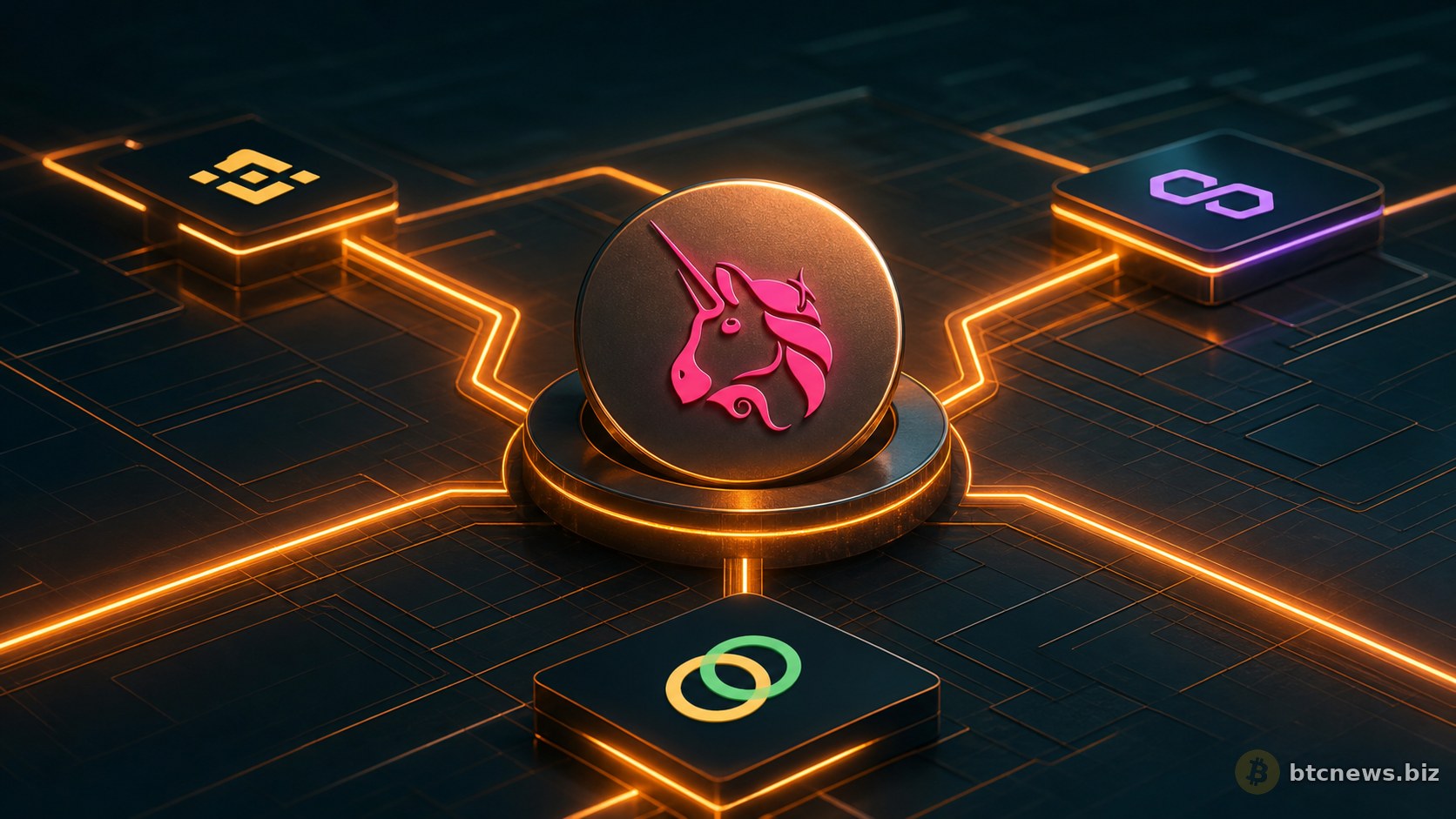
Uniswap wants to bring UNI buybacks and burns to BNB Chain, Polygon, and Celo: does it actually matter?
Uniswap has a governance proposal to extend its fee funded $UNI buyback and burn system beyond Ethereum mainnet to $BNB Chain, Polygon ($POL), and Celo ($CELO). Big headline. My take: the useful question is much smaller. Will those three networks throw off enough fees for $UNI holders to notice?
Right now, the buyback and burn mechanism only runs on Ethereum mainnet. It takes part of protocol fees, buys $UNI on the open market, then removes those tokens from circulation. The proposal would copy that setup onto $BNB Chain, Polygon, and Celo. It is also using Uniswap’s newer “UNIfication” governance process, which skips the usual Request for Comments stage and goes straight to a five day Snapshot vote. If that passes, an on chain governance vote follows. Most governance writeups frame speed as efficiency. That’s only half right. Faster governance also means less time for the market to argue with the details.
For $UNI holders, the pitch is almost too neat. More chains could mean more fees. More fees could mean more $UNI bought and burned. Fewer tokens in circulation can help price, at least in theory. But theory is doing a lot of work there. Why does this matter? Because a burn that barely touches supply is narrative, not value capture. $BNB Chain and Polygon already have serious DeFi activity. Celo is smaller and more tied to mobile payments. I’ll be honest: I would not price those three chains as one bucket. Polygon and $BNB Chain are where the burn could become visible. Celo looks more like a longer, slower bet.
This also fits the market’s shift away from Ethereum-only exposure. Capital moves first. Traders follow cheaper fees, faster settlement, the best incentives that month, or just the chain with the cleanest trade. We have seen the movie before. In late 2021, when Polygon’s daily active users passed Ethereum’s, $MATIC rallied about 30% in a week. That does not mean $UNI gets the same move. It does prove one narrower point: chain activity can hit token prices fast when the market has a simple story to trade. Uniswap is trying to collect fees wherever swaps happen, instead of leaning so hard on Ethereum mainnet while gas costs still push smaller traders elsewhere.
The proposal also says something about what Uniswap thinks it is now. Not just an Ethereum app. Not just a famous exchange with a governance token attached. If the burn expands, Uniswap ties $UNI more directly to activity across Ethereum mainnet, $BNB Chain, Polygon, and Celo. Counter to the usual advice, this is not only about “going multichain.” The sharper point is that Uniswap is trying to make $UNI harder to dismiss as a passive voting chip. Users have little patience in DeFi. Cheaper exchanges appear. Liquidity shifts. Users move even faster.
What this means
This proposal points to a more practical phase for DeFi token design. Governance rights are not enough on their own anymore. Holders want a cleaner link between protocol revenue and token value, and buybacks are one direct way to argue for that link. Is this overkill? For a protocol the size of Uniswap, no. For $UNI holders, the upside is burn pressure if Uniswap can pull steady volume from $BNB Chain, Polygon, and Celo. The downside is just as plain: if the fees are small, the market may shrug.
The five day Snapshot vote comes first. If it passes, $UNI may get a short burst of attention from traders looking for revenue backed burn stories. Yes, this cuts against the clean “buybacks equal bullish” version of the story. Bear with me. After implementation, the headline matters less than the numbers: Uniswap volume on $BNB Chain, Polygon, and Celo, protocol fees, and the actual burn rate. Watch those three lines. If they climb, $UNI has a stronger case over the next few months. If they do not, this becomes another governance proposal that sounded larger than it was.