
















































Circle stock slips as OUSD puts pressure on stablecoin giants
Circle’s stock fell today after more than 140 financial and crypto companies backed OUSD, a new stablecoin. That is not some tiny headline buried in a funding roundup. My take: it gives Circle and Tether a competitor investors cannot casually ignore. Not an overnight death threat, probably. Still, this is exactly the kind of announcement that makes the market reprice a clean story in one ugly session.
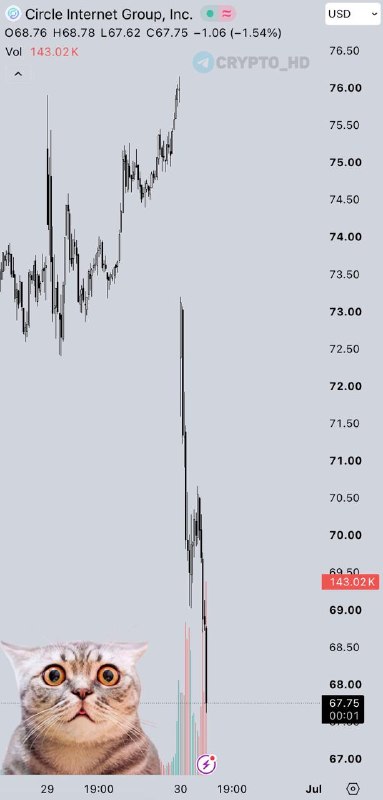
OUSD was the trigger. Open Standard, an independent company led by Zach Abrams, is behind it. Abrams founded Bridge, which Stripe owns. Open Standard says OUSD will give businesses what Circle and Tether do not currently offer in the same package: free transactions, reserve revenue sharing, voting rights, plus a more explicit say in the economics. That matters. Stablecoins have mostly made money for issuers. Users got the utility, issuers kept the float. OUSD is trying to make that bargain look dated.
The backing is what keeps sticking with me. One new stablecoin is usually noise. More than 140 financial and crypto firms backing one stablecoin is harder to wave away. Why does this matter? Because it suggests institutions still want digital dollars, but not necessarily under the Circle-and-Tether rulebook. Free transactions could make stablecoin payments easier to justify for businesses. Reserve revenue could pull in companies that already hold cash-like assets and want some upside from moving those balances on-chain.
Most guides frame stablecoin competition as a peg-and-liquidity story. That is only half right. If OUSD gets real use, not just launch-day attention, it could mean more on-chain activity. ETH could benefit if transactions run on networks where ETH pays for activity. BTC could get pulled in too if stablecoin systems start using it as a reserve asset or collateral option. The comparison is imperfect, and I would not stretch it too neatly, but MicroStrategy’s Bitcoin purchases in August 2020 were an early institutional signal. Bitcoin was near $11,000 then and hit new highs in the months after. Markets notice when large players move together.
The voting rights are worth watching too. They give OUSD a governance angle Circle and Tether do not have in quite the same way. I will be honest: governance language can be marketing fluff in crypto. But here it may do actual work. Crypto users who dislike issuer control may like it, and it may also help answer regulatory pressure without saying that too loudly. Stablecoin issuers have faced scrutiny from regulators, including the SEC and CFTC, especially around reserves, transparency, and control. If OUSD can show clearer reserve economics and some user governance, it may look less like a black box.
I would not take that too far. Voting rights do not erase reserve risk. Skip that fantasy. Regulators will still care who holds the assets, how redemptions work, who gets paid first, and what happens in a stressed market. Counter to the usual advice, the governance feature is probably less important than the reserve economics. But OUSD could still force Circle and Tether to explain why their models should stay as they are. That is enough to move a stock like Circle’s, at least for a day. Crypto markets are twitchy around regulation. SEC actions against crypto projects have often caused quick token selloffs and broader uncertainty, even when the direct effect was narrow.
What this means
OUSD points to a stablecoin market that is no longer only about holding a dollar peg. The pitch now includes payments and reserve income. Governance sits on top, not beside it. That is a different fight. If businesses can move dollars for free and get a cut of reserve revenue, Circle and Tether may have to lower costs or hand users more of the economics. Nobody likes giving up easy margin. Especially easy margin.
Circle’s stock drop may fade, but the reason behind it will not. Investors are reacting to the possibility that USDC’s position is not as protected as it looked yesterday. Is this overkill for one announcement? For a normal stablecoin launch, yes. For one backed by more than 140 financial and crypto companies, no. The numbers to watch are simple: OUSD supply, transaction volume, exchange listings, business usage after launch, and any visible movement in USDC share. Hype is cheap. Liquidity is harder.
Circle and Tether’s responses matter too. A fee change would be the blunt answer. A reserve disclosure update would be the defensive answer. A new reward model or governance feature would show the market they are taking OUSD seriously. Yes, this contradicts the idea that incumbents can ignore newcomers because they already have liquidity. Bear with me: liquidity protects them until economics start pulling users away. USDC’s market cap relative to USDT is another useful signal. If USDC loses share for more than a short stretch, this becomes more than a one-day stock wobble.
Regulators may decide where this goes. Watch for comments from the Federal Reserve, Treasury Department, SEC, or CFTC on stablecoin frameworks. I keep coming back to this point: the product design is only half the story if the rulebook shifts underneath it. If OUSD’s model gets treated more favorably, even quietly, other issuers will copy pieces of it fast. If regulators push back, the launch could become another example of the stablecoin problem: easy to sell, much harder to run at scale.