
















































Ethereum ZK-tech adoption in 3-5 years: a liquidity game changer
Joe Lubin says Ethereum could move much deeper into ZK-tech over the next 3-5 years. If that happens, liquidity may be where people feel it first. Right now, ETH activity is split across Arbitrum, Optimism, Base, zkSync, Linea, and a long tail of other L2s. The whole setup feels more fragmented than Ethereum people usually want to admit. My take: this is the part of the ZK story that actually matters. A ZK-heavy roadmap could pull some of that liquidity back into a system that feels connected, change how traders move between ETH products, and give institutions one less excuse to wait.
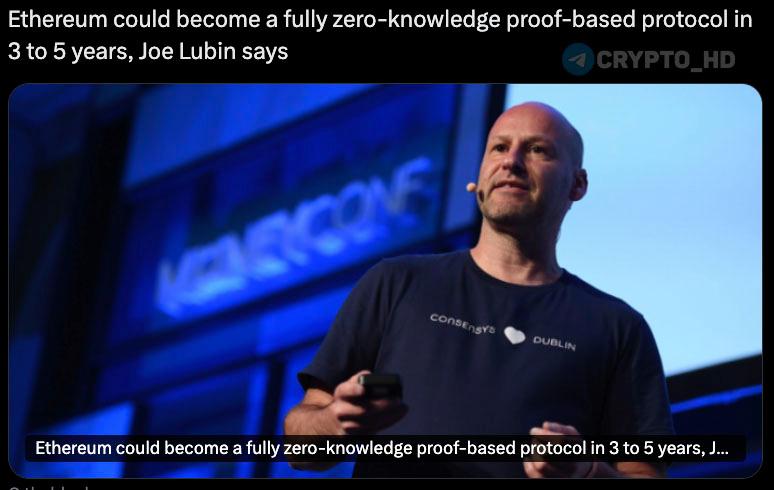
Zero-Knowledge (ZK) proofs could help Ethereum’s L2s work together with less bridge drama, according to ConsenSys CEO Joe Lubin. Lubin’s recent comments put ZK proofs right in the middle of the L2 problem. This is not only about mainnet security or scaling. The simpler goal is to make the networks compatible enough that users can move assets around Ethereum without leaning so hard on bridges. L2s fixed one problem and created another. They gave Ethereum cheaper execution. They also scattered liquidity across Arbitrum, Optimism, Base, zkSync, Linea, and the rest. Most guides frame that as a clean scaling win. That’s only half right. Lubin seems to view the fragmentation as a necessary phase. Maybe it was. But the next phase has to feel less like a maze.
A ZK-based Ethereum stack would give institutions a cleaner pitch: fewer bridges, fewer strange security assumptions, and less operational mess. Today, moving serious money between L2s is still clunky. For a hedge fund or bank desk, clunky means risk. Risk means meetings, approvals, delays, and sometimes no trade at all. Why does this matter? Because a single awkward bridge flow can turn a simple allocation decision into a compliance review. In a better version of Ethereum, a large institution could move hundreds of millions, or even billions, across Ethereum apps without treating every transfer as its own security review. That would not magically send ETH straight up overnight. Markets are messier than that. But if banks, asset managers, or listed companies announce deeper use of a unified ZK Ethereum stack, ETH would probably catch a bid. The obvious comparison is MicroStrategy’s Bitcoin buying in 2020 and 2021, when corporate balance sheet demand became part of the Bitcoin case. ETH’s old high is $4,891.70 from November 2021. A credible institutional ZK story could put that level back in play.
The ZK shift also changes how capital might move through crypto when macro conditions get rough. Crypto still trades like a risk asset most of the time. When the Federal Reserve talks rates and inflation, ETH usually reacts. Still, a more unified Ethereum, with deeper liquidity and fewer bridge risks, could make ETH look sturdier than the average altcoin during choppy markets. I’ll be honest: I would not call it a safe haven. That feels too neat. Counter to the usual advice, the point is not that ETH stops behaving like crypto. The point is that investors may separate Ethereum from thinner, less-used chains when volatility gets ugly. If Ethereum can offer better interoperability and stronger security through ZK proofs, some capital that would have gone to other chains, or stayed in BTC, could rotate into ETH instead. We have seen versions of that before. From January to May 2021, ETH rose more than 400%, helped by DeFi growth and institutional attention, even while macro signals were hardly calm. A ZK-led liquidity reset could create a similar setup, though not an identical one.
Lubin also said some teams may leave the Ethereum Foundation to focus on protocol work, user experience, scaling, and institutions. That part is easy to miss, but it matters. If teams split off to work more directly on the protocol and adoption, Ethereum development may become more focused in some places and messier in others. That is very Ethereum, honestly. It works sometimes. It breaks other times. The bigger point is that the ZK push is not just a technical preference. It sounds like a move away from “let a thousand L2s bloom” and toward “make this thing usable as one system.” Yes, this contradicts the usual Ethereum comfort with messy experimentation. Bear with me: at some point, liquidity needs boring infrastructure more than it needs another clever ecosystem map.
What this means
For investors, the main question is whether ZK adoption makes Ethereum liquidity easier to use, not whether the acronym sounds impressive. If ZK proofs help L2s share liquidity with fewer bridges and fewer trust assumptions, Ethereum becomes easier to trade and build on. It also becomes easier to allocate to. Developers, market makers, DeFi users, treasury teams, and institutions would feel that in different ways. Is this overkill? For a 50-page crypto thesis, maybe. For Ethereum’s next institutional pitch, no. Ethereum’s value comes partly from being the place where capital and applications meet. The current L2 setup weakens that by spreading activity around. Traders should watch whether major DeFi protocols actually integrate ZK-rollup infrastructure, not just whether teams publish roadmaps and conference slides.
The next 12-18 months matter because they should show whether this is real progress or another roadmap that looks good on paper. Investors should track ZK-rollup development from ConsenSys and other Ethereum teams, especially working ZK-EVM deployments and integrations with existing L2s. The details matter. A demo is not the same as production liquidity moving through the system. I would put more weight on live ZK-EVM usage than on another polished conference deck. Institutional announcements matter too, but only if they involve actual usage: custody, settlement, tokenized assets, onchain operations, or balance-sheet-level workflows. Regulation is another thing to watch. Clearer treatment of ZK-tech could make compliance teams less nervous. If concrete progress builds, ETH could retest the $3,500-$4,000 area as confidence improves. If the roadmap slips, the market will notice that too.
FAQ
Q: What is ZK-tech?
A: ZK-tech, or Zero-Knowledge technology, uses cryptography to prove that something is true without revealing the underlying information. In plain English: prove the result without showing all your work.
Q: How will ZK-tech unify Ethereum’s liquidity?
A: It could let assets move between Layer 2 networks with less reliance on bridges. That would make liquidity feel less trapped on separate islands.
Q: What is the projected timeline for full ZK-tech adoption on Ethereum?
A: ConsenSys CEO Joe Lubin has pointed to a 3-5 year window for much fuller ZK-tech adoption across Ethereum.
Q: What are the benefits of ZK-tech for institutional investors?
A: Institutions care about operational risk. ZK-tech could make cross-L2 asset movement simpler and safer, which makes Ethereum easier for large funds, banks, and companies to use.
Q: How might ZK-tech adoption impact ETH’s price?
A: If ZK adoption improves liquidity and brings in more institutional activity, ETH could move higher. A return above the November 2021 high of $4,891.70 would probably require real usage, not just hype.
Q: Will ZK-tech improve Ethereum’s scalability?
A: Yes. ZK-rollups process transactions offchain, then post cryptographic proofs to Ethereum mainnet. That helps Ethereum handle more activity without putting every transaction directly on L1.
Q: What role do L2s play in this ZK-tech transition?
A: L2s still handle much of Ethereum’s scaling work. ZK-tech could make them safer and easier to connect, instead of leaving each network to act like its own mini economy.
Q: What are ZK-EVMs?
A: ZK-EVMs are Zero-Knowledge Ethereum Virtual Machines. They let ZK-rollups run Ethereum-style apps and smart contracts with much less rewriting.
Q: How does ZK-tech address current bridging risks?
A: ZK-tech can verify transactions between networks with cryptographic proofs. That reduces reliance on bridge intermediaries, which have been a major source of exploits in crypto.
Q: What should investors monitor to track ZK-tech progress?
A: Watch ZK-rollup adoption, live ZK-EVM usage, integrations by major DeFi protocols, institutional Ethereum projects, and regulatory treatment of ZK systems.