
















































Edel Finance Google Tokenized Stock Exploit Shows How Weak DeFi Oracles Can Be
An attack on the Edel Finance lending protocol pushed the listed value of tokenized Google shares (GOOGLx) up by 7700%. That fake price left the protocol with $403,000 in bad debt. I’ll be blunt: the ugly part is not complicated. Google stock did not move. Edel’s pricing system did. If DeFi lending markets can be tricked this badly, wrapped assets still have a trust problem.
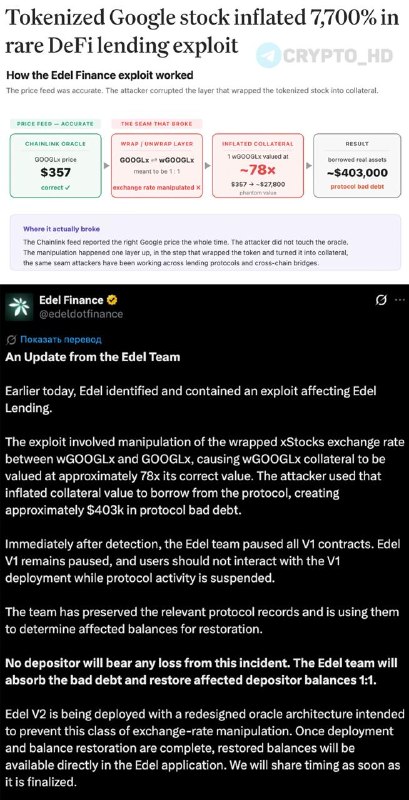
The attacker manipulated the price of wGOOGLx, Edel Finance’s wrapped version of tokenized Google shares. Edel treated the collateral as worth about 78 times its real value. Once the collateral looked that expensive, the attacker borrowed real assets and left the protocol with $403,000 it could not recover. Alphabet’s share price was never the problem. The break happened inside Edel’s process for converting tokenized shares into the wrapped version and back. Edel Finance has frozen the old protocol, said it will cover user losses, and plans to release a safer version. Fine. But reimbursement is not the same thing as resilience.
This was Edel’s bug, but it points at a bigger problem in DeFi lending: oracle services. Oracle attacks have been around for years. This one lands harder because it involved a tokenized traditional asset, the same category crypto teams keep selling as DeFi’s more mature next step. Why does that matter? Because the pitch for RWAs depends on boring reliability, not clever recovery threads after a pricing failure. If a lending protocol accepts collateral at 78 times its real price, trust gets hit. And trust is not a soft extra in lending. It is the product. Traders may respond by avoiding smaller wrapped assets and moving back toward BTC or ETH, even though those markets have their own risks. During the March 2023 banking crisis, Bitcoin rose about 18% in one week and reached $28,000 as some investors looked outside traditional finance. This Edel Finance exploit is far smaller, but the local reaction could follow a similar pattern.
Here is the part that sticks with me: tokenized real world assets are getting more serious attention while the plumbing still looks uneven. BlackRock and other large firms have explored tokenization, but failures like this show how much plain infrastructure has to work before RWAs can sit safely inside DeFi lending markets. Tokenized assets can make ownership more flexible. They can make markets easier to access. Sure. Counter to the usual sales pitch, though, access is not the hard part here. Valuation is. If price discovery and collateral valuation can fail this badly, regulators will not need hypotheticals. They will have examples. The SEC put more pressure on staking services in early 2023, and Kraken shut down its US staking program after settling with the agency. A string of RWA exploits could bring similar pressure to tokenized asset platforms.
What this means
The Edel Finance exploit is a warning for DeFi oracle infrastructure and tokenized real world assets. The link between off-chain asset prices and on-chain lending still has weak spots. As more stocks, bonds, funds, and other real-world instruments move on-chain, protocols have more assets to price and more ways to get those prices wrong. My take: the weak point is not always the oracle brand name. Sometimes it is the conversion logic, the wrapper mechanics, or the fallback path nobody stress-tested hard enough. Most guides say protocols should use several price feeds. That’s only half right. They also need sanity checks around wrapped-asset conversions and collateral jumps that make no market sense. For traders, the practical risk is volatility in smaller wrapped assets with thin liquidity. Some money may move toward BTC and ETH because those markets are deeper and less exposed to this specific wrapped-asset pricing failure. Protocols already changing their oracle setup are worth watching. Protocols brushing this off are not.
Watch how other lending protocols respond. Some may add stricter collateral checks. Others may spread pricing across more oracle sources, pause thin wrapped assets faster, or cap borrowing when a tokenized stock moves far outside the real share price. Is this overkill? For a market that just saw a 7700% fake move create $403,000 in bad debt, no. Edel users are still waiting on the promised compensation, but the wider market will be looking for copycat failures or quiet weaknesses elsewhere. I would watch other tokenized RWA projects for strange price gaps, sudden volume spikes, or odd collateral behavior. Regulators matter here too. This exploit gives them another example to use when arguing that tokenized securities need tighter rules. Yes, that sounds like repeating the same warning twice. It is worth repeating. The next few months should show whether this was one bad implementation or an early sign of a messier RWA problem. Announcements from major oracle providers such as Chainlink will matter, especially if they include new security checks or pricing designs for wrapped assets.
FAQ
What is the Edel Finance Google Tokenized Stock Exploit?
The Edel Finance Google Tokenized Stock Exploit was an attack on Edel Finance where someone manipulated the price of wGOOGLx, a wrapped tokenized Google share. The fake price increase reached 7700% and left the protocol with $403,000 in bad debt. This is not theoretical.
How did the attacker manipulate the price?
The attacker used a flaw in Edel Finance’s conversion process for tokenized Google shares and their wrapped version. That made the system value the collateral at about 78 times its real price.
What is the impact of this exploit on DeFi?
Coindesk has reported on oracle manipulation as a growing threat for DeFi protocols. This exploit showed why lending markets need reliable price feeds, especially when they accept tokenized real world assets as collateral. The uncomfortable bit: a familiar stock name did not make the collateral safer.
Are tokenized real-world assets (RWAs) safe?
The Edel Finance exploit shows that tokenized RWAs still carry infrastructure risk. Liquidity and easier access are useful, but weak price discovery or bad collateral valuation can turn those benefits into a liability fast.
What is Edel Finance doing to address the exploit?
Edel Finance has frozen the old version of the protocol, said it will cover user losses, and plans to release an updated system meant to prevent the same kind of attack.
Will this incident affect regulatory oversight of DeFi?
Regulators are likely to cite incidents like this when arguing for tighter rules on tokenized securities and RWA platforms. It is the kind of failure that makes DeFi look risky to agencies already watching the sector.
What is an oracle in DeFi?
An oracle is a service that brings outside data, such as asset prices, into blockchain smart contracts. Lending protocols use oracles to decide how much collateral is worth.
What is wGOOGLx?
wGOOGLx is the wrapped version of tokenized Google shares on Edel Finance. It is meant to represent Google stock value inside the protocol.
How does this exploit compare to previous oracle manipulation attacks?
It looks like earlier oracle manipulation attacks in some ways, but the tokenized stock angle makes it more uncomfortable. RWAs are supposed to connect traditional assets with DeFi. This showed how easily that connection can break. My read: the wrapper was the weak link, not the Google exposure itself.
What should investors do in light of this exploit?
Investors should be careful with smaller wrapped assets, especially thinly traded ones. It also makes sense to check whether protocols are improving their oracle systems before trusting them with collateral.