















































BitMart insolvency: OpenGradient funds stuck, raising exchange risk concerns
BitMart, a crypto exchange, may be insolvent. Market maker OpenGradient says its funds are trapped on the platform and cannot be withdrawn. The report surfaced about a week after BitMart allegedly asked users to lock their assets there to provide liquidity. Why does that timing matter? Because traders are now asking who else may be unable to get money out.
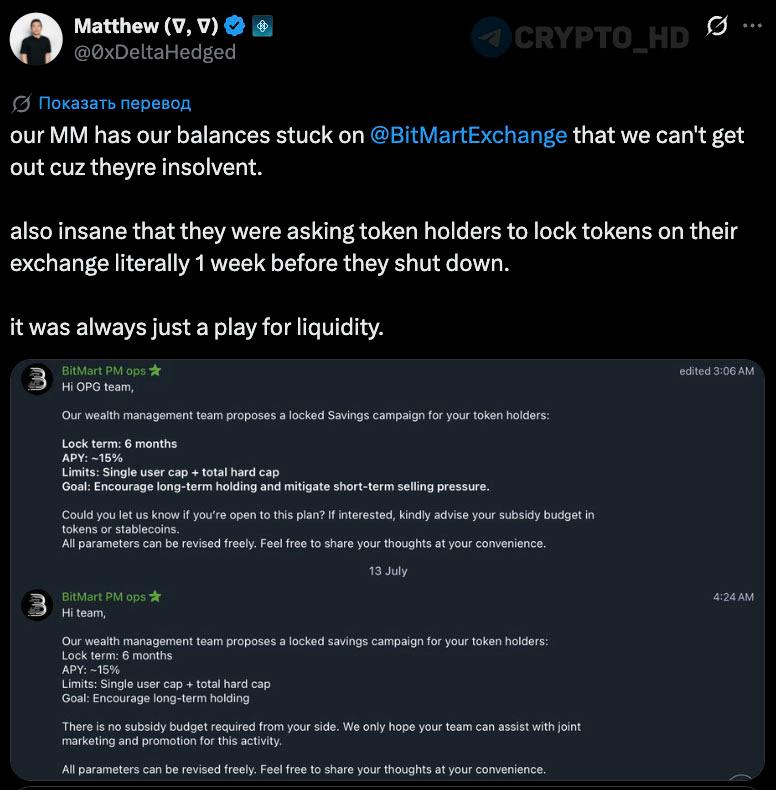
OpenGradient’s CEO said the firm’s market maker funds are stuck on BitMart because of the exchange’s solvency problems. For a market maker, that is not an abstract concern. Trading capital is the business. Lose access to it, and the damage starts immediately.
My take: the broader warning is about control. Assets left with an exchange remain exposed to that platform’s decisions. About a week before the insolvency report, BitMart reportedly asked token holders to lock their assets on the platform. Several crypto news outlets reported on the offer. Looking back, it resembles an effort to bring in liquidity while confidence was already slipping. Earlier messages from BitMart intended to “calm crypto users” did little to answer the bigger questions.
Most guides say a liquidity appeal proves nothing. That’s only half right. Timing matters when withdrawals are reportedly stuck. We tried to read the message as reassurance; the unanswered solvency questions remained.
If BitMart cannot meet its obligations, traders may pull money from other exchanges too. That happened after FTX collapsed in late 2022. CoinDesk reported that billions of dollars moved from centralized exchanges into self-custody. The same reaction may not happen immediately this time. BTC and ETH have not shown a clear BitMart-related move so far.
Still, people with serious money usually test withdrawals when an exchange starts making headlines. It is a simple check. Sometimes, simple checks matter most.
Smaller exchanges could lose liquidity if users move funds to platforms they trust more. Some may transfer coins to personal wallets or use decentralized finance, where they control their private keys. I would not assume one response will win out yet. Counter to the usual advice, self-custody is not automatically safer for every trader; it replaces exchange risk with operational risk.
FTX remains the clearest warning. BTC fell from about $21,000 to $16,000 as the failure spread, and market sentiment changed within days. That precedent is uncomfortable. It is still relevant.
The BitMart case could also increase pressure for stricter crypto rules. Regulators in the United States and Europe have been examining centralized exchanges. Authorities in Asia have been doing the same, with particular attention to reserves and custody. Disclosures matter too.
A failure involving trapped user or market maker funds would give critics another specific example. Is that enough to produce immediate legislation? For regulators, probably not. It would still strengthen the case for faster scrutiny.
The SEC has already taken a hard line on staking services and alleged unregistered securities offerings. Its actions have affected large companies such as Coinbase (COIN) and Binance. If BitMart’s liabilities are larger than currently reported, lawmakers and regulators may move faster on reserve disclosures and custody requirements. Enforcement could accelerate as well. Those changes could affect exchange operations and the way new crypto ETFs reach the market.
Crypto prices often move before the facts are settled. Even rumors of SEC action have sometimes pushed BTC and ETH down by 2% to 3% within a few hours. That does not mean BitMart will move the wider market. It does explain why traders watch every report about withdrawals.
I’ll be honest: the absence of a clear market reaction is not the same as reassurance. Headlines travel slowly through balance sheets. Withdrawals do not.
What this means
OpenGradient’s stuck funds have put counterparty risk back in front of traders. The question is not just whether BitMart survives. Users also need to know whether they can reach their assets when they need them. The old phrase “not your keys, not your crypto” still applies, particularly when an exchange starts asking customers to lock funds.
Investors may shift money toward exchanges with clearer disclosures and deeper liquidity. Some will choose self-custody. Others will use decentralized protocols. Every option carries risk, and there is still no clear sign of a direct effect on BTC or ETH.
Yes, this slightly contradicts my earlier caution about assuming one response will win out. The point is narrower: users can diversify their custody choices even while the market reaction remains unclear.
Prices could react if more information emerges about BitMart’s debts or withdrawals. News involving other affected firms could matter too. That is what I would watch most closely.
Traders should follow statements from OpenGradient, BitMart, affected customers, and regulators. Withdrawal activity on other mid-sized exchanges could provide an early warning. Large outflows would suggest that distrust is spreading beyond BitMart. Trading volume is worth watching too, although volume by itself can mislead.
We saw the same analytical trap after FTX: a busy market can look healthy right up until confidence breaks. Volume helps. It is not proof of solvency.
BTC is also trading near the $60,000 support level cited by market participants. A sustained break below it would not prove that BitMart caused the move, but it could indicate weaker appetite for risk. New SEC proposals or enforcement actions deserve attention for the same reason. After a high-profile exchange failure, those actions can arrive quickly and move prices.
The next FOMC meeting has nothing to do with BitMart, but interest-rate decisions can change how willing investors are to hold risky assets. If the meeting and a fresh exchange headline arrive close together, crypto could react more sharply than it would to either event alone.
My bottom line: watch access first, price second. The market can shrug off a rumor. It cannot easily shrug off confirmed trapped funds.