















































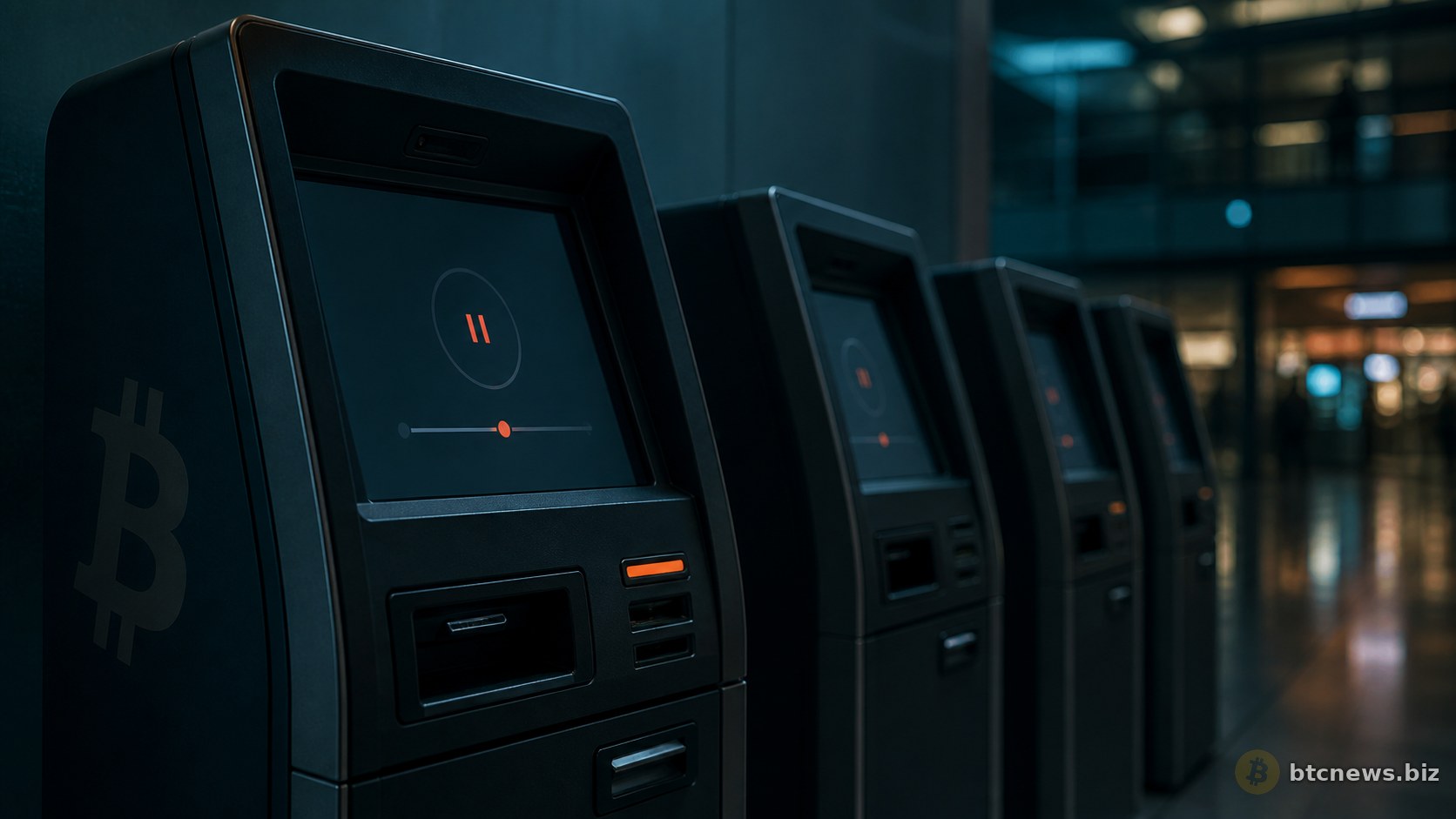
AUSTRAC suspends Cryptolink, taking 96 crypto ATMs offline
Australia’s financial crime watchdog, AUSTRAC, has suspended crypto ATM operator Cryptolink for three months. The order began on August 9. Ninety-six machines went offline across the country. That is a sudden access problem for anyone using cash to buy crypto. My take: the bigger signal is regulatory, not market-related. Australian regulators will act when they believe an operator cannot control money laundering and terrorism financing risks.

Cryptolink Pty Ltd cannot provide virtual asset services during the suspension. AUSTRAC said the company initially complied with an enforceable undertaking issued in October 2025, then failed to file required threshold transaction reports and did not answer an information request. Put simply, promised compliance work was left unfinished. It works. This time, the consequence is a three-month shutdown.
AUSTRAC CEO Brendan Thomas said the business was “too high risk to continue operating at present.” The decision followed an investigation by AUSTRAC’s Cryptocurrency Taskforce, which found alleged breaches of anti-money laundering (AML) and counter-terrorism financing (CTF) rules. Investigators pointed to late transaction reports and gaps in Cryptolink’s risk assessments. The company had already paid a fine of 56,340 Australian dollars, or about $36,600, for earlier problems. Most guides frame fines as the endpoint. That’s only half right.
For crypto investors, access is the immediate issue. Cryptolink is one operator, but ATMs remain one of the few ways to move cash into digital assets without using a traditional exchange. Why does that matter? Because removing 96 machines overnight changes the practical route into the market, even if the price chart barely notices.
Bitcoin was recently trading around $61.4K, and this suspension alone probably will not move the market. I’ll be honest: I would not treat this as a Bitcoin trade. A string of similar actions could hurt sentiment and reduce the flow of new retail money, especially as extra checks make onboarding more frustrating. That is a risk, not a forecast.
AUSTRAC warned crypto ATM operators in March 2025 after finding that some providers lacked adequate AML controls. By June, the agency had introduced a 5,000 Australian-dollar limit on cash deposits and withdrawals. Operators also had to strengthen customer checks, scam warnings, and transaction monitoring.
The timing is hard to miss. Cryptolink’s suspension arrived after months of tighter rules and closer scrutiny. Counter to the usual advice, stricter checks do not automatically mean a healthier market for every user. Traders may face higher compliance costs and slower transactions at exchanges and other on-ramps.
The effect on prices is less clear. Regulatory fear has sometimes pushed Bitcoin down 3% to 5% within 48 hours, but those drops often fade when the action affects only one country or company. Is this overkill? For a single operator, probably. For a pattern of repeated failures, no.
Thomas said AUSTRAC will monitor Cryptolink during the suspension. He warned that other crypto ATM businesses could face action if investigators find serious risks or noncompliance. The message is direct: an operator can lose its right to trade when its controls fail. We tried to reduce this to “more regulation,” but that misses the operational point. A control that is promised, then not performed, is not a control.
The market may become safer. Serving customers will also become more expensive. The lightly supervised part of crypto access is shrinking. My view is simple: anyone using an ATM, exchange, or another gateway should know who operates it and which rules apply. Skip this step.
What this means
The suspension reflects a broader change in how financial regulators treat fiat-to-crypto services. Cash-based access can be difficult to monitor, so these businesses are receiving more attention. Warnings are becoming fines, limits, and suspensions. Smaller ATM companies may struggle to pay for the necessary systems and staff. Larger operators may find it easier to stay open, leaving customers with fewer locations but more closely monitored services.
For the wider crypto market, the case is a reminder that institutional money does not arrive outside the regulatory system. Banks, exchanges, and payment providers need workable AML and CTF controls before serving more customers. Those checks add friction. Nobody wants to wait longer or answer more questions to complete a transaction. Yes, this complicates the access story. Weak controls create a bigger problem, though, particularly when scams and illicit transfers are involved.
Investors should watch what happens to other crypto ATM operators in Australia and elsewhere. More suspensions or fines could unsettle traders in the short term. Smaller altcoins may feel it first if retail liquidity dries up. AUSTRAC announcements matter. So do changes to the 5,000 Australian-dollar cash limit and customer verification rules. Both can affect how easily new money enters the market.
Cryptolink’s three-month suspension should end around early November. The next question is whether the company can resume operations under tighter conditions or whether AUSTRAC takes further action. That outcome will say more than the headline.
If Cryptolink returns, the case may serve as a warning about the cost of weak controls. If it does not, other crypto service providers will likely pay attention. I would watch the follow-up closely. That is where the real precedent forms.