















































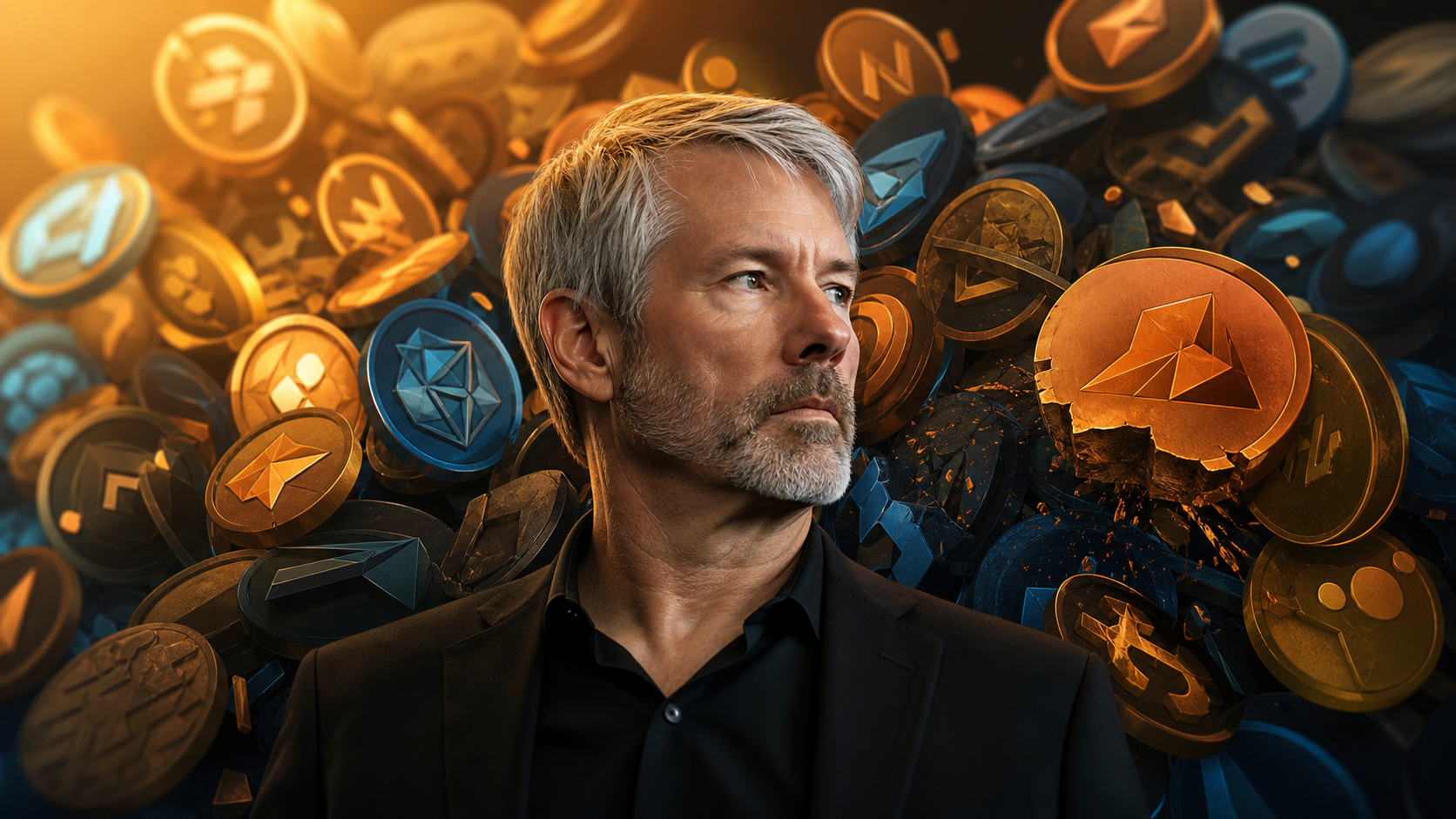
Michael Saylor: Altcoin Market Competition Demands Real Utility
“The altcoin market is now ‘too competitive,’ signaling a move away from story-led pumps and toward actual use and network adoption,” according to Michael Saylor.
Michael Saylor rarely softens this kind of point. He did not soften it here. He called the altcoin market “too competitive.” My take: that is not just a Bitcoin-maxi jab, even if it sounds like one. A token cannot live forever on a clean logo, a founder thread, and one good cycle narrative. Investors have heard the pitch. Now they want users, fees, liquidity, repeat app activity, and some proof the network still matters after the hype cools off.
“A fierce battle for users, liquidity, and attention among major players is stripping altcoins of their ‘digital money’ status,” Michael Saylor stated.
The MicroStrategy chairman pointed to the fight between Ethereum (ETH), Solana (SOL), BNB (BNB), Sui (SUI), Hyperliquid (HL), Arbitrum (ARB), Base, and plenty of other projects. That crowding matters. Most guides say competition is healthy. That is only half right. In Saylor’s view, altcoins cannot expect the market to treat them as “digital money” just because the branding sounds good. Their value has to come from something plainer: people using the network, apps producing revenue, sticky liquidity, demand that holds up when traders stop chasing the next rotation.
“The timing of Saylor’s observation matters, as investors increasingly scrutinize projects for sustainable economic models rather than speculative potential,” according to market analysts.
Saylor is not making a brand new argument. The timing is the sharp part. Over the past year, macro flows have been less forgiving. With the Federal Reserve still fighting inflation through higher rates, risk assets have had a harder time, and many altcoins sit squarely in that bucket. Cheap money made almost any crypto story sound plausible. Tighter money asks a colder question: where is the business?
Bitcoin (BTC) has held up better than many smaller tokens, at least in how investors talk about it. I would not call that magic. It is the advantage of being the asset people already know. Why does this matter? Because Ethereum (ETH), Solana (SOL), BNB (BNB), Sui (SUI), Hyperliquid (HL), Arbitrum (ARB), and Base are not competing in a vacuum; they are competing against Bitcoin’s default status in the minds of allocators. Without a clear use case, a real user base, or fees that show someone needs the network, valuations get harder to defend. The market feels older now. Less forgiving, too.
“Bitcoin has strengthened its position as the dominant digital capital network, while altcoins rarely benefit from a flight to safety,” Michael Saylor observed.
That also explains the safe haven argument, or why most altcoins do not really have one. Saylor says Bitcoin has strengthened its position as the dominant digital capital network. That fits what traders saw during the banking stress in early 2023, when Bitcoin drew attention as a decentralized asset outside the traditional banking system. I’ll be honest: that argument gets overstated sometimes, but it has survived more stress than most altcoin narratives.
Altcoins usually do not get the same treatment. When fear hits, they often trade more like speculative tech than like a place to hide. That is the uncomfortable split Saylor is getting at. Bitcoin has a simple story that many investors already understand. Altcoins still have to explain what they are. Then they have to explain why they matter. Then they have to explain why users should pick them over Ethereum, Solana, Base, or a dozen similar networks.
“The sheer number of Layer 1s and Layer 2s means network effects are now incredibly difficult to build and sustain for altcoins,” according to industry experts.
This is about more than mood. It is basic market structure. Too many Layer 1s and Layer 2s are chasing the same developers and liquidity. Users, too. Attention most of all. That makes network effects harder to build. A new chain can be fast. It can be cheap. Fine. But if developers already build on Ethereum, and traders already keep liquidity on the biggest venues, the new chain needs a sharper reason to exist.
Sui and Arbitrum may have real technical strengths, but they are not walking into an empty room. Ethereum is already there. Solana is there. Base is there. Counter to the usual advice, being technically better is not always enough in crypto infrastructure. Liquidity does not move just because a pitch deck says it should. Users need a reason, and “we are faster” is not enough anymore.
What this means
“Saylor’s commentary signals a major shift in the altcoin market: the era of ‘narrative premium’ is over,” according to market analysts.
Saylor’s point is that the “narrative premium” is shrinking. I think he is mostly right. A token can still run on hype for a while, because crypto has not suddenly turned into a sober accounting seminar. Yes, this slightly contradicts the clean “utility wins” version of the argument. Bear with me. The point is not that hype vanished. The point is that the bar is higher than it was during the easy-money phase.
Investors should pay closer attention to actual usage. Active addresses matter. So do transaction volume, total value locked (TVL), fee revenue, app activity, and liquidity depth. Is this overkill? For a serious altcoin allocation, no. Ethereum (ETH) and Solana (SOL) are useful examples to watch because they have enough activity to separate real demand from marketing noise. Smaller projects need the same kind of proof, scaled to where they are.
“Traders should watch for continued consolidation in the altcoin space and increased scrutiny from institutional investors,” according to financial strategists.
Traders should expect more consolidation. Institutions are usually less patient with vague token stories, especially when rates stay high and regulatory pressure remains a problem. Network upgrades still matter, but only if they lead to more usage, lower costs, clearer revenue, or stronger developer retention. Otherwise they are just dates on a calendar. We have all seen that movie.
The SEC is another piece of this. Any change in enforcement or token classification can affect whether larger funds can touch a project at all. Also watch the total altcoin market cap compared with Bitcoin. If that ratio keeps falling, it suggests capital is choosing the safer, more familiar crypto trade instead of spreading across smaller tokens. Skip the slogan. Watch the flows.
FAQ
Q: What is Michael Saylor’s main concern about the altcoin market?
A: Saylor’s concern is that the altcoin market has become “too competitive.” In his view, projects now need real utility instead of relying on story-driven speculation.
Q: What does Saylor believe altcoins need to succeed?
A: He believes altcoins need actual users, visible revenue, and real demand for their networks and applications.
Q: How does Saylor differentiate Bitcoin from altcoins?
A: Saylor sees Bitcoin as the dominant digital capital network. He argues that altcoins often lack that clear role and tend to trade more like risk assets during market stress.
Q: What impact do Layer 1s and Layer 2s have on altcoin competition?
A: The number of Layer 1s and Layer 2s makes it harder for any one project to attract developers, users, and liquidity. Network effects are harder to build when everyone is fighting for the same crowd.
Q: What should investors prioritize based on Saylor’s commentary?
A: Investors should focus on projects with real usage, solid adoption data, and revenue that does not depend entirely on hype or future promises.