
















































Musk’s Wealth Tops Bitcoin Market Cap: A Macro Flow Reality Check
Elon Musk’s personal fortune is now reportedly larger than Bitcoin’s entire market value, which is a strange and slightly awkward comparison for crypto people. I’ll be honest: it lands because it feels insulting before it feels analytical. The point is not simply that a very rich man is very rich. It is that a huge amount of capital still sits in old tech, private companies, and public markets while Bitcoin, even after years of nonstop attention, remains a younger and smaller market. Crypto Headlines linked the gap to recent growth at SpaceX, which tracks. SpaceX does what private giants are built to do: turn belief and contracts into an enormous paper valuation. Scarcity helps too.
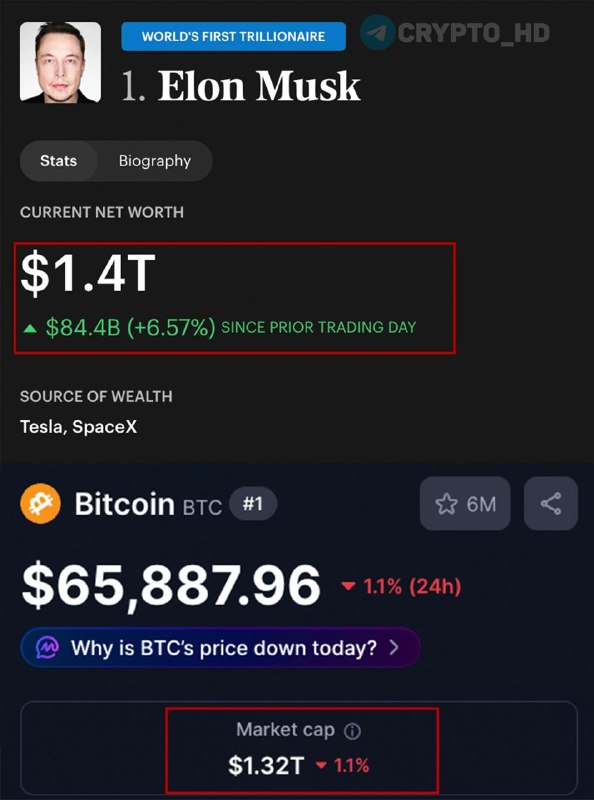
The headline works because it puts one person’s wealth next to the largest cryptocurrency in the world. Weird comparison? Yes. Useful comparison? Also yes. Musk’s net worth mostly comes from companies such as SpaceX and Tesla. Bitcoin’s market cap comes from millions of buyers and sellers repricing a public asset every day. Most crypto commentary treats those as totally separate categories. That is only half right. According to Crypto Headlines, the comparison picked up attention after another strong run for SpaceX, the company Musk founded and still leads.
For me, the useful part is the macro read. Bitcoin has come a long way. It traded around $61.4K earlier this year, and institutions are paying far more attention than they did five years ago. Still, Musk’s fortune sitting above Bitcoin’s market cap shows how much traditional capital has not entered crypto. The Federal Reserve matters here. Inflation prints matter. Rate cuts matter. Pauses matter. Hawkish comments matter. Bitcoin still trades like a risk asset much of the time, whether bitcoiners like that framing or not. If bonds or large tech stocks look safer, money can leave BTC quickly. If investors start worrying more about fiat debasement, some of that money can come back. Why does this matter? Because the flow story is bigger than the ideology story. One person’s wealth outweighing the whole Bitcoin network does not mean Bitcoin is “small” in a cheap-shot way. It says there is still a lot of capital that could move in, and that is part of why BTC can be so jumpy.
The comparison also says something about adoption, though not in a clean victory-lap way. My take: this is where crypto people should resist the easy dunk and the easy cope. Musk has talked up Dogecoin for years, and Tesla once held BTC on its balance sheet. But most of his wealth still comes from traditional equity. That is the benchmark. El Salvador made BTC legal tender in 2021. MicroStrategy has built a huge Bitcoin treasury. Banks and funds keep adding crypto products. Those developments count. Still, Bitcoin’s total market value is small next to the biggest pools of global wealth and, apparently, even next to one tech founder’s net worth. That is not a dunk on Bitcoin. It is where the market is. Every treasury purchase adds weight. Every bank product adds another bridge. The gap is still big. Traders may shrug at this kind of comparison because they care more about the next $2,000 move than a valuation thought experiment.
What this means
Bitcoin is much bigger than it used to be, but it is still not huge next to global wealth. That is the uncomfortable part. It may also be the bullish part, depending on your mood. Counter to the usual advice, the headline is not meaningless just because it is not a trading signal. It tells you where Bitcoin still sits in the capital stack. If more traditional money moves into BTC over time, the upside could be large. But the price will still get pushed around by rates, inflation data, liquidity, and large funds. Is this overkill for one headline? No, because the headline is really about capital rotation. Economic forecasts keep returning to the same question: will Fed policy pull money toward risk assets or push it back into cash, bonds, and mega cap stocks?
Investors should watch the next FOMC meetings, especially any change in rate guidance. I would watch the boring stuff first. Those decisions shape risk appetite across markets, crypto included. It is also worth tracking earnings and filings from companies with large BTC holdings, especially MicroStrategy, to see whether they keep buying, pause, or change their treasury plans. Yes, this slightly contradicts the idea that the Musk comparison is just a broad macro snapshot. Bear with me. Broad snapshots matter only if they connect back to actual catalysts. On the chart, the $60,000 area still matters. A clear move above or below that zone could show whether buyers are ready to absorb more supply or whether the market needs another reset first.
FAQ
Q: How does Elon Musk’s wealth compare to Bitcoin’s market cap?
A: Elon Musk’s personal fortune is now reported to be larger than Bitcoin’s total market capitalization. That shows how concentrated wealth can be in traditional tech and private companies. It is a blunt comparison, but not a useless one.
Q: What does this say about Bitcoin’s maturity?
A: Bitcoin is growing, but it is still young compared with the deepest pools of global wealth. A lot of capital is still outside the market. That is the whole tension.
Q: How do macro factors affect Bitcoin here?
A: Fed policy, inflation, and liquidity shape whether investors want risk. When risk appetite rises, Bitcoin can benefit. When it fades, BTC often feels it quickly. Simple, but brutal.
Q: Is this bad for Bitcoin?
A: Not automatically. It shows that Bitcoin is still trying to become part of mainstream finance. That gap can look like weakness or opportunity. My read is that it is probably both.
Q: What should investors watch next?
A: Watch FOMC meetings, rate guidance, BTC holdings at public companies, and the $60,000 price area. Those signals matter more than the headline by itself.