















































Short-term holders sell Bitcoin at a loss as nerves set in
Short-term holders moved 15,100 BTC, worth about $1 billion, to exchanges at a loss over the past 24 hours. That is a hefty amount of underwater Bitcoin arriving in a single day. I’ll be blunt: newer buyers look rattled. Still, the data does not prove Bitcoin has found a bottom. Prices could get rougher before they settle.
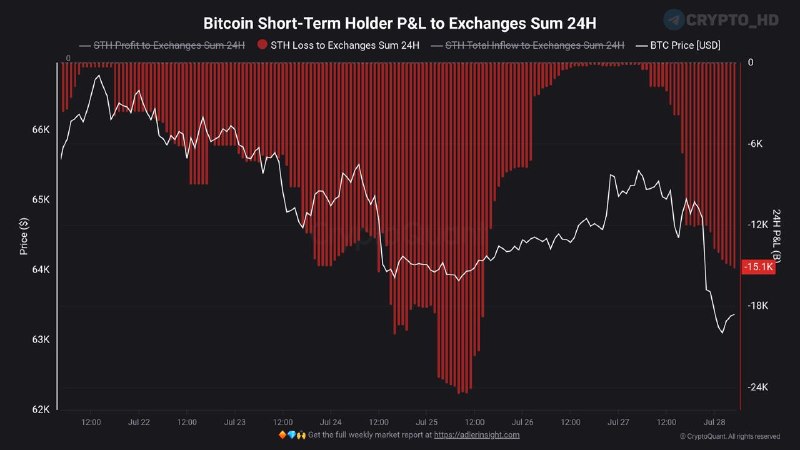
The number comes from CryptoQuant’s STH P&L to Exchanges Sum 24H indicator. It tracks Bitcoin sent to exchanges by short-term holders when the coins are worth less than their purchase price. Here is the catch. It records deposits, not completed sales. Some of the 15,100 BTC has probably been sold; some may still be sitting on exchanges. Why does that distinction matter? Because a transfer signals possible intent, while a sale confirms action. Holders usually deposit coins because they intend to trade, but “usually” is doing real work there.
Large deposits from recent buyers can increase selling pressure. These holders often react quickly to falling prices because they have had less time to grow comfortable with their positions. Others may simply be trying to save what remains of their capital. Most market commentary calls that panic. That is only half right. This is not proof of a final washout, though it plainly shows that plenty of recent buyers are nervous.
The timing is awkward. The Federal Reserve continues to sound hawkish on interest rates, while stubborn inflation has made investors cautious about risky assets. Bitcoin does not move in a vacuum. My take: that line has become a cliché because it keeps being true. When stocks struggle, BTC often trades more closely with indices such as the S&P 500.
The pattern was clear during the sharp rate increases of 2022, when Bitcoin fell alongside other risk assets. The latest exchange deposits may reflect the same urge to reduce exposure as investors brace for tighter global liquidity. A slight change in the Fed’s language can move BTC fast. So can a surprise inflation figure. Recent buyers are often first out the door.
Regulation adds another layer of uncertainty. SEC decisions on spot Bitcoin ETFs continue to shape how traders assess risk. Decisions covering staking and exchange oversight matter too. The January 2024 approval of spot Bitcoin ETFs initially helped lift BTC above $45,000. Later regulatory questions took some of the shine off that rally. To my eye, access improved faster than confidence did.
ETFs have made Bitcoin easier for institutions to buy, but the recent losses expose how shaky confidence can be among newcomers. Tougher enforcement news can sour the mood within hours; so can a delay involving another crypto product. Some investors lock in profits. Buyers who entered near a recent high may sell simply to stop the loss from getting worse. That is not irrational.
What this means
The transfers may be clearing out buyers who were never comfortable sitting through a steep decline. Crypto traders often call them “weak hands,” though I think that label is too glib. Closing a losing position is not necessarily panic. Counter to the usual advice, holding at all costs is not proof of discipline either. Sometimes selling is perfectly sensible risk management.
Previous capitulation events have sometimes led to quieter trading, with longer-term holders buying coins sold by newer investors. If most short-term sellers have already left, pressure could ease and Bitcoin might find a local bottom. Sounds encouraging, right? Maybe—but the word “sometimes” matters. A large realized loss demonstrates stress. By itself, it does not reliably call the bottom.
The volume is hard to dismiss. Moving 15,100 BTC to exchanges at a loss indicates that a sizeable pool of speculative money is leaving, or getting ready to leave. That may eventually make the market less crowded. I’ll be honest: while prices are falling, a supposedly healthy reset rarely feels healthy.
Traders are now focused on $60,000. If BTC remains below that price, attention will likely shift toward the area around $58,000. Holding above $60,000 while buyers absorb the available supply would offer an early sign that selling by short-term holders is losing steam. The level matters. The reaction matters more.
The FOMC meeting minutes expected later this month could also move the market. A more hawkish message may push investors to trim risk again. Exchange net flows provide a separate check: growing net inflows mean more Bitcoin is heading toward possible sale, while lower inflows or net outflows suggest pressure is beginning to ease. Is that enough to call a reversal? No. It is one useful confirmation, not a verdict.
Short-term holder capitulation explained
Short-term holder capitulation occurs when recent Bitcoin buyers sell after the price drops below what they paid. Fear is often involved. Margin calls can force sales too, as can basic risk limits. CryptoQuant recorded 15,100 BTC, worth roughly $1 billion, moving to exchanges at a loss over the past 24 hours. My read: the scale matters more than the dramatic label.
How economic conditions affect Bitcoin
Interest rates and inflation influence how much money investors are willing to put into assets such as Bitcoin. Higher rates make borrowing more expensive. They also make safer investments more appealing. With the Federal Reserve still sounding hawkish and inflation refusing to disappear, traders have less appetite for extra risk. Simple, but not trivial.
Regulation and market sentiment
Rules covering Bitcoin ETFs, staking and crypto exchanges can change investor confidence quickly. SEC decisions continue to keep traders guessing, even after spot Bitcoin ETFs received approval in January 2024. The approval made Bitcoin easier to access. It did not make regulatory uncertainty disappear. Those are separate wins, and markets sometimes blur them.
What the short-term sell-off could do
Heavy selling by recent buyers can lead to a calmer stretch if longer-term holders take the other side. Similar events have appeared near local bottoms before. Yes, that sounds bullish—but bear with me. They have also occurred ahead of deeper drops. Traders still need support from price action plus exchange flow data before drawing conclusions.
Support levels and what comes next
Bitcoin’s next move around $60,000 may provide the most useful short-term signal. Staying below that mark could bring $58,000 into focus. If buyers defend $60,000 and exchange inflows decline, Bitcoin may be close to clearing the remaining fearful or forced sellers from this round. I would not call it settled before both happen.
FAQ
What is a short-term holder in Bitcoin?
Glassnode generally defines a short-term holder as someone whose Bitcoin has been held for less than 155 days. The classification follows the age of the coins. It does not necessarily describe the owner’s usual trading style.
What does “selling at a loss” mean for Bitcoin?
It means selling Bitcoin for less than the buyer originally paid. Fear may drive the choice, but it is not the only explanation. A stop-loss order may trigger it. A margin call or a planned effort to prevent a larger loss can produce the same result.
How does the STH P&L to Exchanges Sum 24H indicator work?
CryptoQuant’s indicator tracks how much underwater Bitcoin short-term holders deposit on exchanges during a 24-hour period. The deposits suggest possible plans to sell. They do not prove that every coin changed hands.
Why are traders watching the $60,000 level?
Traders see $60,000 as nearby technical support. If Bitcoin remains above it, buyers may be absorbing the supply hitting the market. A lasting break below it would likely turn attention to $58,000. Watch the follow-through.
How do Federal Reserve policies affect Bitcoin’s price?
Higher interest rates drain liquidity and make borrowing more expensive. They also make bonds and cash-like assets more attractive. That can pull money out of Bitcoin, along with other risky investments.
How do Bitcoin ETFs affect market sentiment?
Spot Bitcoin ETFs let institutions and regular brokerage customers gain exposure through a regulated product without holding Bitcoin themselves. Approvals may lift confidence. Restrictions or regulatory delays can drag it down. Easier access does not guarantee steadier sentiment.
What is a “capitulation event” in crypto?
Capitulation is a wave of heavy selling as investors abandon their positions, often for a loss. It sometimes occurs near a market bottom. Traders, however, have a habit of declaring victory too soon. The term usually becomes clearer after prices have recovered—which is inconvenient, but true.
Why do exchange net flows matter?
Net flows indicate whether more Bitcoin is moving onto or off exchanges. Net inflows may mean holders are preparing to sell. Net outflows often suggest buyers are transferring coins into private custody. Neither measure can guarantee the market’s next move. Nothing here is automatic.
What are “weak hands” in crypto?
The phrase describes investors who sell soon after prices move against them. It is trader slang, not a precise classification. More importantly, it often mislabels sensible loss management as a lack of conviction.
How does inflation affect Bitcoin’s value?
Bitcoin is often marketed as an inflation hedge, but its short-term price tends to respond more directly to monetary policy. Persistent inflation may push the Federal Reserve to keep rates higher. That generally pressures Bitcoin and other risk assets. The hedge narrative is not useless; it is simply incomplete.