
















































Tether’s Q2 2026 Earnings Report: $1.5 Billion in Profit and a Larger Market Presence
Tether’s Q2 2026 report shows just how large the stablecoin issuer has become. Its reserves now include substantial holdings of U.S. government debt, Bitcoin, and gold. I’ll be honest: calling Tether merely a crypto company no longer captures the situation. It still is one, of course. Yet its balance sheet increasingly resembles that of a large financial institution.
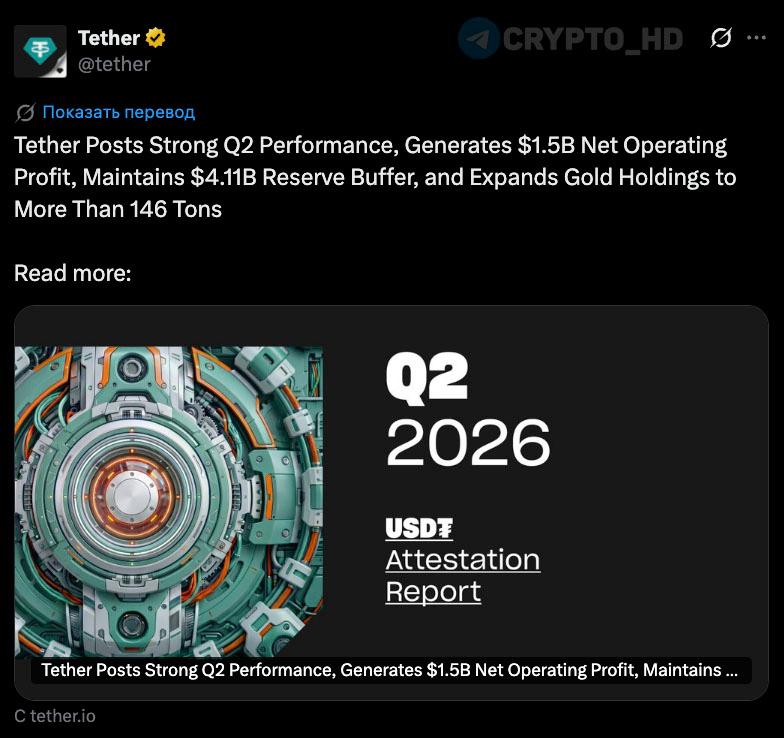
The numbers are blunt. Tether reported more than $1,500,000,000 in quarterly profit and $187,750,000,000 in total reserves, including $4,110,000,000 in excess reserves. It held roughly $140,600,000,000 in U.S. government bonds and secured overnight financing rate (SOFR) repos. That scale is hard to ignore. During the quarter, Tether also bought another 14 tons of gold, taking its holdings above 146 tons and their value to $18,800,000,000. The company’s Bitcoin position stood at about 98,933 BTC, valued at $5,800,000,000. By the end of June, USDT’s circulating supply had reached $184,600,000,000. The quarterly increase was just $446,000,000 from the end of Q1. Even so, USDT still held more than 60% of the stablecoin market.
Tether’s Treasury holdings matter well beyond crypto. Why? Because when the company receives USDT deposits and buys government debt, capital originating in crypto markets helps finance the traditional system. Its purchases could affect bond demand and liquidity, though measuring that effect cleanly is difficult. Most commentary treats stablecoin reserves as a crypto-only concern. That’s only half right. If the Federal Reserve tightens monetary policy while Tether continues buying Treasuries, the additional demand may provide some support for bond prices. Tether is obviously no substitute for the Fed. Not even close. Still, my take is that it has become too large to dismiss as background noise. Regulation could force the company to change course; Tether could also move its reserves voluntarily. Either way, the consequences might reach bond markets as well as assets such as Bitcoin and Ethereum.
Tether’s 98,933 BTC position suggests that the company now considers Bitcoin part of its reserve portfolio. Its gold purchases are easier to explain. Investors often turn to both assets when currencies look vulnerable or inflation fears rise. Geopolitical risk can produce the same response. But neither asset functions as a dependable hedge in every crisis. After the January 2020 strike that killed Qasem Soleimani, for instance, Bitcoin gained 8% within 72 hours and gold rose as well. Does that prove a durable relationship? No. A single episode does not establish one. Counter to the usual “digital gold” shorthand, Bitcoin’s crisis behavior remains inconsistent. I still think Tether’s logic is understandable: owning both may offer some protection when conventional markets wobble.
What this means
Stablecoins are no longer easy to separate from traditional finance. Tether’s Treasury portfolio makes it a sizable institutional buyer, meaning its decisions may affect people who have never touched a crypto token. If USDT keeps growing, bond analysts may need to track Tether’s reserves alongside their usual liquidity measures. Crypto traders, meanwhile, should compare changes in USDT supply with conditions across other risk markets. The gold and Bitcoin positions deserve attention. They do not deserve mythology. Yes, that sounds cautious after emphasizing Tether’s scale—but the distinction matters. Its purchases may help Bitcoin’s reputation as a reserve asset; they cannot guarantee stable prices over the long run. I wouldn’t treat corporate accumulation as a price floor.
Future earnings reports should be checked for changes in Tether’s U.S. Treasury and Bitcoin holdings. A sharp reduction in either could indicate regulatory pressure or a change in the company’s view of market risk. It might also be an ordinary portfolio adjustment. Keep that possibility open. The next FOMC meeting, scheduled for September 18, 2026, is also worth watching. A tougher policy message than markets expect could raise bond yields and alter the economics of Tether’s Treasury portfolio. Technical traders may focus on Bitcoin’s behavior near $61,400, although no single price level deserves much faith. Is $61,400 useless, then? No—a sustained move above that point could indicate firmer demand. But U.S. stablecoin legislation remains the bigger uncertainty. New rules could change how Tether operates and determine whether USDT keeps more than 60% of the market. That’s what I’d watch first.