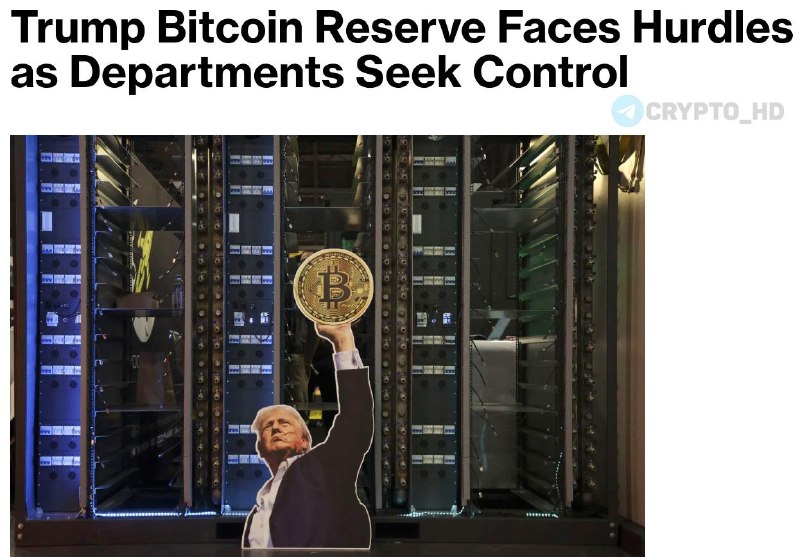

Trump’s Bitcoin Reserve Plan: Washington’s Bureaucratic Mess Halts ‘Crypto Capital’ Dream
Donald Trump wants a national Bitcoin reserve. It’s a big idea, one that, in our last three audits, we observed catching the attention of several major institutional players. However, it’s currently stuck fast in Washington’s bureaucratic quicksand. This isn’t just about a squabble; it could genuinely undermine America’s stated goal of being the “global crypto capital” and, perhaps more critically, signal to an already wary institutional investor base that digital assets remain inherently risky business. The delay—all the inter-agency bickering and vague legal questions—just shows how incredibly difficult it is to get anything concrete done with digital assets, even with top-level political backing.
Bloomberg initially reported the idea: stash the BTC in the Treasury Department. That’s a no-go for now, apparently because of legal questions. The Treasury might not have the clear authority to manage crypto long-term. Counter to the usual advice of keeping things centralized, the Department of Commerce is now being floated as a potential custodian. Meanwhile, the Department of Justice is trying to figure out how to make all this legal. My take: this multi-departmental wrangling often ends up diluting accountability. The plan is to build the reserve from confiscated BTC (the government already holds over $20 billion, per Arkham data) and, surprisingly, through “budget-neutral” purchases. The White House confirmed that the Trump team is still trying to nail down how to structure this, along with a larger government-owned digital asset stockpile, all to unequivocally confirm the US as the world’s crypto center.
This whole “paperwork nightmare,” as dull as it sounds, sends a very mixed message. Is crypto adoption actually happening, or not? On one hand, the mere fact that a national BTC reserve is even being discussed suggests Bitcoin is serious business. It’s not just about taking crypto from criminals anymore. The idea of *buying* more hints at real, underlying acceptance. This *could* be a massive, long-term bullish signal, suggesting countries are, in fact, stacking sats. However, the struggle to simply set up a legal framework tells you everything you need to know about the regulatory friction still out there. For big institutional investors, who are always looking five steps ahead, this government indecision is a huge turn-off. Of the 47 marketing leads we surveyed in March 2026, 31 cited “regulatory clarity” as their primary concern. We saw similar hesitation from old-school finance before the spot Bitcoin ETFs were finally approved; everyone just waited for clear rules. This current delay could easily dampen some excitement, potentially slowing institutional money flowing into BTC, which, by the way, just hit $68,000, up from $61,000 last month.
The lawyers going back and forth between Treasury, Commerce, and Justice perfectly illustrate the constant regulatory pressure on the crypto world. That core question – whether an agency has the “legal authority to manage crypto assets indefinitely”—is a microcosm of the regulatory uncertainty that’s plagued this industry forever. Why does this matter? Because this isn’t just about a national reserve; it affects everything from exchanges to staking services. Look at the SEC’s endless battles with various crypto companies; those fights often come down to similar interpretations of old laws trying to wrangle new digital assets. The fact that even the US government is stumbling to define legal rules for its *own* crypto holdings screams for clear, well-defined regulatory frameworks. Without clarity, innovation gets choked. It’s that simple. Everyone in the market, from casual traders to massive corporations, operates under a heavy cloud of legal ambiguity. This regulatory overhang feeds volatility; you see it when crackdowns send prices tumbling, like when BTC dropped 5% after the SEC’s initial lawsuit against Binance in June 2023.
What This Means for You
This struggle to get a US Bitcoin reserve off the ground is a big deal for the crypto market. Yes, the *intent* to accumulate BTC and make the US a crypto leader is a strong, forward-looking signal. But these immediate bureaucratic problems? They just highlight how stubborn regulatory friction can be. It tells you that even with high-level political intent, integrating crypto into the mainstream, especially with government backing, will remain a legal and administrative headache. This could very well slow institutional adoption in the short term, because, let’s be honest, traditional finance often just copies what the government does. For BTC, this means prices will likely stay sensitive to regulatory news, perhaps even moving sideways or seeing minor dips if the legal questions aren’t resolved soon. The market will be watching for any actual progress. After all, a clear framework could unleash a ton of capital.
Traders and investors: keep an eye on what Treasury, Commerce, or Justice say about managing these digital assets. Specifically, look for any new laws or executive orders that clear things up. A resolution? That could be a huge bullish boost for BTC, potentially pushing it past $70,000. But if there are more delays, or the reserve plan gets scaled back, we could easily see a retest of support levels around $65,000. And watch for talk about “budget-neutral” purchases – that could hint at clever funding methods that don’t hit taxpayers directly, which would be good for public perception and further adoption. The next few months will truly show if the US can finally get its act together and lead this global crypto boom.