
















































Aave Labs UK Subsidiaries Get FCA Cryptoasset Registration for Regulated DeFi Services
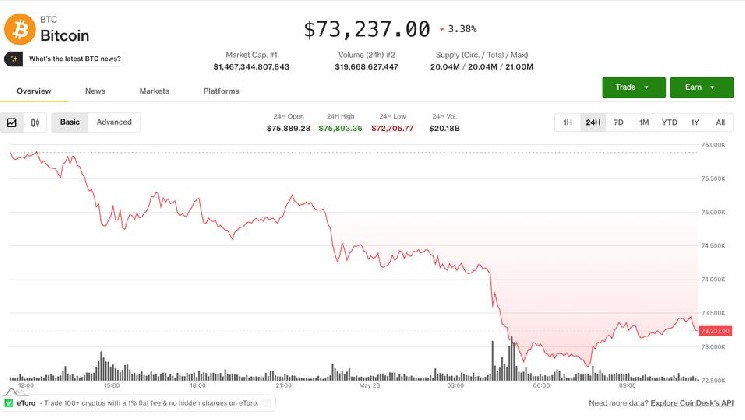
Aave Labs says its UK subsidiaries, Push Labs and Push Virtual Assets, have received cryptoasset business registration from the Financial Conduct Authority. That gives the DeFi developer a cleaner legal route into UK services and payment infrastructure. I’ll be honest: for crypto traders reading this on May 28, 2026, the takeaway is not subtle. DeFi is still trying to look usable to institutions while BTC sits near the mid-$70,000s and regulators decide which venues get serious capital.
The registration applies to Push Labs and Push Virtual Assets, not the Aave protocol itself. That distinction matters. The two UK entities can now operate under the United Kingdom’s anti-money laundering and counter-terrorist financing rules, the same framework UK cryptoasset businesses have faced since January 2021. Aave’s decentralized, open source protocol has not become a regulated product overnight. Read that twice. The regulated layer sits around the affiliated UK businesses, which keeps the AAVE story fairly clean: regulated access near the protocol, without regulators taking over the protocol.
The regulation piece is the clearest part. Since January 2021, the FCA has required UK cryptoasset businesses to register for activities such as exchange, custody, and payment services. The source also says many applications have been rejected or withdrawn. So yes, this matters for AAVE holders and DeFi traders. Most crypto headlines make regulation sound like a wet blanket. That is only half right. AAVE often trades like a pure protocol token; now it has a regulated services angle as well. That does not mean the token has to rally. It does mean institutions have one less easy reason to avoid DeFi lending infrastructure.
Here is the catch: institutions do not buy “decentralization” because it sounds impressive. They buy access and reporting. They buy controls and enough legal cover for the lawyers to sleep. My take: this is where DeFi either grows up or keeps talking to itself. Why does this matter? Because the source says UK users may eventually get regulated services from Push Labs and Push Virtual Assets, possibly including compliant fiat on ramps, custody, or payment infrastructure. For AAVE, that moves the token closer to the ETH infrastructure trade. Less about yield alone. More about pipes.
The timing helps too. Public market snapshots put BTC around $75,876.75 in late May 2026, while AAVE recently traded between $83.87 and $86.99 intraday. Those numbers are market context, not part of the source announcement. Still, they explain why traders care. Crypto usually rewards the liquid names that institutions can touch first. After that, it rotates into sector tokens once the story becomes tradable. Counter to the usual advice, this is not just a “buy the regulatory headline” setup. If BTC holds the $75,000 area into June 2026, AAVE has a better shot at being priced as a DeFi compliance beneficiary instead of just another lending token.
There is a macro angle here, although the FCA news is not really about rates. The next Federal Reserve meeting is scheduled for June 16-17, 2026. That date matters for risk assets, including BTC and COIN. If rate expectations ease, traders usually move further out on the crypto risk curve. If they tighten, money tends to crowd back into BTC or cash. The most liquid exchange linked stocks get attention too. Simple enough. A regulatory win for AAVE lands better when ETH and DeFi beta are already catching bids.
COIN is the obvious equity comparison. Historical market data shows Coinbase Global, Inc. closed at $194.10 on April 28, 2026, and it remains one of the cleaner US stock market proxies for regulated crypto access. Aave Labs is not Coinbase. Push Labs is not a giant exchange. But the pattern is familiar: compliance can turn a crypto product from a technical story into a distribution story. We have seen this movie across ETF approvals, custody rules, and licensing headlines: BTC, ETH, and exchange equities often move before the user metrics catch up.
One caveat: the source does not say Push Labs or Push Virtual Assets launched a new UK product today. It says they obtained FCA cryptoasset business registration. That is permission to build inside a stricter perimeter. It is not proof that UK volume appears tomorrow morning. Is this enough by itself? No. Traders should separate the signal from the trade. The signal is that a major DeFi developer cleared a high UK bar. The trade depends on whether AAVE volume, total value locked, fee capture, or institutional integrations follow in 2026.
What this means
This points to a more practical version of DeFi in 2026. Protocols can stay decentralized while related companies build regulated access points around them. Yes, that sounds like a contradiction with the old DeFi pitch. Bear with me. For AAVE, the affected ticker is obvious. ETH belongs in the frame too, because Aave’s lending markets sit inside the wider Ethereum DeFi stack. If AAVE can reclaim and hold the late May $86.99 area, traders may treat the FCA registration as more than headline relief. If it falls below $83.87, the market is saying the news needs real usage or fresh liquidity behind it.
Watch June 16-17, 2026, when the FOMC meets. Macro liquidity will decide whether traders chase DeFi beta or hide in BTC. Also watch CME crypto futures data after the next weekly update for any rise in BTC or ETH open interest, since institutional leverage often appears before spot rotation. The trading line is plain: BTC holding the $75,000 zone keeps risk appetite alive. AAVE holding the $83.87-$86.99 band keeps this FCA story tradable. Lose both, and the registration still matters strategically, but the trade goes cold. That part is blunt.