














































Bitfone Brings BUSD Mining to Mobile with Multi-Blockchain Support
Bitfone said on May 24, 2026 that it plans to promote $BUSD mining through its mobile app during testnet. For crypto traders, this is not just another app-note headline. My take: Bitfone is trying to pack stablecoin-style utility, phone-based signups, cross-chain transfers, and testnet distribution into one path. That is a lot. It needs proof fast.

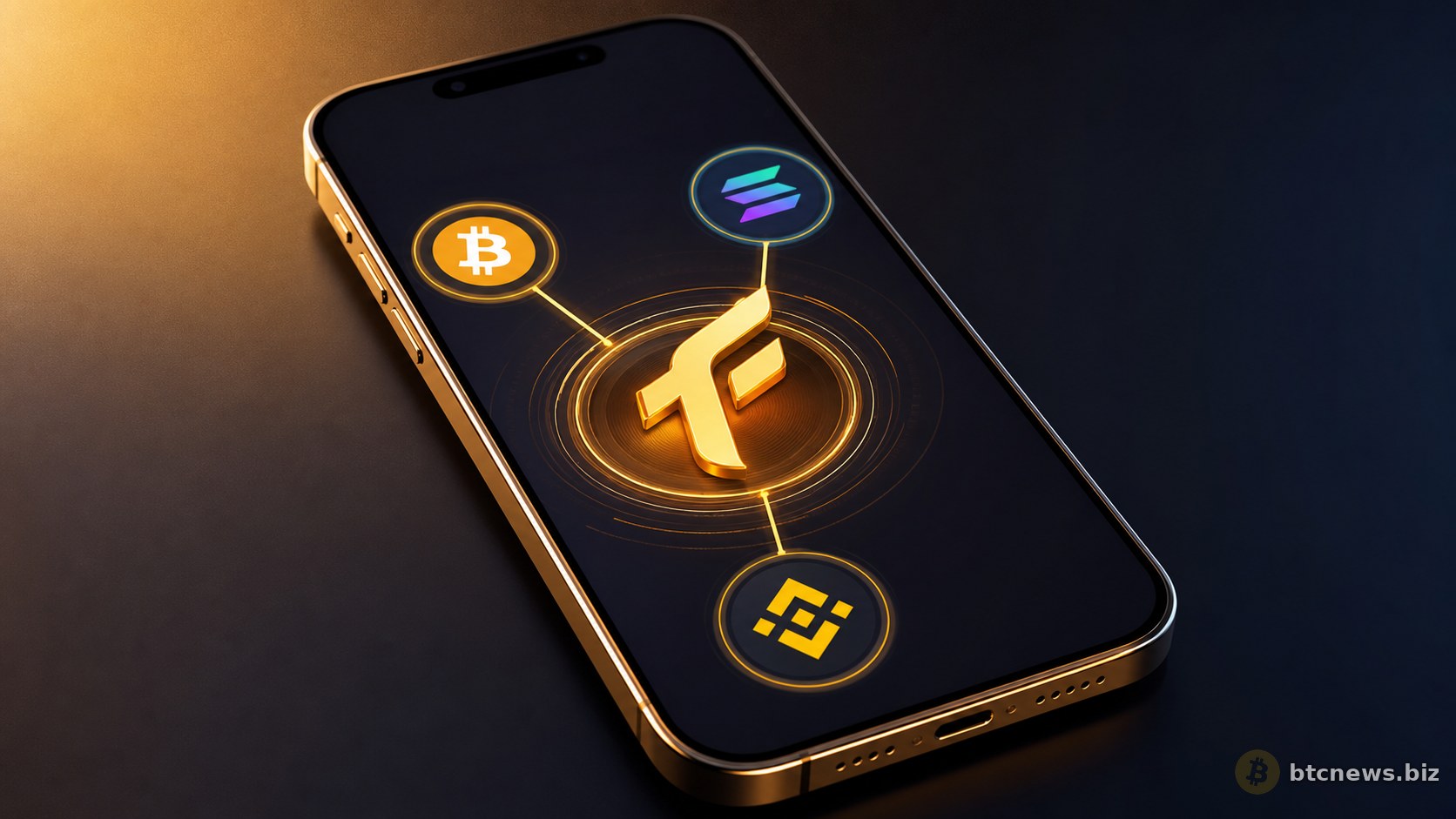
Bitfone said it wants $BUSD to move beyond its BIT-20 network and into larger blockchain ecosystems, including the Bitcoin Network, Solana Network, BNB Smart Chain, the Open Network, and PI Network. The project posted the plan on its official X account on May 24, 2026, saying $BUSD would soon be available across those networks during testnet. The key mechanism is BitBridge, Bitfone’s planned tool for moving $BUSD between blockchains instead of leaving it parked on one chain. Why does this matter? Because bridges are where a nice app story either becomes usable infrastructure or turns into a waiting room.
This is mostly an adoption story. Mobile mining has always sold one clean idea: join without expensive hardware or the wallet setup that makes newcomers leave before the first transaction. Bitfone is applying that pitch to $BUSD, then layering cross-chain movement on top. If it works, users could mine and move $BUSD from a phone across BIT-20, BTC, Solana, BEP-20, the Open Network, and PI Network. That is low-friction access, at least on paper. I’ll be honest: retail crypto keeps circling this exact problem because new users do not want a lecture on bridges, gas choices, wrapped assets, wallet support, and chain quirks before they can do anything.
Slow down here. Traders should separate user growth from liquidity. Most launch writeups blur those two together. That’s only half right. $BUSD on several chains may make Bitfone’s own ecosystem easier to use, but the market will care about whether BitBridge produces real transfers. Not clicks. Not installs. Actual activity. The comparison is not only $BUSD; it is also the chains Bitfone named in the rollout. BTC was near $76.7K on May 23, 2026, ETH closed near $2,119 on May 23, 2026, and SOL traded around $84.82 on May 24, 2026, down 2.08% that day. A mobile bridge pitch sounds different when large-cap crypto is already trading on selective risk appetite.
The macro flow matters for the same reason. If traders are moving back into higher-beta crypto, the Solana Network and BNB Smart Chain pieces could get more attention because app activity and small transfers matter more when the tape is risk-on. If liquidity tightens, this becomes something to monitor, not something to chase. Yes, that sounds cautious after calling the access story interesting. Both can be true. $BUSD is the ticker in Bitfone’s post, but BTC and SOL are the market checks here. BTC near the mid-$70K area shows whether capital still wants crypto beta. SOL around $84.82 shows whether app-chain and consumer crypto stories still have buyers’ attention.
There is also a regulatory angle, though Bitfone did not announce legal action, agency review, or a country-specific license. Stablecoin-linked products get picked apart quickly because traders have seen exchange access, issuer questions, chain support, and liquidity all shift fast. The source only says Bitfone plans mobile $BUSD mining, BitBridge transfers, and support for five additional blockchains. It does not give a mainnet date, audit details, user counts, or transfer limits. Those gaps matter. Cross-chain products usually have to earn trust before volume shows up.
Bitfone also described the testnet as part of its mobile crypto push. The post says users can install the app and join from their phones with a few taps. Simple message. Maybe too simple, but easy to understand. It targets the same retail behavior that helped earlier mobile mining apps spread: daily check-ins and low upfront cost, plus a claim on future token utility. Is this enough for investors? No. Testnet participation is not deep liquidity. It is not sustained demand. It is not reliable bridge volume.
The bullish case is easy to see. If BitBridge lets $BUSD move across the Bitcoin Network, Solana Network, BNB Smart Chain, the Open Network, and PI Network through a clean mobile flow, Bitfone could make $BUSD more useful inside its own ecosystem. More chain options can help users who already spend time on different networks. That is why the project is selling accessibility. In my view, smartphone access is much easier to explain than infrastructure, and that matters when the target user is tapping through an app, not reading bridge documentation.
The bearish case is just as clear. Cross-chain promises are easy to announce and hard to deliver. Counter to the usual launch-day framing, more networks can also mean more places for liquidity to fragment. Traders have watched bridges become bottlenecks, liquidity traps, security risks, and support headaches across several cycles. Bitfone’s May 24, 2026 announcement does not list bridge capacity, launch timing, security design, or outside verification. Until those details arrive, this is a testnet expansion plan. It is not a confirmed liquidity event.
What this means
Bitfone’s announcement shows that mobile crypto mining and cross-chain stablecoin utility are still active stories in 2026. The direct ticker is $BUSD, but the market read also touches BTC, SOL, BEP-20 assets, the Open Network, and PI Network because BitBridge is supposed to connect activity across those ecosystems. We have seen this pattern before in crypto: distribution comes first, then everyone argues about whether usage is real. If Bitfone turns testnet participation into measurable transfers, the story changes. It becomes less about app distribution and more about on-chain use.
Watch the next Bitfone update after May 24, 2026 for a BitBridge testnet date, the order of supported chains, transfer limits, and any audit information. Keep it practical. For market context, keep BTC’s $76.7K area from May 23, 2026 and SOL’s $84.82 level from May 24, 2026 on the board. Weakness there would make adoption headlines harder to trade. Strength would give mobile mining and bridge narratives more room.