
















































Tesla’s BTC Holdings Fell Two-Thirds. That Makes the “Corporate Adoption” Story Look Messier
Tesla’s Bitcoin position is worth much less than it was in 2021, down about two-thirds even though Bitcoin rose over the same stretch. That’s the awkward part, and honestly, it is the part I would not wave away. The chart is blunt: Bitcoin climbed, Tesla’s stack shrank, and the value of the remaining position failed to keep pace.
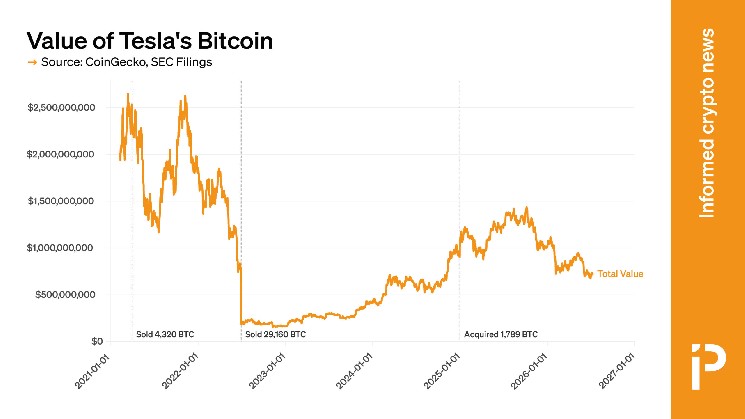
Tesla bought Bitcoin early, at least for a corporate treasury. In 2021, the company bought 43,200 BTC and said it planned to accept Bitcoin for vehicle purchases. Elon Musk pushed the story along in the loudest possible way. He added “#bitcoin” to his Twitter bio. He talked up the asset on Clubhouse. Traders reacted, because of course they did. The price moved.
Then Tesla backed away almost right after it bought in. Less than two months after the purchase, the company sold part of its position. Musk said on April 26, 2021 that the sale was “to prove liquidity of Bitcoin as an alternative to holding cash on balance sheet.” Two months later, Tesla stopped accepting Bitcoin payments, citing the “rapidly increasing use of fossil fuels for BTC mining.” Most corporate-adoption takes frame the initial buy as the signal. That’s only half right. The reversal was a signal too.
By mid-2022, Tesla had sold 29,160 BTC and was down to 9,720 BTC. It later added 1,789 BTC at the end of 2024, bringing the total to 11,509 BTC, though company reports called the amount “immaterial.” Since Musk’s latest public Bitcoin comment in October 2025, Bitcoin has fallen more than 40%. His line then was: “Bitcoin is based on energy: you can issue fake fiat currency, and every government in history has done so, but it is impossible to fake energy.” My take: that framing is elegant, almost too elegant. Tesla’s actual balance-sheet behavior is messier than the slogan.
Tesla’s Bitcoin run is a warning for anyone who treats corporate adoption as a one-way bet. Why does this matter? Because public-company buying can look permanent right up until the next filing says otherwise. When Tesla bought 43,200 BTC, the 2021 purchase looked like a sign that corporate treasuries might start adding digital assets in size. When it later cut the position to 9,720 BTC, the message changed. Tesla now holds 11,509 BTC, and the position’s value is down roughly two-thirds, even while Bitcoin is still up more than 30% over the broader period. That is not steady conviction. It looks like a trade that became a talking point, then a smaller line item. Hard to dress that up.
Regulation is part of the story too, though the details are not clean. One unnamed source said Musk had “unprecedented access to the federal government early in Donald Trump’s second administration through the so-called “DOGE” initiative,” during a period when the administration was “rapidly trying to shift its regulatory stance to support Trump’s vision of himself as a supporter of the crypto industry.” The link to Tesla’s Bitcoin strategy is not clear. Still, I would not separate treasury behavior from the policy backdrop. SEC guidance matters. Treasury policy matters. Tax treatment matters. Political pressure can matter too, especially when a CFO is deciding whether a volatile asset belongs on the balance sheet.
No, you do not. I have not sold any of my Bitcoin. Tesla sold 10% of its holdings essentially to prove liquidity of Bitcoin as an alternative to holding cash on balance sheet.
Elon Musk (@elonmusk), April 26, 2021
Tesla & Bitcoin
Elon Musk (@elonmusk), May 12, 2021
True.
That is why Bitcoin is based on energy: you can issue fake fiat currency, and every government in history has done so, but it is impossible to fake energy.
Elon Musk (@elonmusk), October 14, 2025
What this means
A corporate Bitcoin buy does not mean the company plans to hold forever. Counter to the usual advice, the announcement is not the main thing to study. The next few quarters are. Does the company keep buying? Does it hold when the price drops? Does management explain the strategy in plain English, or does it lean on market-friendly language? Tesla’s sales suggest bad timing, weak commitment, or a treasury team that treated Bitcoin as an experiment. Maybe all three. That matters for other public companies with crypto exposure, including MicroStrategy ($MSTR) and Coinbase ($COIN), because investors may ask the same question there: how much of this is conviction, and how much is market theater?
Traders should watch filings, not slogans. Is that boring? Yes. It also works. Earnings reports will matter more than big public comments, and large buys or sales from major holders will carry more weight than another viral line about money, energy, or fiat. Regulation matters too, especially new guidance from the SEC or Treasury. If Bitcoin breaks above $70,000 and institutions keep buying instead of just talking, the market may move past Tesla’s mixed record. Until then, Tesla’s Bitcoin story looks less like a blueprint and more like proof that corporate adoption can reverse quickly.