















































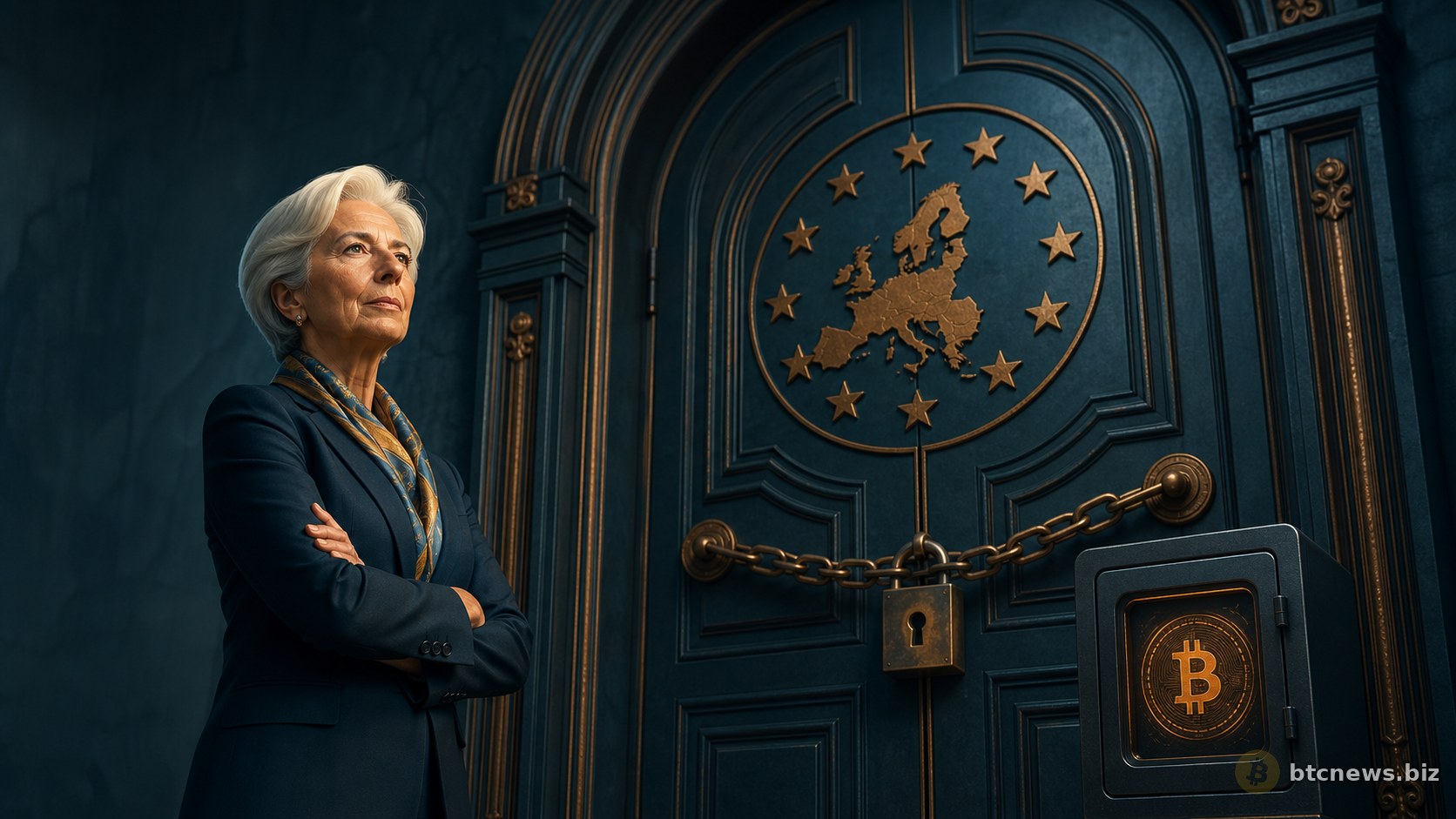
Lagarde Accused of Blocking Binance EU Bid as Stablecoin Pressure Builds
European Central Bank (ECB) President Christine Lagarde is accused of blocking Binance from offering services in Europe. If that claim holds up, it would add pressure on crypto exchanges and the EU stablecoin market. The allegation focuses on Binance’s MiCA license application in Greece. It also comes at a bad moment for the ECB, which is still working on the digital euro and keeping a close eye on private stablecoins.

The Big Whale reported that Lagarde directly helped stop Binance’s MiCA license application for EU services. According to the report, Greece’s capital markets regulator, HCMC, first found Binance’s application compliant with MiCA rules. Then journalist Gareth Jenkinson said a reliable source told him the process was blocked for political reasons. His claim is direct: Lagarde told Greece to reject the application and sent word to the Greek Prime Minister that Binance was not wanted in Europe. That message was allegedly passed to HCMC through the Ministry of Finance. In that version of events, Binance was close to approval before everything stalled.
The accusation is tied to the digital euro project and to the future of stablecoins in Europe. Binance is one of the main channels for stablecoin liquidity in the region. Push it out, and a future digital euro gets more breathing room. I do not think this is just about one exchange. If the ECB is trying to squeeze large stablecoin channels, EU trading volume could fall, especially for pairs like BTC/USDT and ETH/USDC. That matters. Less liquidity usually means worse prices, thinner order books, and jumpier users. Bitcoin already moved after the Fed’s recent interest rate decision, but pressure from Europe could be slower and more local. It could also push some users toward less regulated platforms, which is the part regulators rarely like to say out loud.
The regulatory pressure is hard to miss, if the report is accurate. This would not be a routine rulebook decision. It would be a political block aimed at one company. For other exchanges applying under MiCA, that changes the calculation. If a regulator can decide an application fits the rules and still be overruled later, every applicant has a new risk to account for. It also points to a Europe that may prefer state-backed digital money over private stablecoins. For investors, the question is practical: where do you hold stablecoins, and how much platform risk can you tolerate? Regional crackdowns have shaken crypto markets before. They do not always cause lasting damage, but they can spark fast selloffs and sudden liquidity gaps.
France is reportedly Binance’s last route for staying active in Europe. Binance is said to be talking with France’s financial regulator, the AMF, though it has not filed an official application yet. The split inside France is worth watching. The Treasury and Tracfin, the country’s financial intelligence agency, reportedly support letting Binance operate under supervision in Paris. Their logic is simple: if Binance leaves Europe entirely, the money still moves, just with less oversight. That sounds more realistic to me than pretending users disappear when a platform gets pushed out. France seems to be weighing control against exclusion, and those are very different choices.
What this means
If the allegation is true, Lagarde’s move would show that European financial authorities are ready to take a hard line against large non-EU crypto exchanges. Stablecoin liquidity is the pressure point. The digital euro is the backdrop. Europe may be trying to keep tighter control over digital currency flows before its central bank version is ready. That could split the EU crypto market, with some countries open to supervised exchanges and others more willing to shut them out. For investors, the risk is not theoretical. Stablecoin holdings, trading pairs, and exchange access could all become less reliable.
Binance’s next move in France is now the thing to watch. Any statement from the AMF or the French government would matter. So would stronger language from the ECB on the digital euro or stablecoins. There is no clear date or price level attached to this story, so I would be careful about treating it like a clean trading signal. Still, the direction matters. If Europe keeps tightening around stablecoin liquidity, ETH and other altcoins could feel it because so much trading depends on those pairs. A longer squeeze would force investors to rethink where they keep capital and which platforms they trust.
FAQ
Q: Who is Christine Lagarde?
A: Christine Lagarde is the President of the European Central Bank (ECB).
Q: What is MiCA?
A: MiCA, short for Markets in Crypto-Assets, is the European Union’s crypto asset rulebook.
Q: What is the digital euro?
A: The digital euro is a central bank digital currency project from the European Central Bank.
Q: What is Binance?
A: Binance is one of the world’s largest cryptocurrency exchanges by trading volume.
Q: What are stablecoins?
A: Stablecoins are cryptocurrencies designed to track fiat currencies or other assets.
Q: Which country’s regulator initially assessed Binance’s MiCA application as compliant?
A: Greece’s capital markets regulator, HCMC, initially assessed Binance’s MiCA application as compliant.
Q: Which journalist reported on Lagarde’s alleged intervention?
A: Journalist Gareth Jenkinson reported the allegation, citing a reliable source.
Q: What is the alleged reason for blocking Binance’s application?
A: The alleged reason is to make room for the digital euro and keep tighter control over digital currency flows.
Q: What is Binance’s last reported option for operating in Europe?
A: France is reportedly Binance’s last option for continuing operations in Europe.
Q: Which French agencies reportedly support Binance operating under supervision?
A: The French Treasury and Tracfin reportedly support Binance operating under supervision in Paris.