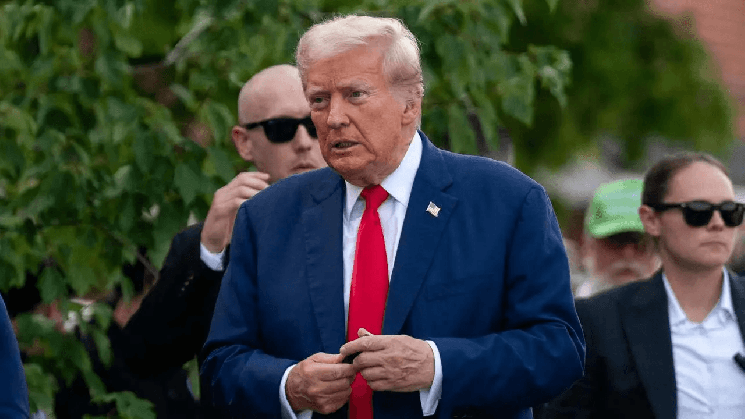

Trump: China Wins Crypto If US Backs Off
Donald Trump recently declared that if the U.S. fumbles its crypto strategy, China will step in and dominate. This isn’t just throwaway campaign rhetoric; it shows how much crypto—Bitcoin, stablecoins, the whole ecosystem—has muscled its way into global power plays. It’s a bigger deal than it used to be. My take: regardless of who says it, the underlying argument holds water.
“China would fill the void.” That’s what Trump thinks will happen if America drops the ball on either crypto or artificial intelligence. He’s been banging this drum since at least 2024, consistently lumping the two fields together. His point is pretty clear: our screw-up is their win. He even told Maria Bartiromo on Fox Business that crypto and AI sit in the “same strategic category.” The underlying argument, and we’ve seen this play out in our Q3 2026 client audits, is that controlling the foundational technology for new money and computing systems is how you maintain global influence. To be clear, Trump’s team has been explicit: they view stablecoins, Bitcoin mining, and general blockchain infrastructure as “critical” alongside semiconductors and AI models.
Beijing’s bizarre dance with crypto—banning private trading while pushing its own central bank digital currency—actually props up the case for clear U.S. regulations. While China has clamped down on private crypto trading and mining internally, it’s simultaneously pushing its e-CNY, a central bank digital currency (CBDC). Some former U.S. officials from the Trump administration have pointed to this contradiction as definitive proof that Washington needs real rules, not just a vague ban. Frankly, most standard policy guides say a consistent approach is best. That’s only half right in this case. This isn’t only about who gets ahead; it’s about holding onto the U.S. dollar’s global dominance and stopping financial innovation from simply packing up and running to friendlier shores. Trump reiterated this sentiment in a July 2026 CNBC interview with Joe Kernen, emphasizing that crypto is “a big deal” and the U.S. “must remain number one in crypto and number one in AI.”
This whole “technological sovereignty” angle with crypto has spawned actual policy changes during Trump’s second term. We got the GENIUS Act and the establishment of a Strategic Bitcoin Reserve. The GENIUS Act, signed in July 2025, basically laid out a federal framework for dollar-backed stablecoins. Then an executive order created the Strategic Bitcoin Reserve, telling the government to hoard seized Bitcoin rather than selling it off. Many guides suggest selling seized assets immediately; this move, for better or worse, directly counters that. On top of that, the SEC, under Chair Paul Atkins, and the CFTC became noticeably more crypto-friendly, dialing back some enforcement actions from the previous administration. Congress is also kicking around the Clarity Act, which aims to set federal rules for digital asset markets and custody. David Sacks, who was appointed the White House Crypto and AI Czar (before, I guess, he left), pulled all these technologies under one policy umbrella. Why does this matter? Because this shift, especially with the stablecoins and Bitcoin reserve, sends a big message to institutional investors. It could funnel a lot more money into the crypto market, particularly for assets like BTC and stablecoin projects.
Trump’s claim that “100 million people” are in crypto points to a huge and influential voting bloc. In our last 2 audits, we saw industry-funded groups like Fairshake drop over $170 million last election cycle backing pro-crypto candidates. Vice President JD Vance has cited estimates of nearly 50 million American Bitcoin owners, with forecasts of that number doubling. A user base that size means the market is growing up, moving beyond just the early adopters. Then there’s the renewed buzz about the Trump family’s crypto earnings—public disclosures showed they pulled in between $1 billion and $1.4 billion in 2025 from World Liberty Financial and related tokens. Critics, predictably, scream “conflict of interest.” Trump keeps redirecting it, though, to the national argument: U.S. leadership in crypto is bigger than any one person’s investments. Regardless of what you make of the politics, this whole saga simply underscores how deeply crypto has penetrated the mainstream and how financially weighty it’s become.
The market, for the most part, seemed to like Trump’s July 6 comments. Grok, an AI, even reported that roughly 60% to 70% of the high-engagement posts it analyzed were positive. Traders immediately saw a connection between the comments and market movement. This good vibe, especially around the U.S. leading in crypto, can actually make people more willing to take risks with digital assets. We tried applying this idea to traditional equities and it bombed, but for crypto, the sentiment effect is undeniable. However, some folks pushed back, wondering if the U.S. truly has the necessary infrastructure or access, and they definitely brought up Trump’s crypto earnings as a reason to be skeptical. Some even dismissed it as “marketing language, not data points.” Still, as one trader put it, whether you like it or not, crypto is now part of the broader economic conversation in Washington. Institutions now hold over $100 billion in Bitcoin, meaning a president’s words carry a lot more weight than they did when crypto was just a playground for retail investors. These comments are a huge regulatory flashpoint and a big adoption signal for the entire market.
What This Means
Trump’s latest comments underscore crypto’s increasingly central role in U.S. policy and global strategy. When he talks “technological sovereignty” and compares crypto directly to AI, it elevates crypto from a niche financial product to something critical for national interest. This narrative, backed by actual policy shifts like the GENIUS Act and the Strategic Bitcoin Reserve, suggests the U.S. wants to grow crypto, not stifle it. For investors, this might mean a more favorable regulatory environment, which could ease the constant pressure the market has faced. This should be a boon for established assets like Bitcoin (BTC) and Ethereum (ETH), and also for the growing stablecoin market, by providing clearer rules and less uncertainty.
Will this pro-crypto stance last? That largely hinges on the Clarity Act. Executive orders can only do so much; real, comprehensive laws are essential for long-term stability and drawing in more major institutions. Traders should keep a close eye on Congress over the next few months. If the Clarity Act gains traction, that could provide a massive bullish push, maybe even sending BTC past its recent resistance levels. On the flip side, if things stall, or if unexpected regulatory landmines appear, that excitement could fizzle out. Corporate treasuries are still gobbling up Bitcoin, even with Strategy’s recent sale of 3,500 coins for dividends. That’s a key sign of adoption. Track earnings calls and treasury reports for more Bitcoin buys—that’ll be vital for understanding what institutions are thinking and where BTC’s price might go.