
















































DeFi Developer Activity Jumps: Santiment Data Points to Adoption During Market Volatility
Santiment says DeFi developer activity rose over the last 30 days, with Chainlink leading its lending-sector list. My take: that matters, but not in the loud “DeFi is back” way people say whenever one chart twitches. Mostly, it shows teams are still writing and shipping code while token prices get knocked around by inflation data, rate fears, and the usual crypto nerves. That part actually matters.
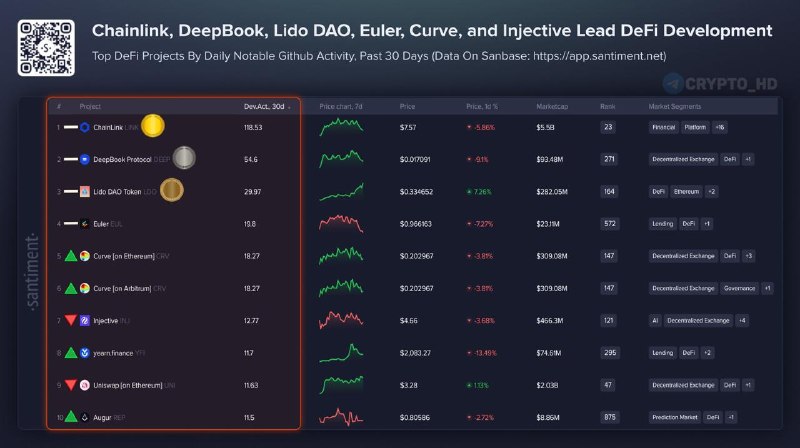
Santiment recently published its top 10 DeFi projects by developer activity in the lending segment over the past 30 days. Chainlink ranked first. DeepBook, Lido DAO, Euler, and Curve on Ethereum came next. After that came Curve on Arbitrum, Injective, yearn.finance, Uniswap on Ethereum, and Augur. Put simply, the defi developer activity santiment report shows work is still happening underneath the price action. Is that the same as demand? No. Markets look messy, but the main teams have not disappeared.
That gives traders something besides macro fear to watch. The Federal Reserve’s hawkish tone on interest rates and stubborn inflation worries have been hard on risk assets, crypto included. Bitcoin fell 5% last week, dropping from $68,000 to $64,600 after a hotter-than-expected CPI report on May 15 brought inflation concerns back into focus. Still, Santiment’s numbers point to the dull but necessary side of DeFi: updates and integrations, plus security fixes and protocol maintenance. I’ll be honest: I would not treat that as a guaranteed bullish signal. The signal is not magic. It is more like proof that the builders are still at their desks.
This may matter for institutions too, although crypto people throw that word around too freely. Most guides frame developer activity as a clean adoption signal. That’s only half right. The market is still under regulatory pressure, including SEC scrutiny of staking services and delays around some spot Ethereum ETF decisions. In that setting, stronger DeFi infrastructure helps. Chainlink ranking first is worth paying attention to because oracle networks supply the outside data used by lending markets, DEX pricing, collateral engines, and liquidation systems. Why does this matter? Because larger pools of capital will not tolerate obvious weak points. Spot Bitcoin ETFs were approved in January 2024 only after years of regulatory work and market plumbing, and BTC later moved past $45,000. DeFi probably needs the same kind of boring foundation work before bigger money gets comfortable. Even Uniswap on Ethereum at number 9 says something useful: mature protocols still need steady work on usability and liquidity. Security too.
What this means
Developer activity in DeFi lending is a decent health check. I would put it plainly: it suggests these projects are building through a choppy market instead of waiting for prices to fix the story for them. Counter to the usual advice, though, the busiest GitHub chart is not automatically the best trade. For traders, projects such as Chainlink and Lido DAO may be worth watching because they sit close to core DeFi infrastructure. But developer activity is not a buy signal on its own. Code commits do not pay your bills. They do show where teams are still putting in the hours.
Investors should keep an eye on Santiment and other analytics firms for follow-up developer activity reports. LINK, LDO, and UNI are the obvious tokens to watch for signs of accumulation or stronger institutional interest. Yes, this slightly undercuts the builder argument above, but bear with me: protocol upgrades only move prices when the market is ready to care. New feature launches from these teams could matter if buyers are already looking for a reason to step in. Is this overkill? For a lending-sector list over 30 days, no. Macro still matters, probably more than DeFi fans want to admit. Do not ignore macro. The next Federal Reserve FOMC meeting on June 12 could change risk appetite quickly if rate expectations move, and actively developed DeFi tokens would feel that too.