
















































Ethereum whales are buying while macro pressure hangs over the market
Ethereum whales have been adding to their bags. Wallets holding 100 to 100,000 ETH increased their share of total supply by 1.73% over the past month. Smaller wallets moved too. That matters. This is not just the usual “a few rich wallets bought the dip” story. My take: some buyers still seem to think ETH has more room to run, even with rates, inflation, shaky risk appetite, and the general mess around crypto making the trade uncomfortable.
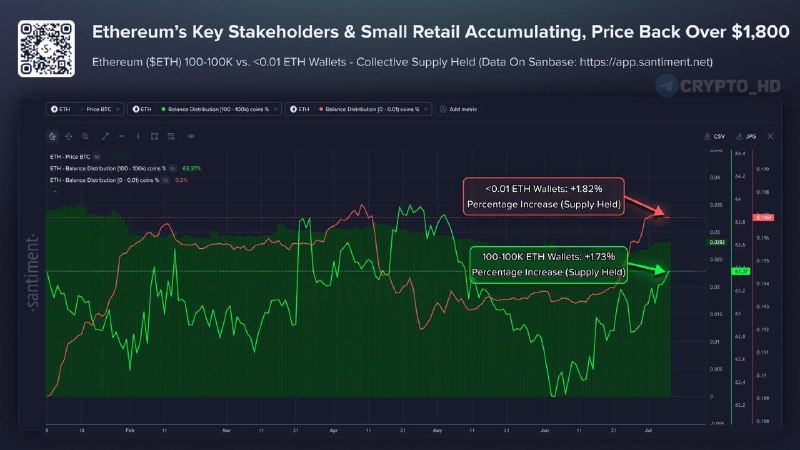
Santiment says Ethereum ownership shifted over the past month. Large holders, usually called “whales,” added to their positions. Wallets with 100 to 100,000 ETH now control 1.73% more of the total ETH supply than they did a month ago. That is not tiny. What caught my eye, though, is the smaller end of the chart: addresses holding less than 0.01 ETH also increased their share by 1.82% over the same period. Big wallets buying can mean strategy or hedging. Small wallets buying usually says something blunter: people still want in. Is that too simple? Maybe, but simple signals are sometimes the ones worth respecting.
This is happening while macro pressure keeps leaning on risk assets, including crypto. The Federal Reserve’s interest rate stance and sticky inflation have made the market jumpy. When the Fed sounds hawkish, investors often pull money out of assets like ETH. We saw that during the tightening cycle in 2022. ETH traded above $1,600 in August 2022, then fell below $1,200 by November as rates kept rising and risk appetite dried up. The Fed’s 25 basis point hike in March 2023 had a similar effect on sentiment, even if the price reaction was less dramatic. Most guides say whale buying is bullish. That is only half right.
So the whale buying matters, but not in a clean little headline way. Maybe these wallets think rate pressure is already priced in. Maybe they expect a Fed pivot later. Or maybe they just think ETH is cheap enough to accumulate while everyone else is still arguing about inflation prints. I’ll be honest: I would not call it proof of a rally. I also would not shrug it off. Large holders do get things wrong, sometimes loudly, but they rarely add this much exposure by accident.
The Ethereum network itself gives buyers a reason to stay interested. The Shapella upgrade in April 2023 allowed ETH withdrawals from the Beacon Chain, removing one of the bigger unknowns around staking. Before that, locked ETH made some institutions nervous. After Shapella, the staking picture became easier to read. It works. Not perfectly, not risk free, but cleaner. That matters because ETH is easier to explain when the withdrawal mechanics are no longer the awkward part of the conversation.
There is also the use case, and this is where the story gets less tidy. Ethereum still carries much of the activity in DeFi, NFTs, stablecoins, tokenized assets, and settlement experiments. Corporations and financial firms have been testing tokenization on Ethereum and related systems for years. The Santiment data does not prove those institutions are the buyers here, so that leap would be too convenient. Counter to the usual advice, I would not over-read institutional intent from wallet size alone. Still, steady buying from larger wallets often appears when bigger players are watching. Price has not collapsed either. ETH spent much of the past month around $1,800 to $2,000, which is a respectable hold given the macro backdrop.
What this means
The simple read: some buyers think ETH is worth accumulating here. That includes whales and tiny holders, which gives the move a little more weight. Does it guarantee a breakout? No. Crypto loves punishing neat stories, especially the ones that sound obvious by the third paragraph. But the data suggests current prices are attractive enough for both large and small wallets to keep buying despite rate uncertainty, inflation worries, regulatory noise, and a chart that still has work to do.
If that buying continues, ETH may have a stronger floor than it would otherwise. The $1,900 level matters here. A steady hold above $1,900, paired with more Santiment accumulation data, would make the bullish case harder to dismiss. A break below it would weaken the setup fast, especially if macro data turns ugly or the Fed sounds tougher than expected. We tried. It broke. That is basically how fragile crypto support can look when macro pressure hits at the wrong time.
The next things to watch are inflation reports and Fed commentary. Then the late July FOMC meeting. Any shift in tone from the Fed could move risk assets quickly. Ethereum-specific news matters too: staking flows, institutional tokenization projects, regulatory decisions around Ethereum-based protocols, and whether accumulation keeps showing up in the Santiment data. For now, the setup looks constructive, but messy. Whales are buying. Small wallets are buying too. Useful information, yes. A free pass to ignore the chart? Absolutely not.