
















































Falcon Finance fUSD stablecoin launch tests regulated yield demand
Falcon Finance’s fUSD launch is a practical test: do institutions still want yield on stablecoins when the legal structure is tighter? Falcon Finance and Anchorage Digital Bank have launched fUSD, a regulated dollar stablecoin for institutional crypto investors. Their joint announcement says fUSD follows the GENIUS law and offers about 3% annual rewards to qualified institutional clients. That history matters more than the headline. Terra UST collapsed in May 2022. USDC briefly fell to about $0.87 in March 2023. After those two events, stablecoin yield stopped sounding like a free add-on and started sounding like a risk disclosure. My take: this is not a market changing launch yet. Not close. It is a signal that issuers still want yield, but they are trying to keep it outside the stablecoin itself.
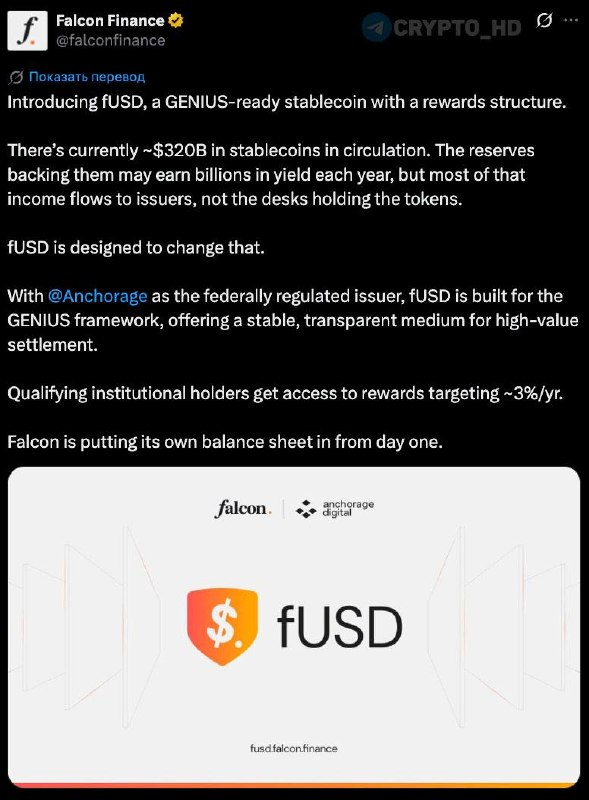
The structure is deliberately split: Anchorage issues the token, Falcon handles the rewards. Anchorage Digital Bank issues and mints fUSD. One source describes Anchorage as the first federally licensed crypto bank in the United States, and it also mints Tether’s U.S. stablecoin. Falcon Finance provides the roughly 3% annual reward through separate agreements with qualified institutional clients. That split is the product. Under the GENIUS law, stablecoin issuers cannot pay interest directly to holders. So Anchorage does not pay the yield. Falcon does, through a separate contract. Most guides would frame that as a compliance workaround. That’s only half right. It is also the whole commercial pitch, because the product only works if that distinction holds.
For crypto markets, fUSD is mostly about regulatory pressure and the structures people build around it. Stablecoins sit under BTC and ETH trading as cash, collateral, settlement, and sometimes margin fuel. U.S. rules have pushed issuers to separate payment tokens from products that pay a return. That line became harder to ignore in February 2023, when U.S. scrutiny around BUSD made legal structure a trading issue, not just a lawyer problem. fUSD looks designed around that lesson. The issuer is regulated. The reward is outside the issuer relationship. The yield goes to qualified institutions, not retail users. Why does this matter? Because 3% is not cosmetic for a fund already parking dollars on crypto rails. I would not overstate it, but treasury desks notice numbers like that.
The adoption pitch comes from the bank wrapper, but that does not create liquidity by itself. Because Anchorage Digital Bank issues fUSD, Falcon Finance gets a regulated banking structure that many offshore or crypto native stablecoin projects do not have. That helps the sales case. It does not mean traders will use the token. We have seen a version of this before in regulated access stories. In January 2024, spot BTC ETFs turned access into a flow narrative for Bitcoin before traders agreed on what the flows were worth. In July 2024, spot ETH ETFs did something similar for ETH, although the reaction was less clean and the staking issue made the story weaker. fUSD sits in that same access category. Useful, yes. Automatically bullish, no. If funds want regulated dollars, collateral, and settlement inside crypto rails, it gives them another choice.
The macro point is straightforward: fUSD has to compete with cash. This is not only a fight against USDT and USDC balances. If Falcon can pay about 3% annually to qualified institutional clients while Anchorage stays inside the GENIUS framework, treasury desks may compare fUSD with money market funds and T-bill exposure. Idle exchange balances are in the mix too. Traders should read it through BTC and ETH liquidity, not as a standalone stablecoin chart. When cash yields are attractive, idle stablecoins need a reason to stay put. When risk appetite returns, those dollars can move into BTC, ETH, or listed crypto stocks such as COIN. Simple point: institutions get a reason to keep dollars inside crypto rails instead of moving them out.
There is also a market making angle because Falcon Finance has DWF Labs behind it. Falcon Finance was started with support from DWF Labs, and Andrei Grachev, DWF Labs’ CEO, is also Managing Partner at Falcon Finance. That matters because stablecoins do not win just by launching. They win when traders can use them on venues, in collateral systems, across liquidity programs, and inside actual execution workflows. A bank issued dollar token with a 3% institutional reward will not earn market share on its own. Counter to the usual advice, the wrapper is not the moat. Distribution is. Market maker support can help it get early depth. For BTC and ETH traders, the question is blunt: does fUSD sit around as another passive dollar balance, or does it become collateral that tightens spreads and supports more leverage in liquid pairs?
The old stablecoin failures explain why fUSD is built this way. In May 2022, Terra UST showed how yield can become dangerous when the backing model is weak. In March 2023, USDC’s drop to about $0.87 showed that even reserve backed stablecoins can trade like credit when banking risk appears. fUSD is being pitched differently: regulated issuer, GENIUS compliance, and rewards paid by Falcon rather than Anchorage Digital Bank. Yes, this contradicts the easy “stablecoins are just dollars on-chain” line. They are not just dollars when stress hits. The institutional focus makes sense. A retail yield product with the same structure would probably get a much louder response from regulators. I’ll be honest: that is probably the point.
What this means
fUSD points to a stablecoin playbook built around regulated issuance, separate yield, and institutional users. For BTC and ETH, the first effect is not price. It is plumbing. If fUSD gets used as collateral or settlement currency, it could change where dollar liquidity sits before it moves into BTC, ETH, or COIN-linked trades. Is this overkill for one stablecoin launch? For a retail token, maybe. For institutional cash that can rotate between money market funds, T-bill exposure, exchange balances, BTC, and ETH, no. The 3% annual reward is the number to watch. It tells you whether the product has a real cash management hook or is just another dollar token looking for exchange listings.
The next things to watch are disclosures, venues, and how regulators treat the reward split. Falcon Finance needs to show where fUSD will trade, who qualifies for the rewards, and how minting and redemption work through Anchorage Digital Bank. The market signal is not an fUSD breakout, since the token should stay near $1. Watch the pairs. The signal is whether BTC and ETH liquidity starts moving through fUSD pairs if exchanges or institutional desks list them. The regulatory checkpoint matters just as much: how U.S. stablecoin guidance under the GENIUS law treats rewards outside the issuer. If that line holds, fUSD could become a structure others copy. If it narrows, the 3% yield becomes the pressure point.