
















































Squid protocol hack $3m loss hits Ethereum and Base DeFi
The “Squid protocol hack $3m loss” hit DeFi activity on Ethereum and Base. Blockaid said an attacker targeted Squid and compromised 86 Gnosis Safe wallets in about two hours. Fast, messy, and hard to ignore.
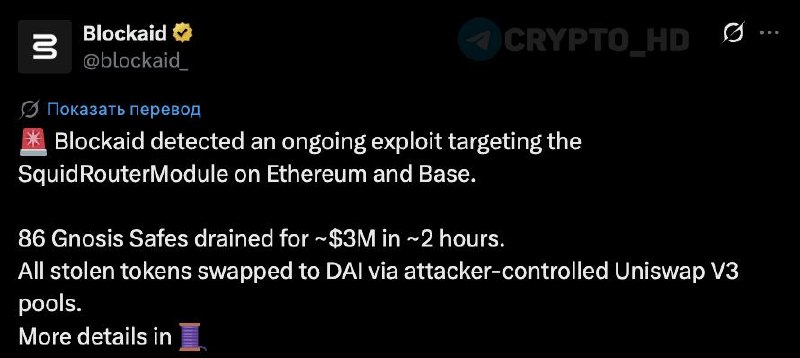
Blockaid said the attack affected Squid on both Ethereum and Base. In roughly two hours, 86 Gnosis Safe wallets were compromised, with losses near $3 million. Blockaid also said the stolen assets moved through Uniswap V3 pools controlled by the attacker. Its first post did not say what final asset the attacker received. That gap matters.
My take: the ETH angle matters because this is an Ethereum and Base issue, not a BTC macro issue. It raises questions about DeFi risk around ETH, L2 liquidity, and wallet infrastructure. A $3 million exploit usually will not move the ETH chart on its own. Most market notes stop there. That is only half right. 86 Gnosis Safe wallets getting hit in about two hours is exactly the sort of thing that makes desks recheck approvals, multisig flows, bridge exposure, Uniswap V3 routing, and then price.
On regulation pressure, agencies and lawmakers now have another clean talking point. The SEC, CFTC, and Congress already argue that on-chain finance carries operational risks many users do not understand. The known facts are limited: Squid, Ethereum, Base, 86 Gnosis Safe wallets, about $3 million lost, and attacker controlled Uniswap V3 pools. Is that enough for a full policy argument? No. Is it enough to fuel arguments against DeFi front ends, liquidity routing, cross-chain apps, and wallet setups that sit close to custody without always looking like custody? Absolutely.
The adoption read is bad. Gnosis Safe is widely used because multisig setups are meant to reduce single-key risk. The source does not blame Gnosis Safe itself. I will be careful here: that distinction is not legal fine print, it is the whole story until a postmortem says more. Still, when 86 Gnosis Safe wallets are compromised in roughly two hours, investors will ask where the weak point was. An approval? An integration? A routing path? Something else around Squid, Ethereum, Base, and Uniswap V3? Even a conservative treasury setup can have ugly execution risk buried inside it.
Liquidity routing is the part I would not brush off. Blockaid said the stolen assets were converted through attacker controlled Uniswap V3 pools. In Uniswap V3, concentrated liquidity can change execution, slippage, pricing, and settlement behavior quickly, especially in thin or custom pools. Counter to the usual advice, the theft itself may not be the most important market detail. The exit route may be. The problem is not only that assets were stolen. It is that the attacker may have prepared the exit route before anyone else knew something was wrong.
For BTC traders, the link is indirect. BTC often gets treated as cleaner collateral when the stress is specific to DeFi, while ETH carries more protocol and app-layer risk. That does not mean BTC benefits just because Squid lost $3 million. Why does this matter? Because the cleaner trade to watch is ETH/BTC. If ETH starts lagging BTC after the 86-wallet compromise, the market may be pricing in concern around Base, Ethereum DeFi, and Uniswap V3 routing.
COIN sentiment can take a hit too, but only indirectly. Base is tied to the Coinbase ecosystem, while the source only says the attack happened on Ethereum and Base. It does not say Coinbase failed. I’ll be honest: traders often blur that distinction in the first few hours, especially when Base, wallet compromises, DeFi losses, and routing all land in the same headline. The reported damage, about $3 million, is not a system-wide number.
The market has a short fact set. Squid was attacked. Ethereum and Base were involved. 86 Gnosis Safe wallets were compromised. About $3 million was lost. The stolen assets moved through attacker controlled Uniswap V3 pools. That is enough for a risk desk to pause and check exposure. It is not enough to blame Squid, Gnosis Safe, Base, Ethereum, or Uniswap V3 with confidence. Slow down.
What this means
This incident shows how DeFi exploit risk can run through routing, wallet flows, cross-chain app surfaces, and liquidity design, not just simple contract drains. ETH is the main market to watch, followed by Base ecosystem tokens and Uniswap-linked liquidity. Yes, this sounds like it contradicts the earlier point that a $3 million exploit usually will not move ETH by itself. Bear with me. For traders, the point is not a magic price level from the source. It is whether ETH/BTC weakens after the reported $3 million loss and 86-wallet compromise because investors start cutting app-layer risk.
Over the 24 hours after the Blockaid alert, I would watch whether Squid publishes a technical postmortem, whether Gnosis Safe wallet operators find a shared approval or integration pattern, and whether the attacker controlled Uniswap V3 pools stay active. CME crypto positioning in the next weekly release matters too, along with ETH/BTC into the next daily close. Is this overkill for one exploit headline? For a 50-wallet scare, maybe. For 86 Gnosis Safe wallets, Ethereum, Base, Uniswap V3 routing, and about $3 million lost, no. If those start to crack, the Squid hack stops looking like another contained exploit headline and becomes a broader DeFi confidence trade.