
















































Tether shuts down Alloy, aUSDT gold-backed token
Tether is closing Alloy by Tether and its aUSDT token, which was backed by Tether Gold (XAUT). Users have until September 17, 2026, to redeem aUSDT and withdraw their XAUT. That is enough runway to avoid panic, but not enough to pretend this is a product reset. It is over. My take: gold-backed crypto still sounds neat in a deck, then runs into the same old wall in live markets. Traders want liquidity. They want clean terms. They want tokens that already sit in every exchange workflow.
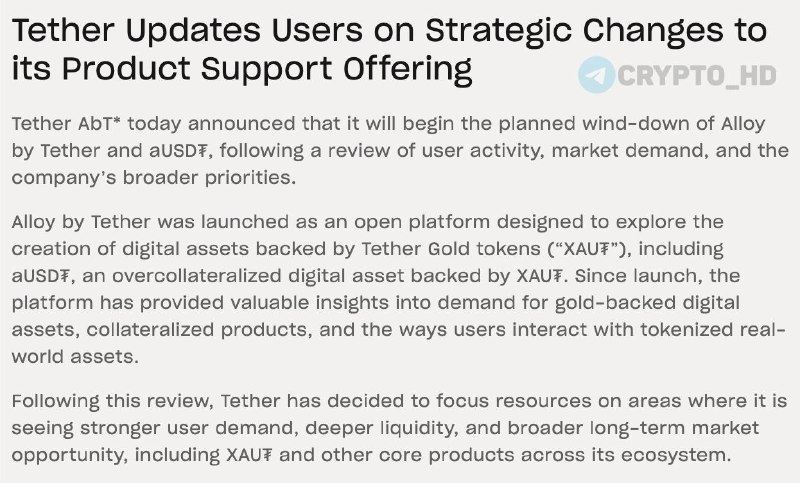
Tether said aUSDT holders must exchange their tokens and withdraw their XAUT by September 17, 2026. That leaves roughly three months from the June 2026 announcement window to unwind positions without a rush, assuming liquidity holds. Why does this matter? Because deadlines change behavior before the deadline actually arrives. Market makers get cautious, holders ask whether they should exit early, and the product starts to feel finished even while redemptions are still open. Alloy is not being paused while Tether adjusts the model. It is being shut down.
Tether’s decision comes while stablecoins remain under close regulatory scrutiny. Regulators in the U.S. and other markets have spent years looking at stablecoin reserves, redemption rights, disclosures, and products that ordinary users may struggle to understand. aUSDT was not a standard dollar token. It was built on XAUT, which represents tokenized gold. That extra layer likely made the product harder to explain, harder to oversee, and harder to sell. Most guides treat “more backing” as automatically more trust. That is only half right.
Crypto markets react quickly when regulation becomes clearer. When the SEC approved spot Bitcoin ETFs in January 2024, Bitcoin rose above $45,000 as traders priced in easier access and institutional demand. Uncertainty works the other way. Smaller products lose attention. Teams stop talking about them. Users move back to the deepest pool they can find, usually USDT or another familiar venue token. In this case, that was not aUSDT.
The shutdown also weakens the digital gold pitch, at least a bit. Gold has been a safe haven for generations. XAUT brought that idea into crypto, and aUSDT stacked another structure on top. The logic is easy enough to follow. I’ll be honest: I am not convinced the market cared. During the Russia-Ukraine shock in February 2022, Bitcoin briefly touched $45,000 as some investors looked for ways around currency stress, sanctions risk, and banking friction. That helped Bitcoin’s hedge narrative more than tokenized gold products helped their own.
XAUT still exists, and tokenized gold is not dead. But aUSDT never came close to Bitcoin’s role as the default digital refuge. Counter to the usual advice, the simpler product may be the stronger one here. Tether winding Alloy down instead of building around it looks practical: drop the niche product, keep USDT at the center, and protect the exchange liquidity engine that matters most. Not exciting, maybe. But in stablecoins, boring usually wins.
What this means
The Alloy shutdown suggests the stablecoin market has little patience left for complicated products. Issuers have more reason to support the tokens people already use, especially fiat-backed stablecoins such as USDT and USDC. Those tokens move money in and out of Bitcoin, Ether, and other risk assets every day. Traders use them because they are liquid and familiar. Is this unfair to experimental products? Maybe. But if someone needs a long explanation to understand the backing, the redemption path, the risk, and the reason to hold the token, the product already has a problem.
For Tether, the decision may be basic cleanup. aUSDT was a niche, multi-asset product in a market where scale matters a lot. USDT remains the main business. XAUT is the simpler gold token. Alloy sat awkwardly between them. We tried this logic before in other crypto cycles: clever middle-layer products often look useful until users have to choose where to park real money.
Investors should watch XAUT through the September 17, 2026, redemption deadline. The useful signals are simple: market cap and redemptions. Then spreads. Then any odd price moves while holders exit. If XAUT trades normally, the wind-down is probably orderly. If liquidity thins or the price starts to wobble, that would say more about demand for tokenized gold than a press release ever could.
The bigger question is whether Tether still wants to push asset-backed tokens beyond fiat stablecoins. Maybe it does, just not through Alloy. Yes, this contradicts the clean “boring wins” point above a little. Bear with me. A failed product does not kill the category; it just shows which version users rejected. The next clue will come from Tether’s announcements and XAUT’s numbers, not from vague talk about real-world assets.