
















































tether georgia launch gel stablecoin gives regulation a fresh test
A wire/TG post says Tether and Georgia’s government plan to launch GELT, an official stablecoin pegged to the Georgian lari. My take: this is not just another token headline. It gives regulators a live case to argue over, especially while the United States is still circling the proposed GENIUS legislation. For crypto traders, I would read the tether georgia launch gel stablecoin story as adoption first. Policy comes second. Price comes later, if at all.
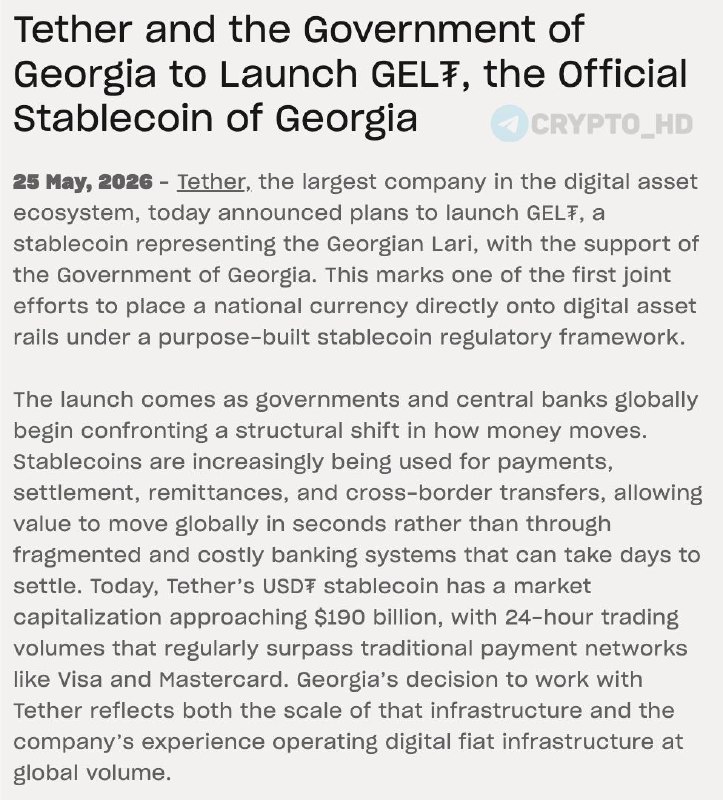
The source says GELT is meant to support fintech, digital payments, and cross-border trade in the region. It also says Georgian authorities believe the country’s rules fit with future U.S. stablecoin regulation, including GENIUS. On May 25, 2026, the post still did not give a launch date, issuance size, reserve breakdown, or exchange listing plan. That missing detail matters more than the announcement tone. A headline is not a market.
Country-linked stablecoins are moving past basic payment tokens. More precisely, GELT would push stablecoins toward national and regional payment rails, not just exchange balances. Most guides treat that as a simple adoption win. That’s only half right. For BTC and ETH investors, the first price reaction may be small, or there may be no reaction at all. Still, the direction is worth watching. When a government works with Tether, the issuer behind USDT, it shows how far stablecoins have moved from their old role as exchange-side tools for traders.
The adoption read is cleaner. USDT already sits at the center of crypto settlement, and GELT would copy part of that model in a local-currency lane tied to the Georgian lari. I’ll be honest: I would not buy BTC just because this headline crossed. It does not make GELT a BTC catalyst by itself. But it does add to the case for more on-chain payment volume, deeper exchange liquidity, easier regional crypto access, and better cross-border trade rails if that use case becomes real.
The regulation angle may matter more for COIN, ETH, and stablecoin-linked venues than for BTC spot demand. The source directly connects Georgia’s framework with future U.S. stablecoin regulation, including GENIUS, so traders should treat GELT as part of that policy track. Why does this matter? Because in 2024 and 2025, crypto markets often treated clearer rules as risk-on news for exchanges, ETFs, and institutional products. That logic still holds. Rules do not make a business good. They can make the business easier to price.
Still, GELT is not a macro shock. It does not change the Federal Reserve’s policy path, U.S. inflation expectations, or the dollar liquidity cycle on May 25, 2026. BTC still trades more like a high-beta liquidity asset when rates are being repriced. Stablecoins are payment plumbing. Yes, that cuts against the adoption excitement above, but both things can be true. The better question is narrower: do more official stablecoin projects make it easier for capital to move into and out of crypto?
There is also a safe-haven contrast here, though GELT itself is not a safe-haven asset. In stress periods, traders still compare BTC with gold, dollars, stablecoins, and sometimes plain cash access. During the January 2020 Soleimani shock, for example, BTC rose about 8% in the immediate risk window. That was one of those moments when geopolitical flows briefly helped crypto. GELT is different. It is built for payments, trade settlement, and local fiat access, not crisis hedging.
One caveat is hard to ignore. The source includes no direct quote from Tether, no comment from a named Georgian official, and no technical documentation for GELT. No docs, no certainty. Without reserve terms, redemption mechanics, or launch timing, investors should not treat this as a finished product rollout. The cleaner read is this: Tether keeps moving toward government-adjacent stablecoin infrastructure, while Georgia wants its fintech framework to look ready for regulated digital money.
What this means
GELT suggests stablecoin adoption is moving from exchange balances into national and regional payment rails. For crypto markets, the affected tickers are less about “GELT versus BTC” and more about USDT, BTC, ETH, and COIN as proxies for stablecoin liquidity and regulated access. Is this overkill for one Georgia-linked token? For a serious trader, no. Reserve disclosures, wallet integrations, exchange support, and redemption terms would separate a symbolic launch from real transaction volume.
The next thing to watch is the U.S. stablecoin rule path tied to GENIUS, plus the next FOMC decision on June 17, 2026. My read: liquidity still drives BTC more than local payment pilots do. On the chart, BTC traders should pair this adoption signal with CME futures positioning and the nearest major support or resistance level on their venue instead of chasing the headline. GELT is a signal. Liquidity decides whether it becomes a trade.