
















































Whale activity jumps in top 10 tokens, pointing to possible market rotation
Whales were active this week. Not mildly active. Santiment data shows a sharp rise in large-wallet moves across a short list of tokens, and that usually means bigger players are shifting before the wider market catches on. Does that guarantee a breakout? No. Crypto is full of head fakes. My take: when the largest wallets keep showing up around the same names, it is worth paying attention even if the signal is ugly.
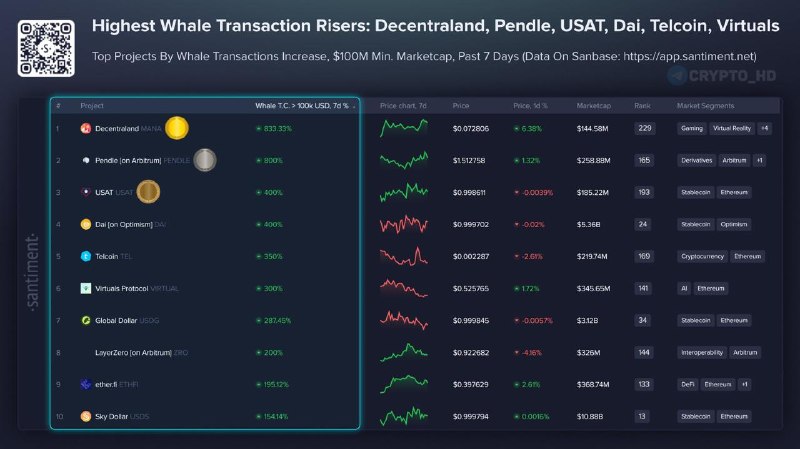
Santiment’s top 10 tokens for increased whale activity over the last week were Decentraland, Pendle on Arbitrum, USAT, Dai on Optimism, Telcoin, Virtuals Protocol, Global Dollar, LayerZero on Arbitrum, ether.fi, and USDS. The list is the point. Raw volume by itself is a lazy read. What matters is buying or selling pressure from wallets large enough to move thin markets without needing much help.
The stablecoins are the first thing that jumps out. Dai on Optimism, USDS, USAT, and Global Dollar all made the list, so this is not just another altcoin-chase story. It has a clear macro flow angle. When whales move into stablecoins, they may be parking cash. They may be waiting for a better entry. They may simply be getting nervous. Most guides treat stablecoin inflows as dry powder. That is only half right. If the Federal Reserve sounds more hawkish at an FOMC meeting, altcoins usually take the hit first. We saw something like that in early 2022, when BTC kept wrestling with the $40,000 level while inflation worries and rate-hike expectations pushed more capital into stablecoins.
Decentraland and Pendle look different. MANA could be an adoption signal, or maybe just a bet that metaverse assets still have one more speculative cycle in them. I’ll be honest: I would be careful with that read. Corporate Web3 experiments have created plenty of noise and not much lasting user demand. Still, if whales are accumulating MANA, they may be positioning for another round of metaverse trading. Pendle is cleaner. Its yield-tokenization model gives DeFi traders something closer to fixed-income exposure, which is exactly the sort of product large wallets tend to revisit when yields get interesting. Why does that matter? Because yield narratives do not need mass retail interest to move first. MicroStrategy’s 2020 BTC buying, now above 214,400 BTC, showed how early treasury moves can shift the market’s mood before retail catches up.
LayerZero on Arbitrum and ether.fi deserve attention too. LayerZero is tied to cross-chain activity, which matters if users keep spreading across different networks instead of settling on one chain. Ether.fi sits inside the liquid restaking trade, one of the busier Ethereum narratives right now. These are not random meme bets. They are infrastructure bets. They are also Ethereum-linked finance bets. Counter to the usual advice, I would not lump them together with every other “narrative token” on a watchlist. The US approval of spot Ethereum ETFs could bring more attention here, especially if capital starts chasing anything connected to staking and restaking. Ethereum yield sits right in the middle of that.
What this means
This is not a clean bullish signal. It is messier than that. The stablecoin activity suggests some whales are taking risk off or waiting for volatility. The altcoin activity suggests others are trying to get into the next trade before it becomes obvious. That split feels about right for this market: defensive in one corner, impatient in another. Is this overreading one week of wallet data? Maybe. But whale activity can show where capital is moving before the headlines catch up, so traders should watch price action and on-chain flows in these tokens instead of treating the list like background noise.
The Fed still matters. A hawkish surprise could push more money into stablecoins and away from risk assets. For MANA, the level to watch is recent resistance near $0.45. For PENDLE, the cleaner signal is whether it can keep momentum above $5.00. For Dai and the other stablecoins, market cap and wallet flows matter more than price, since the question is whether capital is entering or leaving crypto risk. Yes, this cuts against the tempting altcoin-rotation read above. Bear with me: both can be true at once. The June 12 FOMC meeting could be the next major test for that decision.