
















































Whale ETH short liquidation risk: $2M loss shows how ugly leverage gets
A whale wallet, “0x0Ddf”, is down almost $2,000,000 on a large ETH short. The position is about $87,000,000 with 3x leverage. It was opened near $1,700, with liquidation at $2,172. ETH has traded close enough to that level to make the whole thing uncomfortable. I’ll be honest: this is not a cute chart setup. It is a very expensive timer.
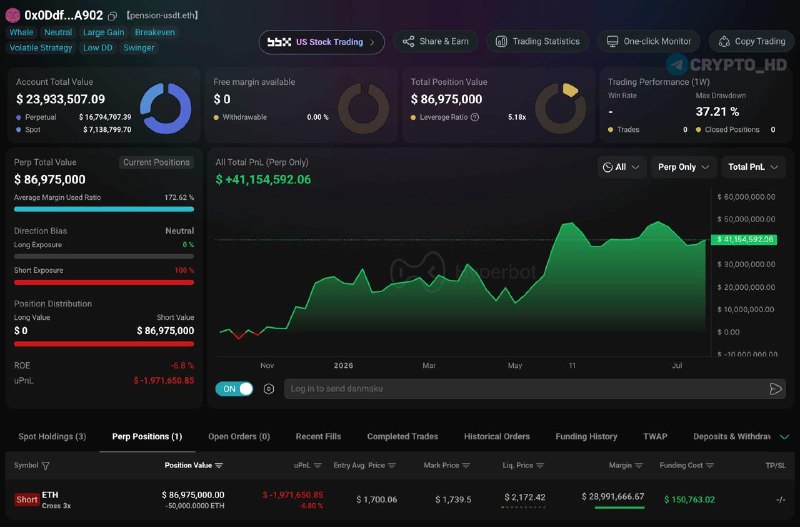
This is the part of crypto that still makes me wince. A trade can look clever for a while, then one strong move turns it into a countdown. Most leverage guides say the danger is volatility. That’s only half right. The quieter danger is time, because a position can bleed while the trader waits for the “real” move. No grand market lesson. Less room to be wrong.
The setup also matches how ETH tends to trade around macro news, especially FOMC minutes, CPI releases, and Fed rate decisions. In November 2021, ETH traded above $4,800. By June 2022, it had dropped below $1,000 as rates rose and traders dumped risk assets. That move was not subtle. When the Fed sounded tougher, crypto sold off hard. With ETH now around $2,000, the same pressure still matters. Why does this matter? Because one hot inflation print or rough Fed comment could scare buyers off fast. A softer reading could do the opposite and push ETH toward $2,172.
The whale’s short is bleeding, but the bet itself is plain enough: someone put real size behind the view that ETH would fall. The market disagreed. My take: people overcomplicate this part because the wallet is huge. It is still just a short that moved against its owner. This has happened before, just with bigger damage. In the May 2021 crash, more than $10 billion in leveraged crypto positions were liquidated in a day across major exchanges. BTC got hit. ETH got hit too. Margin did the rest.
If ETH keeps climbing, this position becomes squeeze fuel. The whale may need to buy ETH back to close or reduce the short. That buying can push price higher, which can force more shorts to close. Counter to the usual advice, the danger is not only the liquidation print itself. The danger is the market sniffing out that level before it happens. It gets ugly fast.
What this means
This trade puts a clear line on the chart: $2,172. If ETH moves through that area, the “0x0Ddf” position could be liquidated. Is that one wallet enough to move ETH by itself? Probably not for long. But a trade that large can bend short term price action, especially if other traders are packed into the same bet.
For traders, the lesson is blunt. Size matters. Leverage matters more. I know that sounds obvious, but it keeps being the sentence people skip. A 3x position does not need a historic move to become a problem. It just needs the market to drift the wrong way for long enough. We tried. It broke.
The next area to watch is ETH near $2,172. After that, watch the macro calendar. FOMC minutes matter. CPI releases matter. Fed rate decisions matter. The December 13 FOMC decision is the kind of event that can jolt risk assets either way. A hawkish tone could pressure ETH and pull it back toward the whale’s $1,700 entry. Softer inflation data or strong spot buying could push ETH through the liquidation level and turn the short into forced demand. Yes, this slightly contradicts the idea that the liquidation line is the whole story. Bear with me: the line matters because the macro catalyst can shove price into it.
Funding rates matter too. If ETH perpetual futures show deeply negative funding, the short side may be overcrowded. That is when a squeeze stops being theoretical. Everyone can see it coming, and somehow it still catches people off guard. My read: the obvious trade is often the crowded one, and crowded shorts rarely exit politely.