
















































WUSD/GLOVE liquidity pool hack: privacy protocols face new pressure
A “liquidity pool hack” is simple enough: someone drains funds from a DeFi pool without permission, usually by exploiting a smart contract bug or a weakness in the protocol around it. Not glamorous. Just expensive.
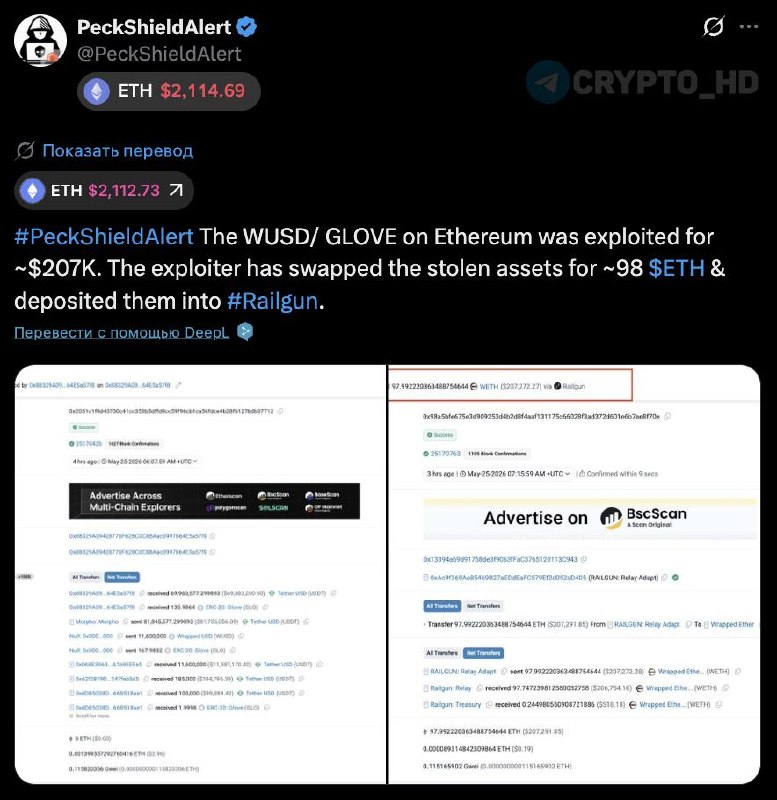
This time, attackers stole about $207,000 from the WUSD/GLOVE liquidity pool on Ethereum and moved the money into Railgun almost immediately. PeckShield confirmed the exploit. I’ll be honest: this is the part that still bothers me. DeFi markets itself as open and verifiable, yet $207,000 can disappear in minutes. Once the money reaches a privacy tool, the trail becomes harder to follow right when everyone most needs clarity.
The attack did not drag on. The attackers hit the WUSD/GLOVE pool, took roughly $207,000, converted the assets into about 98 ETH, and sent that ETH to Railgun. Railgun is built for private transactions. That is not automatically suspicious. Privacy matters. Counter to the usual advice, the privacy tool is not the whole story here. The timing is. When stolen funds land there minutes after a hack, regulators do not need a complicated theory to argue that privacy protocols deserve closer scrutiny.
This lands in the middle of an already tense regulatory fight. In the US, agencies have been pushing for more visibility into crypto markets, with exchanges getting one kind of attention and staking products another. DeFi activity sits in its own uncomfortable category. A hack like this gives privacy skeptics another example they can point to. My take: it probably will not decide an ETF application by itself. But it does add to the pile of incidents that make institutions hesitate. Why does this matter? Because markets often price the fear before anyone has read the actual filing. On January 10, 2024, Bitcoin fell nearly 3% after reports tied to SEC delays around a spot Ethereum ETF decision.
The hack also dents the “crypto as a safe haven” pitch. I have never found that argument fully convincing, at least not without caveats stacked on caveats. A $207,000 exploit is not a system wide crisis. Still, it reminds people that crypto risk is not only about macro conditions or failed exchanges. Sometimes it is a small pool. A weak contract. A wallet moving faster than anyone can respond. During the first days of Russia’s invasion of Ukraine in February 2022, BTC dropped from above $38,000 to below $35,000 before recovering as some buyers treated it as a hedge. That rebound helped the safe haven story. Repeated exploits do the opposite. They tell cautious investors, especially institutions, that decentralization does not erase risk. It changes the shape of it.
What this means
A “persistent vulnerability” in DeFi means the same kind of weakness keeps appearing across protocols. Usually the pattern is not mysterious: light audits, rushed code, incentives that look fine in a deck but strain once real money shows up.
The WUSD/GLOVE hack points to a familiar weak spot: smaller liquidity pools that may not get the same security review as larger DeFi venues. The quick move into Railgun shows the second stage of the problem. Attackers move funds. Security firms trace them. Privacy tools get dragged into the policy argument, whether their builders asked for that role or not. Most guides say higher yield means higher risk. That’s only half right. Higher yield often means you are also taking on weaker review, thinner liquidity, and slower incident response. For traders, the lesson is blunt. Newer pools can pay more because they carry more risk. Sometimes that risk is very real.
From here, watch the regulatory response. An agency statement or a bill aimed at privacy protocols would matter. So would a new enforcement action. DeFi security sentiment matters too. One hack is noise. A string of similar exploits can push traders out of smaller altcoins quickly. Is this overreading one $207,000 incident? For the whole market, maybe. For privacy protocols and thin DeFi pools, no. ETH is also worth watching because the exploit happened on Ethereum. The $3,000 level matters here. If ETH stays below it for a while, that would point to weaker appetite across DeFi, not just concern about one pool.
FAQ
What is the WUSD/GLOVE liquidity pool hack?
The WUSD/GLOVE liquidity pool hack was the theft of about $207,000 from an Ethereum-based liquidity pool. The stolen funds were later moved to Railgun.
Which privacy protocol was used by the hackers?
The attackers used Railgun, a privacy protocol that can hide transaction details and make fund tracing harder.
What was the approximate value of the stolen funds?
The attackers stole roughly $207,000, then converted the funds into about 98 ETH.
How does this hack affect regulatory discussions?
It gives regulators and privacy skeptics another example of stolen crypto moving through a privacy protocol. That can support calls for tighter controls.
Why does the transfer to Railgun matter?
The Railgun transfer matters because it makes the case harder to track. Users have legitimate privacy needs, but attackers can use the same tools to hide stolen funds.
Has PeckShield confirmed the incident?
Yes. PeckShield, a blockchain security firm that tracks exploits, confirmed the incident.
What does this mean for DeFi security?
It shows that smaller or lightly audited liquidity pools remain risky. Better audits help, but they do not make a pool untouchable.
How might this affect institutional adoption of crypto?
Hacks like this can make institutions more cautious, especially when stolen funds move through privacy tools. The concern is not only theft. It is compliance exposure.
How do markets usually react to security incidents like this?
One smaller exploit may not move the whole market, but repeated incidents can wear down confidence and push capital toward safer assets.
What should traders consider when using liquidity pools?
Traders should treat newer or thinly reviewed pools as higher risk. Higher yields often come with a real chance of contract failure or an exploit.
How might regulators respond to events like this?
Regulators could issue warnings, open investigations, or propose rules aimed at privacy protocols and services linked to anonymized fund movement.
What is the potential effect on altcoin markets?
If similar exploits keep happening, traders may pull back from smaller altcoins and DeFi-linked tokens. Confidence can disappear quickly in that part of the market.
Which cryptocurrency should be watched for regulatory pressure?
Ethereum (ETH) is worth watching because the exploit happened on Ethereum. Privacy-related tokens should also be watched for signs of regulatory pressure.
What key price level matters for Ethereum (ETH)?
The $3,000 level is the main ETH marker here. Sustained trading below that level could point to weaker DeFi sentiment.