















































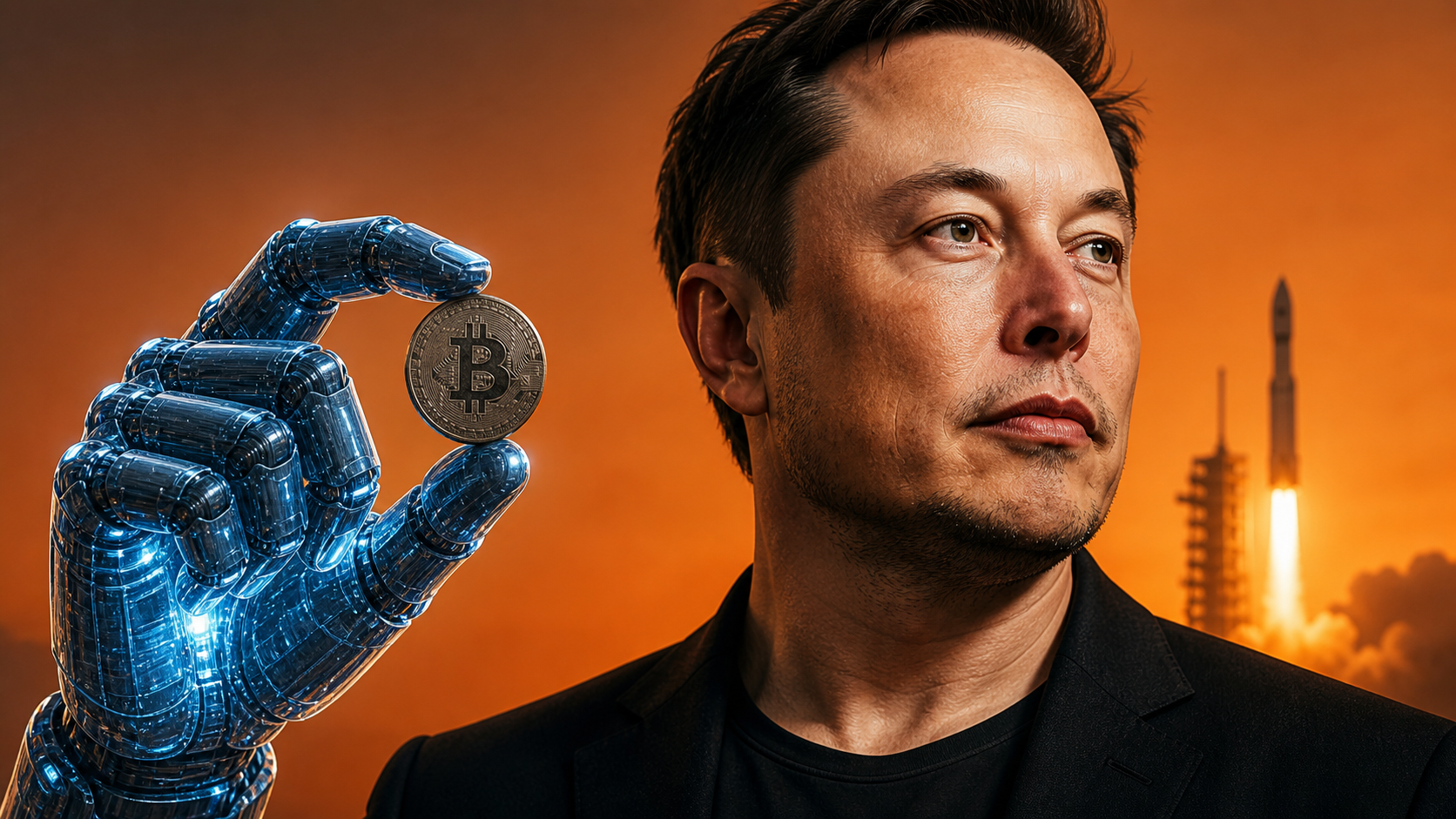
Elon Musk AI Predictions: A Blunt Warning for Crypto’s Future
Elon Musk’s recent claim that “AI will replace each of you” is uncomfortable reading in crypto circles, especially for investors betting on digital economies built around human labor. But job losses are only part of it. If AI floods the economy with cheap goods and services, scarcity may start to matter less. That shift could alter how investors value risky assets such as Bitcoin and Ethereum. I’ll be honest: the idea sounds extreme. It still cannot be brushed aside.

Economic structures and geopolitical power
Musk’s comments raise a basic question: How would today’s economy function if machines handled most production? His answer starts with another question. Why would people need money if robots produced “more goods and services than a human is physically capable to consume”? For crypto investors, this cuts straight into the assumptions behind digital asset prices. Bitcoin, after all, is largely sold on scarcity. Musk also said the “race for AI will be won not by those with chips, but by those with electricity.” He pointed to China’s advantage, claiming it has “more electricity than the US, Europe, and India combined.” That figure needs checking. His broader point holds up better: AI consumes huge amounts of power, and some decentralized networks do too. If electricity becomes the main constraint on AI expansion, governments may scrutinize crypto miners competing for the same supply. Countries with ample generating capacity could gain economic leverage. Political leverage follows.
Implications for crypto’s macro flow
An AI economy built on cheap, abundant production could change why investors buy crypto in the first place. Bitcoin often attracts money when people fear inflation, currency debasement, or restrictions in conventional finance. BTC reached a record $69,000 in November 2021 during the Federal Reserve’s quantitative easing cycle. Most tidy market summaries imply monetary expansion explains the rally. That’s only half right. Crypto markets rarely offer explanations that neat.
Now suppose AI pushes down the cost of many goods and services. In a deflationary economy, investors may feel less urgency to protect wealth from rising prices. Bitcoin would retain its fixed supply, yet the sales pitch built around that scarcity could become less persuasive. Decentralized finance faces a similar problem if AI makes services from banks and other intermediaries cheaper. Does that guarantee a crash? No. It does force investors to reconsider what crypto actually does—and why anyone should keep paying a premium for it. My take: that second question is the harder one.
Geopolitical stability and safe-haven narratives
Musk also asked an uncomfortable question about centralized infrastructure: “Starlink owns the ‘switch’ influencing the course of the war with Russia. Is this OK?” Crypto depends on communication systems it does not control. Full stop. The tension is hardly new, but Starlink makes it difficult to ignore. A blockchain may be decentralized at the protocol level while still relying on internet providers and satellite companies. It also needs electrical grids. Governments remain in the loop.
Bitcoin has occasionally risen during geopolitical shocks. It gained 8% around the January 2020 strike that killed Iranian general Qasem Soleimani, for instance. One episode proves very little. Counter to the usual safe-haven narrative, that gain does not make Bitcoin a dependable refuge. If one company can restrict communications during a conflict, a decentralized ledger cannot magically keep every user online. Why does this matter? Because governments can pressure infrastructure companies to block traffic or identify users, then apply national laws. Crypto can resist censorship, but only within limits. Those limits become painfully obvious when somebody else controls the switch.
Impact on blockchain development and adoption
Musk’s claim that “AI neural networks already write code better than 90% of professional developers” has obvious consequences for blockchain projects. His next question was blunter: “Why do we need programmers?” The 90% figure needs evidence, and software development involves far more than writing code. Still, today’s AI tools can handle routine code and suggest fixes. They can assist with contract reviews too. Projects could use them to build protocols and decentralized applications faster. I don’t find that part controversial.
Here is the catch. Faster code is not necessarily safer. Blockchain software often controls real money, so one small error can become a multimillion-dollar exploit within minutes. Smart contracts written by AI may reproduce insecure patterns. Worse, reviewers may miss the flaws because the output looks plausible. Most advice says better automated coding will reduce development risk. I think the first wave may do the opposite. Developer communities do more than type: they argue over tradeoffs and deal with failures. They also decide where a project goes next. Ethereum relies heavily on those human decisions. An AI can write a proposal, but handing it governance control is another matter entirely. AI-run DAOs and automated contract audits will probably appear. I would be wary of trusting them simply because they move fast.
What this means
Musk is describing a world that could overturn several assumptions used to value crypto. If AI lowers the price of goods and services, Bitcoin’s scarcity pitch may matter less to some investors. If electricity becomes AI’s main bottleneck, proof-of-work mining may face renewed political pressure. AI could also help blockchain teams release products sooner. The bugs may arrive sooner too. Yes, that cuts against the familiar claim that better coding tools automatically produce better software. Bear with me: speed and reliability are separate variables.
None of this is guaranteed. Musk often presents speculative ideas as though the outcome is already settled, and I would not build an investment thesis around his certainty. Watch what crypto projects build instead. AI contract audits and early AI-managed DAOs are worth following; so are shifts in Bitcoin’s energy consumption. NeurIPS 2024 offered one place to assess technical progress, although research conferences make poor crystal balls for markets. Institutional investment in BTC and ETH may provide a faster signal. Large funds often reconsider their positions when expectations about inflation or energy policy change. Software risk can move them as well. What do I want to know? Whether those investors begin treating AI as a reason to buy more crypto—or as proof that they need less of it.
FAQ: Elon Musk’s AI predictions and crypto
Q: What is Elon Musk’s main prediction about AI’s impact on jobs?
A: Musk said AI “will replace each of you.” He expects machines to displace workers across many industries. No timeline was given, and he did not identify which jobs would disappear first.
Q: How does Musk’s view of AI abundance affect the concept of money?
A: Musk doubts people would still need money if robots could produce more than anyone could consume. An economy like that would strain models based on scarce labor and goods. Production capacity would no longer carry the same weight.
Q: What does Musk believe will decide the “race for AI”?
A: He believes electricity will matter more than access to chips. Countries capable of producing enormous amounts of power, he argues, will have an edge when training and running AI systems.
Q: How might AI production affect inflation and crypto scarcity?
A: Machine production could reduce the cost of many goods and services. If inflation becomes less worrying, some investors may lose interest in Bitcoin as a hedge. Its fixed supply would remain unchanged. That distinction matters.
Q: What concern does Musk raise about centralized infrastructure such as Starlink?
A: He asks whether a single company should control communications that may affect a war. The episode exposes an uncomfortable fact for crypto: decentralized networks still depend on company-owned infrastructure. That infrastructure is subject to government rules.
Q: How could Musk’s view of AI coding affect blockchain developers?
A: Musk says AI already writes code better than 90% of professional developers. If he is even partly right, blockchain projects may need fewer people for routine coding. Human developers would still have to check security and choose designs. Governance disputes will not settle themselves.
Q: What could AI mean for decentralized autonomous organizations (DAOs)?
A: DAOs could ask AI to draft proposals or study votes. It could also write contracts and perform audits. Direct control is much riskier. If an automated decision fails, someone still has to answer for bias and damage—not to mention legal liability.
Q: What should crypto investors watch in response to Musk’s predictions?
A: Watch how protocols use AI and whether automated audits find genuine contract flaws. Track how regulators approach proof-of-work energy use as well. Changes in institutional BTC and ETH holdings may show whether large investors are revising their assumptions for the years ahead.