















































Bitcoin capitulation signal 2026: CryptoQuant warns of major correction
“CryptoQuant analysts say the DIPI indicator is flashing again, and in past cycles it has appeared near brutal Bitcoin capitulation periods.” That is the part I would not brush aside. The signal is back in 2026, after crypto’s recent run, and it points to a market that may be closer to a shakeout than traders leaning on the rally want to admit. Not comfortable. But useful.
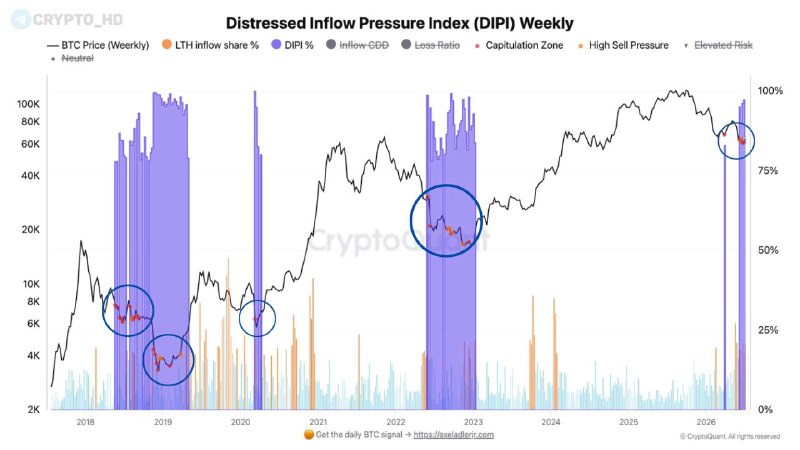
“DIPI, short for Distressed Inflow to Exchanges, tracks stressed BTC inflows to exchanges.” It looks at older coins moving again, long term holders sending coins to exchanges, and Bitcoin deposits made at a loss. In CryptoQuant’s model, that usually means holders are preparing to sell. Or cutting losses. Or getting pushed out because the trade no longer works. I’ll be honest: this is one of those indicators that sounds niche until it starts lining up with price damage.
“Big DIPI spikes have matched some of Bitcoin’s worst pressure points.” CryptoQuant points to 2018, when BTC fell hard after its late 2017 peak. The signal also showed up in 2022, before another ugly downturn as Terra/Luna collapsed, FTX failed, and macro conditions turned against risk assets. Now it is rising again in 2026. Most guides would stop there and call it a crash warning. That’s only half right. It does not promise a crash, but it is not a chart I would ignore.
“The DIPI signal is appearing while the macro picture for risk assets already looks fragile.” CryptoQuant does not need to explain the whole Fed story for the link to make sense. In 2018 and 2022, Bitcoin’s worst stretches came during tighter financial conditions or market panic. Why does this matter? Because forced selling gets nastier when liquidity is already thin. If central banks sound more hawkish on rates or quantitative tightening, selling pressure could build quickly. Money can leave BTC and ETH for cash, Treasuries, or the sidelines. Bitcoin often reacts hard to Fed language, and even a small change in tone can move the price by several percentage points.
“A large correction would also put Bitcoin’s treasury adoption story under real pressure.” My take: this is the part people underprice. Companies, and a few sovereign-linked buyers, have added BTC to balance sheets because they see it as a long term store of value. A hard drop would test that belief in public. Long term holders may say they are unfazed, and some of them probably mean it. Quarterly reports are less forgiving. Companies that bought near the $60,000 to $70,000 range could be sitting on painful unrealized losses, which can spook investors even if management says the thesis has not changed.
What this means
“CryptoQuant’s latest DIPI reading is a warning that Bitcoin may be entering a stressed phase.” More coins are moving to exchanges, and that often means sellers are getting ready. Is that automatically bearish? No. Counter to the usual advice, exchange inflows are not always instant sell pressure. But when older coins, loss-making deposits, and a fragile macro backdrop show up together, the setup gets harder to dismiss. If this plays out like 2018 or 2022, the damage probably would not stop with BTC. ETH and larger altcoins usually follow Bitcoin lower during broad selloffs, sometimes harder.
“Traders should watch exchange flows, especially older coins and coins moved at a loss.” CryptoQuant also points to the $60,000 BTC level as an important support area. A clean break below it could make the selling faster and messier. Watch the calendar too. FOMC meetings and inflation reports can either add pressure to the bearish setup or give the market room to breathe. Yes, this slightly contradicts the idea that on-chain data leads the story — bear with me. In moments like this, the chart can warn first, but macro can still decide how bad it gets. The next few weeks may decide whether 2026 turns into another capitulation year like 2018 and 2022, or just another false alarm that rattled everyone for a while.