
















































Matrixport Whale Liquidation Losses Pile Up in Market Selloff
“Matrixport whale liquidation losses” means losses tied to a large crypto holder, or “whale,” linked to Matrixport after leveraged positions were shoved toward closure during a market drop. One wallet cluster tied to Matrixport is now carrying almost $100,000,000 in unrealized losses. Ugly number. I’ll be honest: in crypto, numbers this large do not stay quiet for long. Traders start tracking liquidation levels. Then they watch exchange flows. Then the real question lands: can BTC or ETH absorb the pressure?
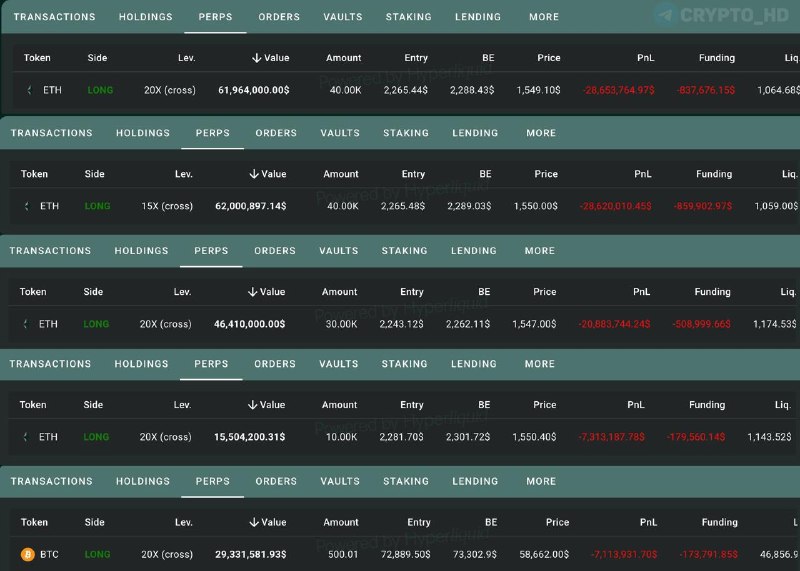
Market data shows one whale holding large BTC and ETH long positions worth about $217,000,000. The wallets, labeled 1, 2, 3, 4, and 5, are all underwater. The selloff has been sharp. Coinglass data shows that $570,000,000 in long positions were liquidated across exchanges in a single hour. That is not ordinary market noise. That is leverage being pulled out fast. We tried to treat moves like this as “just volatility” before. It usually broke.
The $570,000,000 liquidation wave points to a familiar problem: crypto is still reacting to pressure from traditional markets. Most guides say crypto trades on its own internal cycle. That’s only half right. When stocks and rates move against risk assets, crypto tends to feel it quickly. This time was no different. Analysts point to the Federal Reserve’s hawkish tone and persistent inflation worries. They also point to weaker appetite for risk assets as pressure on crypto. My take: BTC struggling around major support says the quiet part out loud. Crypto still cares about macro. Research also shows BTC remains closely correlated with indices like the S&P 500, so claims that crypto has fully decoupled still look early.
The whale’s $217,000,000 BTC and ETH long exposure shows how much leverage remains in the system. Big positions can look fine until volatility jumps. Then they become targets. Why does this matter? Because liquidation math does not care whether the holder is small, famous, or tied to a major crypto financial services firm. Legal experts say SEC and CFTC scrutiny around exchange practices and derivatives could add to these swings. Counter to the usual advice, “wait for regulation clarity” is not always calming for markets. Even talk of stricter rules for crypto lending or derivatives platforms can push large holders to cut risk, especially when prices are already weak. This is not only a price story. It is also about how exposed the biggest players are when the market turns.
What this means
This looks like forced deleveraging among large BTC and ETH holders, not a calm pullback. The $570,000,000 in liquidations within one hour shows how many leveraged positions were caught on the wrong side. Fast moves punish lazy leverage. A whale tied to Matrixport, a major crypto financial services firm, taking losses this large shows the pain is not limited to smaller traders. Yes, this sounds like it contradicts the usual “whales control the market” line. Bear with me: sometimes whales are the ones getting controlled by margin. The market is still acting risk-off, and the old “buy the dip” reflex is getting tested.
BTC needs to reclaim and hold $60,000 before traders can relax. Is that level magic? No, but traders cluster around obvious lines, and forced selling often starts where everyone can see it. A clean break below that level could trigger more forced selling. The next FOMC minutes matter too, because any shift in the Fed’s tone can move risk assets quickly. CME Bitcoin futures open interest and funding rates are also worth watching. If they fall hard, more leverage is leaving the market. My read: the next few weeks should show whether this was a violent flush or the start of a deeper BTC and ETH drawdown.