
















































Solo Bitcoin Miner Luck: A Small Story About Bigger Crypto Forces
A solo Bitcoin miner just collected a 3.15 BTC block reward worth $199,000. The miner had only 2.4 PH/s of hashing power and almost no chance of pulling this off. Almost none. Yet that is part of Bitcoin’s peculiar appeal. People spend serious money on machines and go up against industrial mining operations. Occasionally, somebody gets absurdly lucky. I’ll be honest: that tension is more interesting than the payout alone. The win offers a small glimpse at retail interest, too, along with the economics surrounding crypto.
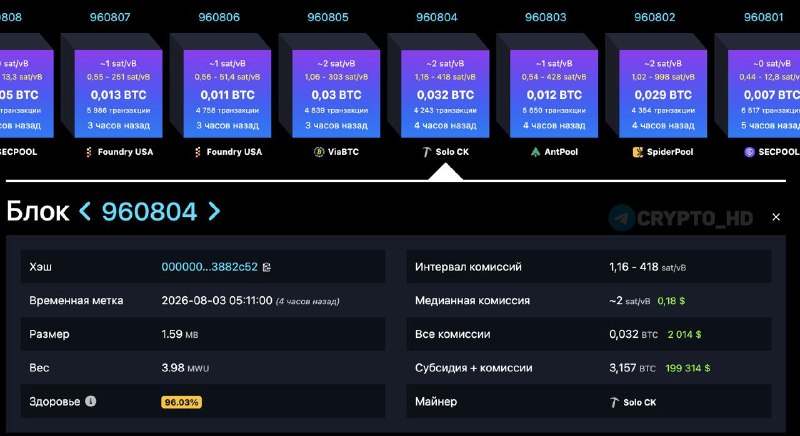
The miner’s estimated chance of finding a block was roughly 1 in 966,000,000. Those are lottery odds, except the ticket was specialized hardware running day and night. Similar wins appear now and then because chance is built into Bitcoin’s proof-of-work system. With the global hashrate near 600 EH/s, 2.4 PH/s is little more than a rounding error. Why does that matter? Because this time, the rounding error won.
The payout says something about adoption, although one lucky miner does not prove much by itself. Most commentary treats mining as an industrial game now. That is only half right. When an independent operator finds a block, people get a reminder that Bitcoin remains open to miners without corporate backing or warehouses full of equipment. The odds are awful. Still, technically, anyone can take a shot. My take: that openness remains part of Bitcoin’s grassroots identity, just as it has since the beginning.
Retail activity rose in Q1 2024. Platforms such as Coinbase (COIN) reported higher trading volume, with BTC attracting much of the interest. This payout did not cause that increase. Full stop. But stories like this spread quickly because they offer something a price chart cannot: someone switched on a machine and ended up with $199,000 against ridiculous odds. I can see why that beats most advertising. A few readers may open trading accounts. Others might look up mining equipment. Then they discover what it costs to keep the thing running.
The timing also connects the story to macro flows. Central banks, particularly the Federal Reserve, have adjusted interest rate policy while investors continue to worry about inflation. Some have responded by buying assets outside the conventional financial system. Bitcoin is often sold as protection from financial instability because its supply is capped and central banks cannot control it. Counter to the usual pitch, that does not automatically make Bitcoin a dependable hedge. Its price swings make any simple answer hard to defend. To my eye, certainty is the least credible position here.
One solo miner’s win obviously will not influence Fed policy. It does, however, show that the Bitcoin network continues processing transactions and rewards regardless of interest rate decisions. During the March 2020 liquidity crunch, BTC dropped below $4,000 before recovering dramatically. That episode helped fuel claims that Bitcoin could eventually become a safe haven or sometimes move independently of traditional markets. Did it settle the argument? No. The record remains mixed. Still, I keep coming back to one detail: the network delivered a $199,000 reward without a bank handling the payment. That helps explain its appeal among people who distrust conventional finance.
What this means
There is something oddly romantic about a tiny miner beating odds of 1 in 966 million. Anyone with suitable equipment can participate in the open, permissionless network. But here is the correction: “can participate” does not mean “will make money.” Not even close. Most solo miners will never find a block. This payout simply proves that individual miners have not vanished, even as large companies claim a growing share of the industry. I would not mistake survival for economic viability.
For traders, this is a story about mood, not a market signal. One miner’s good fortune will not move BTC on its own, though it could attract retail attention when prices are trapped in a narrow range. Wins like this make Bitcoin seem accessible. The economics of solo mining tell a much harsher story. Yes, that sounds contradictory. Both can be true at once.
Investors would learn more by watching retail activity than by treating this payout as a price indicator. The $60,000 area is notable support, with resistance near $70,000. A sustained break through either level would matter more if accompanied by heavier retail trading or a change in the news cycle. Either would mean more than one miner’s windfall. Is that less exciting? Absolutely. It is also more useful. The June FOMC meeting is worth watching because a change in interest rate policy could affect Bitcoin along with other risk assets. My read: the miner makes the better headline, but those levels and the June FOMC meeting carry the real market information.