
















































London Crypto Millionaire Kidnapping Exposes a Real-World Risk
Two French crypto investors were kidnapped in London, tortured for 52 hours and ordered to make a $150,000 crypto transfer. Horrifying, obviously. But the case also exposes something no market chart can price: once people know you hold a lot of crypto, you can become the attack surface. My take: that physical risk makes the usual claim that digital assets offer safety during financial or political turmoil far less tidy for Bitcoin (BTC) investors.
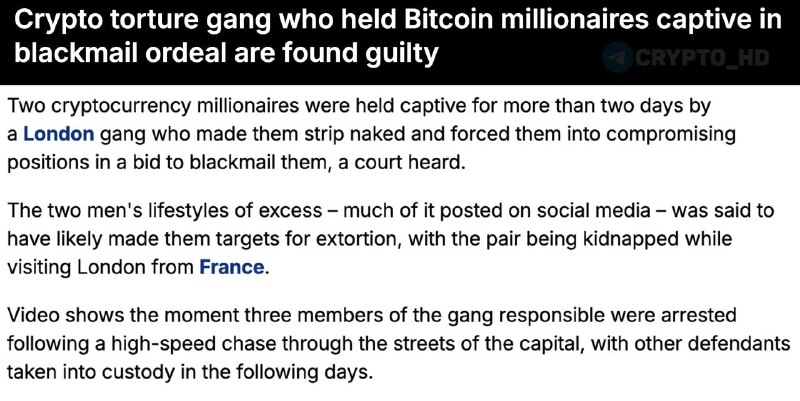
The court details are grim. A UK gang held the men for more than two days. According to testimony, the kidnappers beat them and poured boiling water on them. They burned them with cigarettes, too, and threatened to kill them. The attackers obtained $30,000 in cryptocurrency before police arrested them. Reports have described a wider pattern of “hunting crypto investors,” amid rising crypto crime in France. Why does this matter? Because a bank may struggle to seize wealth stored on a blockchain, while a criminal can simply target the person holding the wallet credentials. That is the ugly loophole.
One case will not wreck Bitcoin’s safe-haven image overnight. BTC has climbed during previous crises; around the January 2020 US strike that killed Iranian general Qassem Soleimani, for example, it gained 8%. Some investors buy Bitcoin in uncertain periods because it is decentralized and difficult for governments or banks to confiscate. Most bullish arguments stop there. That is only half right. Difficult to seize does not mean impossible to steal, and if an attacker forces the owner to approve a transfer, the blockchain’s security offers little practical protection. I would treat technical security and personal safety as separate problems. Because they are.
The kidnapping may also intensify calls for tighter regulation. To be clear, this was a violent crime—not an enforcement action. Still, politicians and police could cite the 52-hour ordeal when arguing for stricter know-your-customer and anti-money-laundering rules. Authorities already struggle to trace some pseudonymous crypto transactions. A kidnapping with a $150,000 demand and $30,000 actually transferred gives them a vivid new reason to seek more information from exchanges. Wallet providers could face pressure as well.
That could mean broader data sharing and stricter identity checks. Transactions may slow. The privacy many crypto users value may shrink. I’ll be honest: there is no clean solution here. Police need enough information to follow stolen funds, but users do not want every transaction tied to a database full of personal details. Counter to the usual advice, collecting more identities can create another security risk even as it helps investigators. Intrusive or burdensome requirements may also weaken confidence in exchanges such as Coinbase (COIN) and Binance. After a crime this brutal, however, politicians will probably favor more surveillance.
What this means
The wallet can be secure. Its owner may not be. Crypto investors sometimes brush that distinction aside, yet anyone who publicly displays substantial holdings can become a target—especially when criminals believe a transfer can be forced within minutes. Does this mean Bitcoin itself is insecure? No. It does mean that calling it an “unseizable asset” sounds much too confident.
Wealthy holders may rethink how openly they discuss their portfolios and where they store wallet credentials. They may also reconsider who knows what they own. Some could move more funds into cold storage or use insured custody services; others may divide access between different locations. And yes, some may simply stop showing off. In my view, that could improve their safety more than another expensive hardware wallet. Personal security begins long before anyone reaches for a private key.
Watch the concrete responses from British and French authorities: investigations and proposed laws, plus any cross-border agreements for tracing stolen crypto. Traders may also monitor demand for privacy coins or decentralized finance protocols that disclose less about their users. A rise in that activity could indicate growing anxiety about identification. Institutional investors are likely to take a different route. I would expect questions about better insurance and stricter access controls, followed by demands for firm procedures when an extortion attempt occurs. Is that overkill? After two investors were held for 52 hours, no.
FAQ: London crypto millionaire kidnapping
What happened in the London crypto millionaire kidnapping?
According to court documents, two French crypto investors were kidnapped in London and held for 52 hours. Their captors tortured them, then forced them to transfer cryptocurrency. It was not a remote wallet hack. The owners themselves were attacked.
How much cryptocurrency was stolen during the incident?
The kidnappers demanded $150,000. According to reports of the court proceedings, they obtained $30,000 in cryptocurrency before their arrest.
What methods of torture did the kidnappers use?
Court testimony says the kidnappers beat the victims and scalded them with boiling water. They also burned them with cigarettes and threatened to kill them. The distinction matters: this was sustained physical coercion, not ordinary digital theft.
How long were the victims held captive?
According to the court proceedings, the two investors were held for 52 hours—a little more than two full days.
What does this incident mean for crypto investors?
It shows that visible crypto wealth can place its owner in physical danger. A blockchain may resist hacking or direct seizure. That protection has limits. Someone can still threaten an investor and force approval of a transfer. My take: wallet security is no longer enough once an attacker knows whom to target.
Could this incident lead to more crypto regulation?
It could. More violent crypto crime may strengthen demands for tighter KYC and AML rules. Governments and police could also seek additional customer data from exchanges, both to identify suspects and to track stolen funds. More regulation is not automatically more safety, though; larger identity databases bring risks of their own.
How might this affect Bitcoin’s safe-haven reputation?
Bitcoin (BTC) is often considered a safe haven because it operates outside the traditional banking system and is difficult to confiscate directly. The London case exposes the catch: criminals can target the person who owns it. If attacks like this continue, some investors may question how safe a large crypto position is in practice. That question is uncomfortable. It is also overdue.
Are there similar patterns of crypto-related crime?
Law enforcement reports have described criminals “hunting crypto investors,” while France has recorded more crypto-related crime. The London case involved two French investors, a 52-hour captivity and a forced $30,000 transfer. That combination points toward a deliberate, organized attack on people believed to hold substantial digital assets—not random theft.
What should wealthy crypto holders consider after this event?
They should consider who knows about their holdings and where they keep wallet access. They also need a plan for an extortion attempt. Cold storage helps, but discretion counts too. I think that second point gets underestimated. Showing off wealth or casually discussing large balances can reveal far more than an investor intends.
What are authorities doing in response to these crimes?
UK and French authorities may devote more resources to crypto crime and cooperate more closely when stolen funds cross borders. Confirmed measures could include legislation or improved tools for tracing illegal transfers. Still, caution is warranted. Until officials announce their plans, any specific response remains speculation.