
















































Tether CEO Paolo Ardoino Sees Bitcoin Market Cap Overtaking Gold
Paolo Ardoino, CEO of Tether, thinks Bitcoin’s market cap could eventually pass gold’s. Big claim. I’ll be honest: I usually discount this kind of line from crypto executives, because the market has heard it for years. Ardoino is harder to wave away, though, because Tether sits close to the plumbing of the market. His case is simple enough: if investors keep using BTC as protection against weak currencies, debt anxiety, and central bank stress, money now parked in older hedges could drift into Bitcoin.
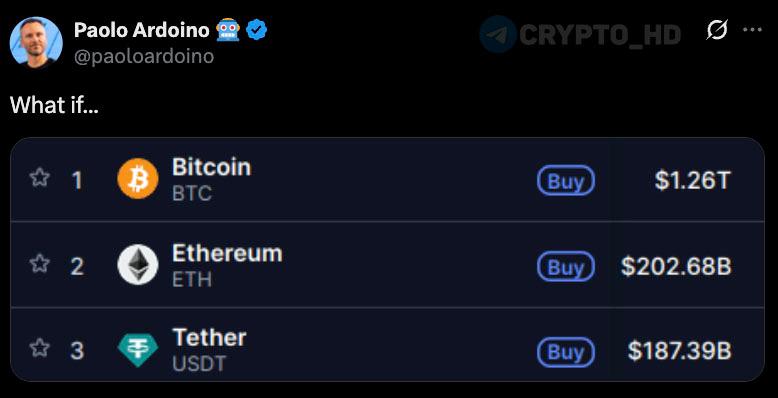
Ardoino is one of crypto’s more visible operators. Before becoming Tether’s CEO, he was CTO at Tether and Bitfinex. Tether issues USDT, the largest stablecoin by circulation, so he is not commenting from the cheap seats. He also did not give a timeline, which matters more than the headline. Most guides flatten this into “Bitcoin will beat gold.” That’s only half right. The real questions are when, at what price, and after what kind of market cycle. Gold is worth many trillions of dollars. Bitcoin wants the store of value crown.
His argument lines up with the macro trade that has helped crypto at several points over the past few years. When central banks fight inflation and move interest rates, some investors look for assets outside the usual system. Why does this matter? Because Bitcoin’s best narrative has always been strongest when trust in fiat, policy makers, or banking rails looks shaky. Bitcoin has long been called “digital gold,” sometimes fairly, sometimes lazily. In late 2021, when inflation fears were running hot, BTC climbed above $60,000 and hit about $69,000 in November 2021. Ardoino is leaning on that same idea: if the macro backdrop stays messy, Bitcoin could keep pulling attention away from gold. Maybe from other safe haven trades too.
Then there is adoption. Gold has centuries behind it. Bitcoin has existed since 2009, which is barely any time for a store of value, but it has moved quickly. El Salvador made BTC legal tender in September 2021, a messy but real sovereign experiment. My take: that experiment gets mocked too easily, but it also should not be treated as proof that sovereign Bitcoin adoption is inevitable. Since then, large financial firms have launched Bitcoin products. Some companies have added BTC to their balance sheets. That does not put gold parity around the corner. I would be careful with that jump. Still, Bitcoin is no longer only a retail speculation story. More institutions now treat it as something they at least need to model.
What this means
Ardoino’s comments show that major crypto insiders still see Bitcoin as a future global store of value, not only a volatile trading asset. No surprise there. But it matters because Tether handles huge stablecoin liquidity and sits near a lot of crypto market flow. Counter to the usual advice, traders should not treat this as a clean buy signal. It is a long term bullish signal for BTC, not a promise that tomorrow’s candle goes green. Bitcoin can still fall hard. It often does. The larger point is colder and more mathematical: if Bitcoin absorbs even a small slice of gold’s market, the valuation math changes quickly.
Watch allocation data, not speeches. Is this overkill? For a market trying to challenge gold, no. The strongest signals would be Bitcoin purchases or new products from sovereign wealth funds and pension funds. Add major corporations and large asset managers to that list. On the chart, BTC’s $70,000 area is still an obvious level, since a clean break above it could put new highs back in play. Yes, this sounds less exciting than the gold-flippening headline. That is the point. Gold matters too. If gold ETFs see steady outflows while spot Bitcoin ETFs take in money during a policy shock or geopolitical scare, Ardoino’s thesis stops sounding like crypto talk and starts showing up in the tape.