
















































Moody’s Puts Credit Ratings on Solana Debt Assets. DeFi Gets a Little Less Murky
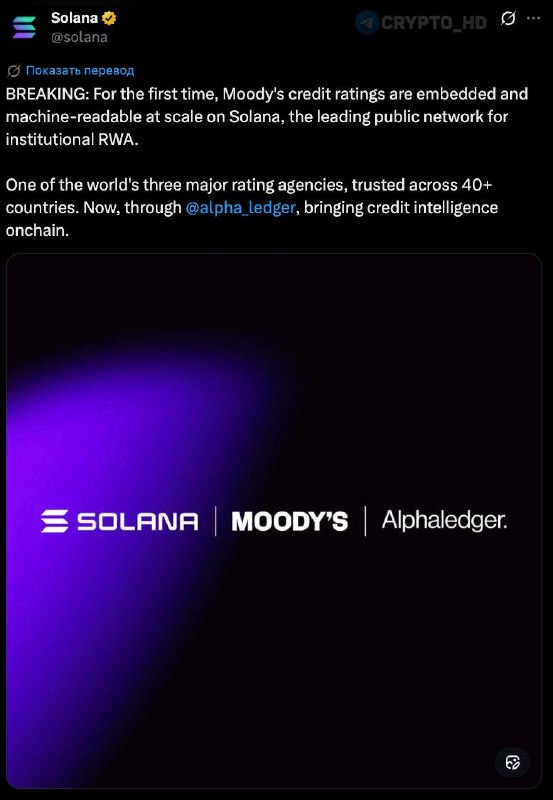
Moody’s is adding credit ratings to tokenized debt assets on Solana through Alphaledger. The pitch is simple: investors get credit risk on chain instead of digging through separate reports or trusting a thin dashboard. Why does this matter? Because institutions already know how to read ratings, even when they do not know what to make of DeFi. My take: that is the real story here. Not maturity theater. Translation.
Moody’s ratings already affect how banks, funds, and large investors judge debt risk. They shape how investors assess bonds and companies. They also influence where large pools of capital are even allowed to go. Most crypto commentary will frame this as Solana becoming more “institutional.” That is only half right. The more useful point is that rated tokenized debt gives compliance teams something familiar to hold onto. It is not flashy. It is plumbing. But finance runs on plumbing. A rated tokenized debt product is easier to explain than an unrated on chain yield product with a slick name, a vague risk page, and a Discord full of confident strangers.
For Solana, this is a real adoption signal, though probably not an instant price catalyst. Moody’s using Solana for this kind of financial data gives the chain more credibility with institutions that still look at crypto sideways. Traditional finance news can move markets: BlackRock’s spot Bitcoin ETF filing helped push BTC from around $25,000 in June 2023 to more than $40,000 by the end of that year. This is not that. I’ll be honest: trading this like an ETF filing would be sloppy. It is quieter, more technical, and probably slower to show up in price. Still, it supports the real world asset case and gives Solana another talking point beyond memecoins, retail trading, and fast block times. SOL rose more than 900% in 2023 as developer interest and ecosystem activity returned. This adds to that story, especially if tokenized debt issuance on Alphaledger becomes real volume rather than press release volume.
The larger effect is on institutional capital, which still hates ambiguity. Large investors manage trillions, and most of them cannot chase yield just because something looks good on chain. They need ratings. They need custody and reporting. They need a memo their risk committee will not tear apart in five minutes. Moody’s on chain ratings solve one part of that problem. Picture a pension fund that can only buy highly rated debt. If tokenized debt on Solana has a Moody’s rating, that fund can at least evaluate it in a format it already knows. Does the money flood in tomorrow? No. The conversation just gets less strange.
Counter to the usual advice, this is not mainly about “bringing Wall Street on chain” in one dramatic leap. It is about removing one objection at a time. Fed rate decisions and inflation prints will still set the tone for Bitcoin and Ethereum, but infrastructure like this changes who can participate when the cycle turns. If rate cuts arrive later in the year and investors start looking for yield again, rated tokenized debt could look more useful than another speculative rotation. Boring wins here.
What this means
Moody’s ratings on Solana move crypto a bit further into institutional finance, especially around real world assets. They give Solana a stronger case as a place for tokenized debt and other financial products that need more than speed and low fees. For investors, the appeal is clearer risk information with possibly less due diligence friction. I would not overstate it, though. A rating does not magically make an asset liquid, safe, or easy to sell in a stressed market. It may bring more attention to Alphaledger, Solana finance apps, and RWA protocols watching from the side. It may also push other Layer 1 chains to chase similar traditional finance integrations. No chain wants institutions to skip it when serious debt products move on chain.
The numbers matter now. Watch how much tokenized debt gets issued on Alphaledger with Moody’s ratings attached. That will say more than the announcement. SOL price action is worth watching too, especially if other financial firms follow with similar integrations. Some technical traders are watching the $120 area, where SOL last traded in early 2024, as a possible sign of stronger demand if price breaks above it. Is this overkill for one ratings integration? For a tiny DeFi app, yes. For tokenized debt aimed at institutions, no. Regulation is the other piece. Any SEC comment, or guidance from another regulator, could change how quickly rated tokenized debt grows. Clear rules could help. A hard line could slow it down.
FAQ
Q: What is Moody’s integrating with Solana?
A: Moody’s is adding credit ratings to tokenized debt assets on Solana through Alphaledger.
Q: Why does this matter for crypto?
A: Investors can see familiar credit risk data on chain, which makes tokenized debt easier to evaluate.
Q: How does this help institutional investors?
A: It gives them a risk framework they already use in traditional debt markets. That could make DeFi less painful for compliance teams.
Q: What does this mean for Solana (SOL)?
A: It gives Solana another institutional use case and could support more developer activity and network usage if demand follows.
Q: What are real world assets in this context?
A: Real world assets are traditional assets, such as debt instruments, represented as tokens on a blockchain.
Q: What is Alphaledger’s role?
A: Alphaledger is the platform bringing Moody’s ratings to tokenized debt assets on Solana.
Q: Will this move SOL’s price like a Bitcoin ETF filing moved BTC?
A: Probably not in the same immediate way. This is more of an infrastructure story than a headline trading event.
Q: What should investors watch now?
A: Watch rated debt volume on Alphaledger, SOL price action, and any regulatory response.
Q: How does this reduce the opacity around digital assets?
A: It puts a familiar credit rating next to tokenized debt, so investors are not relying only on crypto native disclosures.
Q: Could this pull more traditional financial firms toward blockchain?
A: Yes. If it works in practice, other firms may test similar setups instead of leaving tokenized debt to crypto only platforms.