















































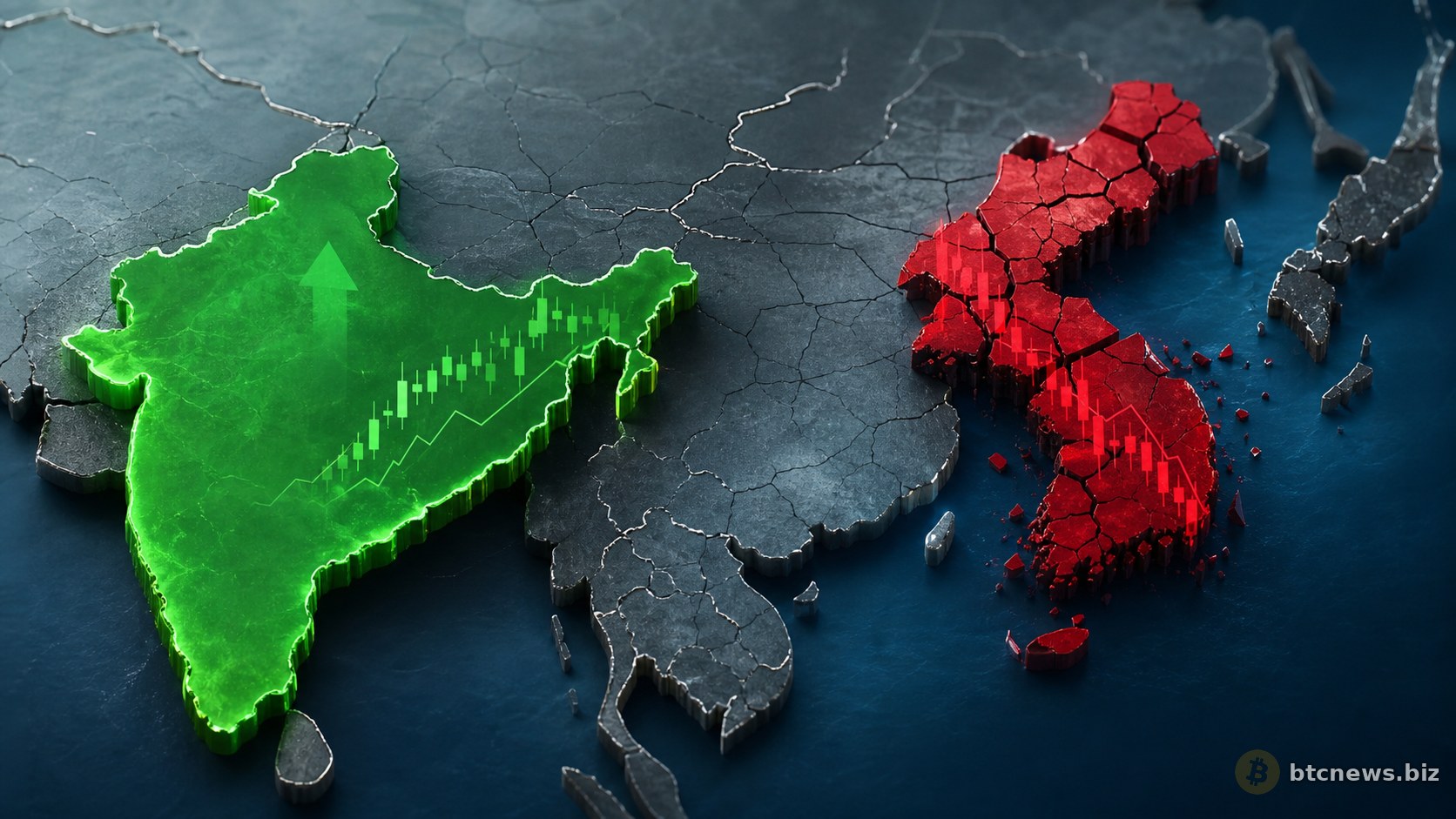
Asia’s crypto map breaks apart as regulation squeezes traders
Asia’s crypto market no longer moves like one regional trade. It has fractured into local fights, each with its own gatekeepers. In the week of July 6, 2026, new token listings in South Korea fell 74% from the week before, India’s $USDT premium climbed to 8.5%, and Taiwan put formal crypto laws on the books. Same asset class. Different rulebooks. My take: the regional story is now mostly a compliance story with price charts attached.

South Korea’s tighter rules are choking off new token listings and shrinking retail access to altcoins. New token listings on South Korean exchanges dropped 74% this week, based on the market data reviewed. That is not background noise. It is the kind of move traders feel almost immediately, especially in a market where altcoin access has long been part of the retail appeal. Local exchanges seem to be stepping back under pressure from regulators and banks. Most guides say regulation simply “reduces risk.” That’s only half right. It also decides which assets ordinary users can even touch. Korea has long had a busy altcoin market, sometimes too busy for comfort, and now the “altcoin casino window,” as some traders call it, is getting smaller. Liquidity and speculation will not disappear. They rarely do. But they may shift to markets with fewer roadblocks. That is the plain effect of regulation pressure: governments are drawing harder lines around crypto, and the riskiest new assets lose easy access first.
India’s $USDT premium shows strong retail demand, even with capital controls and banking friction in the way. India has a different problem, and honestly, it is the more revealing one. The $USDT premium against the rupee reached 8.5%, the highest level in months, according to CoinGecko data. Why does this matter? Because a spread that wide usually means buyers are still showing up while the clean money routes are clogged. Demand exists. Supply limps. Indian exchanges have dealt with banking trouble for years, and the premium shows how much of the market still runs through side channels. Arbitrage looks easy on a chart; it gets ugly when bank transfers slow down or payment access narrows. I would read this as a real adoption signal, though a messy one. People still want crypto, especially stablecoins like $USDT, even when the system makes the trade expensive and annoying.
Taiwan has put formal crypto rules in place, while Binance’s move into the Philippines points to a more regulated kind of expansion. Taiwan’s dedicated crypto law adds another split to the map. The country has moved away from its looser approach and is now setting rules for custody, token issuance, exchange operations, and related services, according to the Financial Supervisory Commission. That removes another possible shelter for offshore platforms that do not want local registration. Counter to the usual advice, “more rules” is not always bad for large exchanges. Sometimes it clears the field for them. In the Philippines, Binance is taking the opposite bet. Its official entry this week gives the world’s largest exchange a direct position in a market with a large retail user base. Binance seems to see more than tolerance in Manila. It sees rules it can work with. Smaller local platforms will feel that quickly. The move could bring more capital and better infrastructure into the Philippine market, but it will also make life harder for domestic exchanges that cannot match Binance on liquidity or product depth.
Russia’s proposed crypto transfer delay could slow liquidity for Asian counterparties that use ruble and $USDT routes. Russia’s proposed 48-hour crypto transfer delay sits outside Asia, but it still matters here. Moscow-linked OTC desks and ruble-to-$USDT routes have served Asian counterparties for years. A two-day delay would hurt traders who rely on speed. Is this an Asia story? Yes, because settlement chains do not care about neat regional labels. Some volume would probably move to non-custodial routes or Asian desks without the same waiting period. Crypto liquidity is global in the most inconvenient way: a rule written in one market can make someone else’s trade worse 3,000 miles away.
Developer activity is still strong across major blockchains, and Asian builders remain part of that work. Under the policy mess, developers are still shipping code. Ethereum, BNB Chain, and Polygon lead global developer activity, with Solana, Cosmos, Avalanche, and other large ecosystems close behind, according to Electric Capital’s Developer Report. That technical layer matters, but I would not overstate it. Code does not automatically become access. Asia-based teams remain active across these networks and often work through short term policy swings. The harder question is whether that code can reach local users without getting stuck in compliance filters. Yes, this slightly contradicts the builder optimism from the first sentence of this paragraph. Bear with me. The Korean listing drop, India’s premium, and Taiwan’s new law all point to the same bottleneck: distribution is now the fight.
What this means
Asia’s crypto market now needs a local reading, because regulation is shaping access and liquidity country by country. The 74% fall in Korean listings is the clearest warning. Domestic oversight is getting tighter. If that continues, new token launches and retail volume may move offshore. That would not destroy liquidity. It would move it away from the regulators trying to contain it. Traders will face more fragmented markets, higher costs on some cross border trades, slower settlement routes, and more local rules to track. India’s 8.5% $USDT premium is another pressure reading. If it stays high, the on-ramp problem is getting worse, despite years of lobbying from the industry. Users may lean harder on peer-to-peer trading and DeFi because the normal banking routes still do not work well enough.
Taiwan’s law and Binance’s Philippine entry are worth watching because they will show which regulated models actually work. Taiwan’s next implementing rules matter more than the headline law. They will decide whether the framework is usable or just another paperwork wall. I’ll be blunt: the difference between those two outcomes can be a few filing requirements, one custody rule, or a registration process that takes months instead of weeks. Binance’s Philippines push is the other test. Can a global exchange operate inside a compliant local structure and still move fast enough for retail traders? Watch Philippine exchange volumes and new listings over the next few months. The old idea that Asia’s crypto markets move together is finished. Traders now have to read each jurisdiction on its own terms, because the spreads, volumes, and available assets are already splitting apart.