















































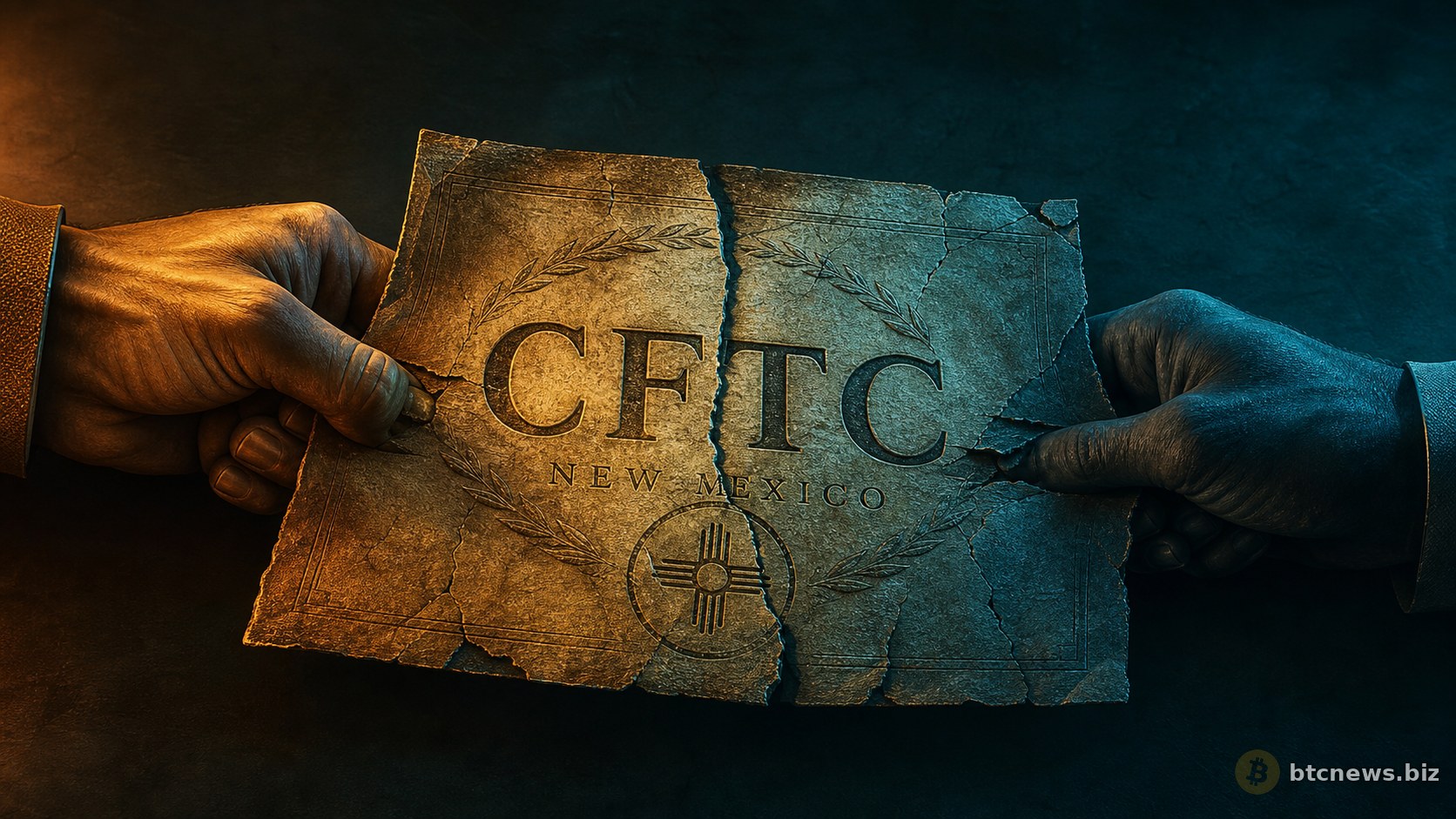
CFTC sues New Mexico as prediction markets become a federal-state fight
The Commodity Futures Trading Commission (CFTC) sued New Mexico on Thursday, June 11, asking a federal court to stop the state from applying gaming laws to federally regulated prediction markets. Dry? Absolutely. But crypto investors have been waiting for Washington to say, plainly, who regulates what. My take: the CFTC is not just cleaning up a legal edge case here. It is trying to claim the ground under event contracts, digital asset derivatives, and the exchanges that list them.

The complaint asks the court for a declaratory judgment saying the CFTC has sole authority over event contracts. It also asks for a permanent injunction blocking New Mexico from using state gaming laws against CFTC registrants. The timing matters. The filing came about a week after New Mexico sued KalshiEX LLC, a CFTC registered exchange, in state court. New Mexico says Kalshi’s sports event contracts amount to illegal online sports betting.
CFTC Chairman Michael S. Selig did not soften the agency’s position. “New Mexico is the latest state seeking to nullify black letter law and decades of judicial precedent by imposing state gaming laws on federally regulated derivatives exchanges subject to the CFTC’s exclusive jurisdiction.” He also said the agency has the expertise and the duty to defend that jurisdiction. I would not read this as a narrow Kalshi dispute. It is also a warning flare for crypto derivatives platforms, including Coinbase (COIN), Binance, and others already stuck between commodities law, securities law, state enforcement, and product risk.
New Mexico Attorney General Raúl Torrez filed the state case on June 4. His office says Kalshi ran an unlicensed sportsbook and let users ages 18 to 20 participate, even though New Mexico’s gaming age is 21. The state wants to block sports related event contracts and treat them as sports wagering under New Mexico law. For crypto firms, the headache is familiar: one product, fifty possible state interpretations. Legal bills start before anyone even knows whether the product is allowed.
The CFTC is leaning on the Commodity Exchange Act. Its argument is blunt: once a market is a designated contract market, states cannot regulate it like a local sportsbook. Most guides frame this as a prediction-market story. That’s only half right. New Mexico is the eighth state pulled into federal litigation over this issue. The CFTC sued Arizona, Connecticut, and Illinois in April, then added New York, Minnesota, Rhode Island, and Wisconsin. This is not a one off dispute. It is a campaign.
Why does this matter? Because crypto still trades on jurisdictional fear as much as product fundamentals. For crypto investors, the live question is which federal agency gets the final say, and how much room states have to push back. That uncertainty reaches spot markets and futures. It can also affect token listings, liquidity, and sometimes prices. I’ll be honest: regulatory headlines still move this market more than they should.
The fight is getting crowded. Former CFTC and SEC Chair Gary Gensler filed an amicus brief this week at the Sixth Circuit arguing that sports prediction markets fall outside CFTC swap rules. That runs against the CFTC’s current position, which makes the whole situation even stranger. The CFTC also published proposed rules on event contracts, including sports contracts. So now there are state lawsuits, federal lawsuits, proposed rules, and a former regulator telling a court the agency may be wrong. We tried to treat this as a clean agency turf fight. It isn’t. The outcome will decide whether these markets follow one federal rulebook or face state gaming enforcement one jurisdiction at a time.
What this means
This case tests how far the CFTC can reach into products that sit near the edge of traditional finance. If the agency wins on federal preemption, crypto derivatives may get a cleaner path. That could help institutional products tied to Bitcoin (BTC), Ethereum (ETH), and possibly other altcoins. Clear rules usually make large investors less nervous. They do not make the market safe. They do remove one big excuse for staying out.
Counter to the usual advice, more federal power is not automatically bullish. It can mean clearer approvals, yes, but it can also mean tighter gates. If New Mexico or the other states gain ground, though, the picture gets worse fast. Exchanges could face state by state compliance, with sports contracts blocked in some places and allowed in others. The same logic could later hit crypto products that resemble prediction markets, gaming, or event based derivatives. That raises costs. It slows launches. It could push smaller firms out before they get a real chance.
Investors should watch the next court rulings and appeals, especially any decision that deals directly with federal preemption. The CFTC’s proposed event contract rules matter too. So do any SEC moves on digital asset derivatives. Is this overkill for one New Mexico lawsuit? No, because the same fight already spans Arizona, Connecticut, Illinois, New York, Minnesota, Rhode Island, and Wisconsin. A clean federal framework could support deeper regulated derivatives markets and help BTC retest levels near its Q4 2021 highs. More confusion could keep BTC below $70,000 for longer, especially if liquidity stays cautious and exchanges hesitate to list new products.