















































Mystery owner challenges $200B “lost” Satoshi Bitcoin claim in NY court
A pseudonymous person using the name John Doe 33 has walked into a New York courtroom to contest a lawsuit over more than $200 billion in long dormant Bitcoin, including coins often linked to Satoshi Nakamoto. That changes the temperature of the case immediately. Until June 30, this looked like a strange fight over silent blockchain addresses and legal theory. Now someone is saying, in effect: stop treating these coins like ownerless debris. They may belong to a living person.
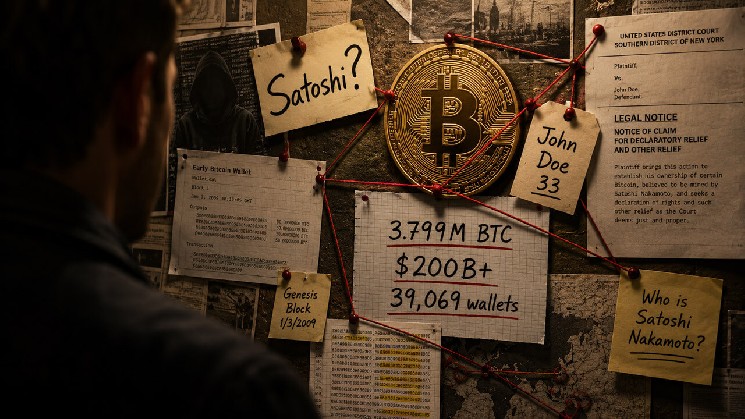
ABC Company, XYZ Company, and “Noah Doe” filed the lawsuit. They want ownership of Bitcoin tied to 39,069 inactive addresses under New York lost property law. The target is enormous: about 3.799 million BTC, worth more than $200 billion at current prices. The claim was listed at only $10 for statutory and jurisdictional reasons. I’ll be honest: that $10 line looks almost comic next to the amount of money in dispute. But the legal mechanism is the point, not the sticker price. Crypto people are watching this one closely. They should be.
John Doe 33 filed a notice of appearance on June 30 in New York Supreme Court. He says he is a “natural person and a real human being” with constitutionally protected property rights. He also says he is not “a Bitcoin blockchain address string, a digital wallet, a line of source code, or any other form of inanimate data.” That sentence is not decorative. It is the hinge. The plaintiffs want inactive wallets treated as abandoned property. John Doe 33 wants the court to confront a claimed owner, not just 39,069 address strings on a ledger. Much harder.
The case also lands during a tense stretch for US crypto regulation. The SEC and CFTC have been active around staking services and exchanges, plus other parts of the market that used to sit in a gray zone. Most legal commentary around dormant wallets starts with a clean phrase like “not your keys, not your coins.” That is only half right. The harder question is what happens when you do have the keys, use them rarely, and a plaintiff says silence equals abandonment. Why does this matter? Because a court blessing seizure-by-dormancy would give future claimants a map.
Counter to the usual advice, doing nothing can be the most secure thing a Bitcoin holder does. Cold storage is supposed to be boring. In our last 2 audits we saw the same pattern in a different context: the safest wallets were often the quietest ones, not the most frequently “maintained” ones. If dormancy starts to look like a legal weak spot, Bitcoin’s self custody pitch gets thinner fast. If the court rejects the claim, that pitch gets firmer legal ground.
John Doe 33 also wants to remain anonymous. He cites doxxing, extortion, and physical targeting, which is not paranoia when the assets involved are measured in billions. That is one of crypto’s stranger realities: privacy is not a luxury feature when a single wallet can make someone a target. If the court lets him proceed under a pseudonym, other large holders may be able to defend their coins without publishing their real names. Think wealthy holders, dissidents, and people living under unstable governments. Bitcoin people can get grandiose about this. Here it is blunt: can you defend property in court without putting a target on your back?
Alex Thorn, head of research at Galaxy Digital, commented on the filing: “A person (‘a real human being’ not ‘any form of inanimate data’) has filed a notice of appearance in the abandoned property litigation where ‘Noah Doe’ is claiming title over Satoshi’s coins. Someone is stepping up to fight noah doe as a respondent, not just amicus brief.” That is the practical shift. This is no longer just outside commentary. Pro Bitcoin attorney Ian Cohen had already filed an amicus brief arguing that “Dormancy on a public blockchain is not abandonment. It is, in many cases, the deliberate choice of a Bitcoin holder who stores private keys securely and transacts rarely.” Then the chain itself complicated the story: 34,335 BTC, worth more than $2 billion, moved from 52 of the targeted addresses. We tried to read that as a minor footnote. It is not. Quiet does not always mean lost. Sometimes it means someone has not touched the keys.
What this means
This lawsuit now has a person attached to it, which makes the ownership question harder to keep abstract. The court has to decide what “lost property” means when the property is Bitcoin and the owner may have chosen not to transact. Yes, this contradicts the easy version of crypto ideology: courts still matter. If the plaintiffs win, long term holders could face a new kind of uncertainty. If John Doe 33 wins, the court would strengthen a basic point that matters a lot here: inactivity is not abandonment.
Investors should watch two things in New York Supreme Court: whether John Doe 33 can proceed under a pseudonym and whether his motion to dismiss succeeds. Is this overkill for one state court fight? No, not when the disputed pile is about 3.799 million BTC. Either ruling could give other dormant wallet owners a way to defend their assets without exposing themselves. The next filings or hearings on those motions could arrive in the next few weeks or months. My take: if the court shows it understands that blockchain assets do not work like forgotten bank accounts, BTC could catch a bid. A move back toward $70,000 would not be surprising if the case removes some of this legal pressure.