
















































Revolut Delists USDT Over MiCA, Raising Pressure on EU Stablecoins
Revolut is dropping USDT for European users on August 31, 2026. The reason is blunt: MiCA rules now apply, and Tether still does not have the authorization Revolut needs. USDT holders have a deadline. USDC, which Revolut treats as authorized, gets the easier route inside the EU. My take: this is less a crypto drama story than a distribution story.
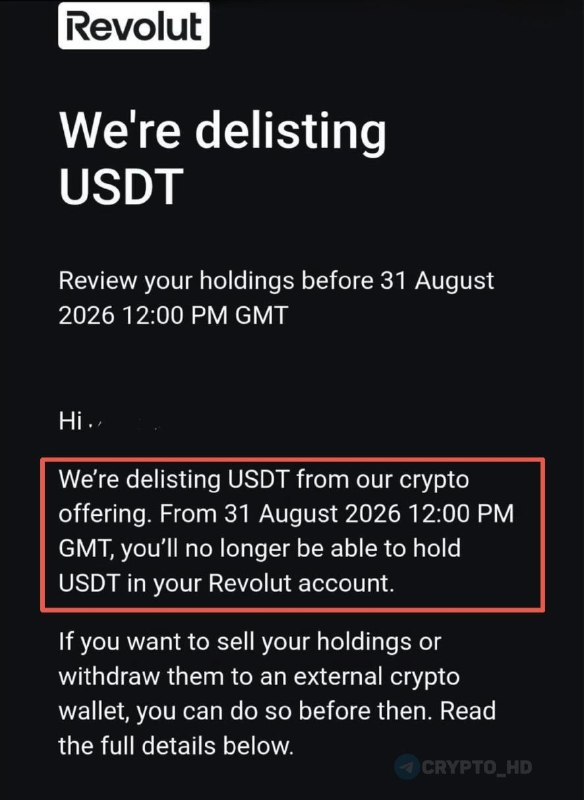
Revolut told users by push notification and email that any USDT left in their accounts after August 31, 2026 will be converted to fiat at the market rate. There is not much ambiguity in that. Tether has not secured MiCA authorization. USDC has. Revolut has removed assets for compliance reasons before, so the logic is familiar: no license, no listing. Simple. Bybit, meanwhile, seems to be taking a different route through the same rules. Counter to the usual advice, the interesting part is not only what Tether does next; it is what regulated apps decide they can no longer carry.
This adds pressure to the regulation pressure already building around crypto in Europe. MiCA, short for Markets in Crypto-Assets, is the EU rulebook for digital assets, stablecoins included. For stablecoin issuers, it covers reserves and reporting. It also covers transparency and operational resilience. Dry material, yes, but it decides what people can actually trade. Why does this matter? Because if USDT stays outside MiCA while USDC stays inside it, Europe could end up with two stablecoin markets. Traders who rely on USDT for liquidity or certain pairs may have to move to USDC or another approved option. That can move volumes, spreads, and arbitrage. Regulation changes markets. The US showed that when spot Bitcoin ETFs were approved in early 2024 and BTC pushed past $45,000.
The Revolut move is also an adoption signal, though I would not overstate it. I will be honest: one delisting does not crown USDC king of Europe. Still, this is one large fintech deciding that compliance matters more than supporting the stablecoin with the longest market history. Revolut has millions of users across Europe, so this is not a tiny exchange tidying up an old token list. If an issuer cannot meet the rules, it can get pushed out of regulated apps, even when traders still prefer it elsewhere. USDC may benefit from that, especially among banks and fintechs. Payment firms too, if they want fewer regulator conversations. We have seen versions of this before. PayPal adding crypto in 2020 helped Bitcoin feel more mainstream before its move toward $20,000. China banning crypto mining in 2021 cut the other way, with BTC falling below $30,000.
What this means
Revolut’s USDT delisting says the quiet part out loud: crypto products in Europe now need paperwork, not just demand. Most guides frame MiCA as a compliance checklist. That is only half right. MiCA is already changing what apps like Revolut can offer, which gives authorized assets like USDC an edge over assets that have not cleared the same bar. It may also split stablecoin liquidity. European users could lean toward USDC, while USDT stays stronger in markets with looser rules. Is this overkill for one app? No, because Revolut is a consumer gateway, not an obscure offshore venue. For investors, the practical question is simple. Where do you trade, and which stablecoins will still be available there? Revolut users holding USDT have until August 31, 2026 to convert it or move it somewhere else.
The next thing to watch is whether other European exchanges and fintechs make the same call. One delisting is news. Several delistings start to look like market structure. Watch the volumes. The Revolut-style EU platforms matter most, especially those serving retail users through regulated entities. Tether’s next statements matter too. Yes, that sounds like it contradicts the point above about platforms driving the story, but it does not. If Tether makes progress on MiCA authorization, the story changes fast. If it does not, USDT may keep losing ground in Europe even if it remains dominant globally. The cleanest data point will be boring but useful: USDC and USDT trading volume inside European markets over the next few months.
FAQ
What is MiCA?
MiCA, or Markets in Crypto-Assets, is the European Union’s rulebook for digital assets, including stablecoins.
Why is Revolut delisting USDT?
Revolut is delisting USDT because Tether, the company behind USDT, has not secured the MiCA authorization required under EU rules.
When will USDT be delisted from Revolut?
USDT will be delisted from Revolut on August 31, 2026.
What will happen to my USDT on Revolut after the deadline?
After August 31, 2026, Revolut will convert any remaining USDT balance to fiat currency at the market rate.
Which stablecoins are MiCA-compliant?
Based on Revolut’s move, USDC has secured MiCA authorization and is being treated as compliant in the EU.
Will other exchanges delist USDT due to MiCA?
Other European fintechs and crypto platforms may follow Revolut, but each platform will make and announce its own decision.
How does this affect crypto investors in the EU?
EU investors may have fewer places to use USDT and may need to shift some trading or liquidity activity to USDC or another MiCA approved stablecoin.
Is this Revolut’s first regulatory driven delisting?
No. Revolut has removed assets for regulatory reasons before, so this fits its usual compliance approach.
What should USDT holders on Revolut do?
USDT holders on Revolut should convert or move their USDT before August 31, 2026 if they want to avoid automatic conversion to fiat.
Will Tether seek MiCA authorization?
Tether’s position on MiCA authorization is still worth watching. Real progress could change how exchanges and fintechs treat USDT in Europe.