
















































Michael Burry’s Stock Market Crash Prediction: What It Means for Crypto
Michael Burry, the investor who saw the 2008 mortgage crisis coming, is betting against the US stock market rally again. His warning is blunt: A crash like the one in 1987 may be ahead. Expensive AI stocks are only part of the problem. In my view, the more unsettling piece is automated trading, which Burry believes could turn a routine decline into a frantic search for cash. That matters. Money would drain from crypto, putting Bitcoin’s (BTC) reputation as a safe haven through a serious test.
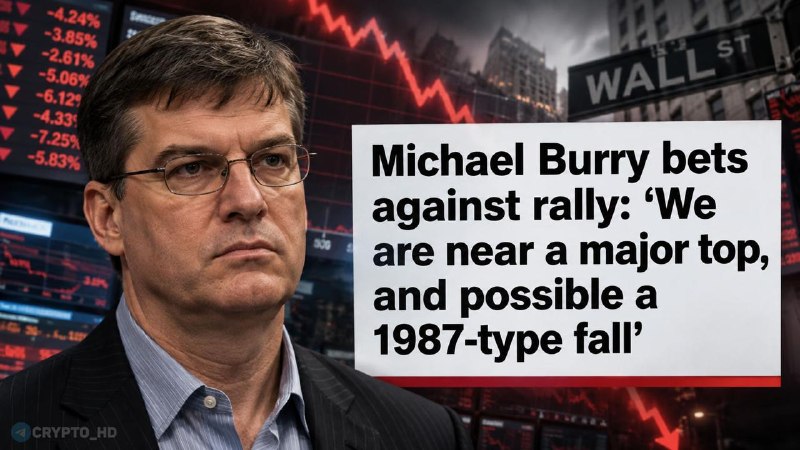
Burry is watching funds that adjust their stock exposure based on market volatility. These funds control roughly $500 billion. Calm market? They take more risk. Once prices begin swinging, they cut back. Burry says a 2.5% fall in the S&P 500 could shrink their equity allocation from 77% to around 50%. Why does that matter? Because the adjustment could unleash forced selling: Lower prices push volatility higher, more shares get sold, and stop-loss orders begin firing. Most explanations frame this as a simple feedback loop. That’s only half right; speed is the real danger. A similar cycle fed the “Black Monday” crash on October 19, 1987, when the Dow Jones plunged 22.6% in a single session. It is still the index’s biggest one-day percentage loss. Burry’s successful 2008 trade inspired “The Big Short,” and he has since bet against AI stocks. I’ll be honest: Calling out an overheated trade is familiar territory for him, but being early can look exactly like being wrong.
Crypto would probably get caught in the sell-off. No mystery there. During a severe cash shortage, investors often sell anything they can, even assets they intended to keep for years. March 2020 offered a concrete preview: As panic over COVID-19 spread, BTC dropped more than 50% in a matter of days, falling from about $9,100 to $4,500. It did not look much like digital shelter then. Counter to the usual bullish argument, Bitcoin’s larger market today does not make it immune. A sudden stock crash could still drag BTC lower and punish altcoins such as Ethereum (ETH) even more. Investors would likely reach for cash first. Questions come later. And what happens afterward is more revealing: Does money flow back into Bitcoin? Can BTC quit behaving like a risky technology stock when markets turn nasty?
A crash would put Bitcoin’s safe-haven pitch through a real stress test. During a panic like “Black Monday,” investors could eventually search outside the stock market for assets that move independently. Gold has done that job for decades. Bitcoin is often called “digital gold,” but I am not convinced the comparison has been settled. Consider one specific episode: After the January 2020 strike that killed Iranian general Qassem Soleimani, BTC gained 8% within 72 hours. That suggests geopolitical fear can draw buyers to it. A computer-driven stock sell-off is different. Yes, that complicates the safe-haven argument — bear with me. Bitcoin could tumble during the initial scramble for cash, then recover if instability continues and faith in conventional markets starts to crack. My take: The second move matters more than the first. Keep an eye on $61.4K. If BTC holds that price, or retakes it quickly while stocks keep falling, dismissing its safe-haven case becomes more difficult.
What this means
Burry’s warning matters to crypto investors because forced stock sales seldom remain confined to stocks. A steep correction could lead investors to reduce positions across several markets. BTC and ETH would probably be sold first as funds try to raise cash. Is that the end of the safe-haven thesis? No. If the strain on stocks continues, people looking for another place to keep their money may reconsider Bitcoin. It could happen. There is no guarantee. In fact, most guides jump too quickly from “stocks fall” to “Bitcoin wins.” That leap is premature. Bitcoin still needs to show that it can separate from other risky assets when markets are under pressure.
Start with the S&P 500. A lasting decline of at least 2.5% could trigger the automated sales Burry described. Then watch BTC around $61.4K. If it rebounds quickly while stocks continue to slide, that would suggest some buyers view Bitcoin as protection instead of one more position to unload. I would treat that divergence as a stronger signal than a brief price spike. Comments from the Federal Reserve and FOMC could change the picture too. Emergency support or a shift in expected policy might steady markets and free up cash. Crypto prices could move within hours.
FAQ
What is Michael Burry’s current prediction?
Burry says the stock market could suffer a crash similar to 1987 if volatility-targeting funds automatically sell shares as prices fall. The mechanism matters more than the headline.
What are volatility-targeting funds?
These funds adjust how much stock they own based on market volatility. They tend to take more risk when markets are calm. Once trading becomes rough, they reduce their holdings.
How could a stock market crash impact Bitcoin (BTC)?
BTC could initially fall as investors sell assets to raise cash. If problems in traditional markets persist, some investors may later buy Bitcoin as a hedge. My read: That later response would be the real test.
What is the “1987-style” crash Burry refers to?
Burry means “Black Monday,” October 19, 1987. The Dow Jones Industrial Average fell 22.6% that day, with automated sales speeding up the collapse.
Why does the $61.4K support level matter for BTC?
Market analysts consider $61.4K an important support area. If Bitcoin holds there during a stock sell-off, it would show that buyers are still prepared to step in when conditions worsen. Simple level. Serious signal.
Has Michael Burry predicted market crashes before?
Yes. Burry anticipated the 2008 mortgage crisis and made money by betting against subprime mortgages. “The Big Short” later portrayed his trade.
How much capital do volatility-targeting funds control?
Burry estimates that volatility-targeting funds manage about $500 billion in assets.
What S&P 500 decline could trigger automated selling?
Burry says a 2.5% decline could force volatility-targeting funds to cut their equity allocation from 77% to roughly 50%. That is not a marginal adjustment.
Could a stock market crash benefit gold?
Yes. Gold has often drawn buyers when stock markets are under strain because many investors use it to preserve value. Still, “stocks down, gold up” is not an automatic rule.
What is Bitcoin’s “safe-haven narrative”?
It is the idea that Bitcoin can hold its value during economic or financial turmoil, much as gold sometimes does. Its record is mixed. So is the label justified? Not yet — another major crash would give that claim a tough test.