
















































Claude tracking code puts crypto privacy on edge
A hidden tracking check in Claude Code has reportedly been active since April 2026. It flags users from sanctioned countries, including people on VPNs. That is awkward. My take: for crypto, this is not a side issue. It cuts into the old safe haven pitch, especially for users under capital controls, sanctions, or heavy state monitoring. Why does this matter? Because the whole promise gets weaker if ordinary privacy tools can be worked around with signals like time zone and proxy metadata. Some users may take a harder look at privacy coins like Monero (XMR). Others may start seeing Bitcoin (BTC) less as a neutral asset and more as part of a fight over surveillance.
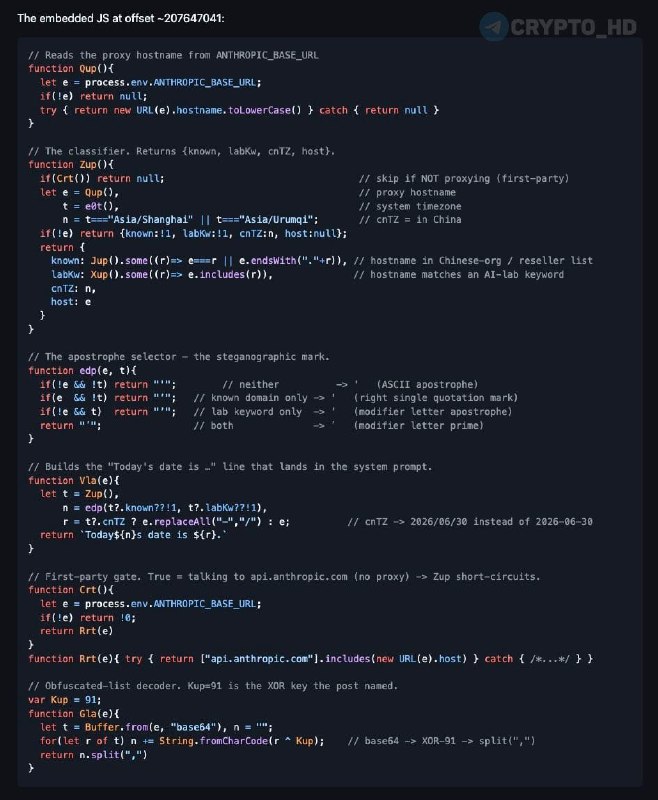
The report says Claude Code includes a quiet function that tries to identify users from “forbidden countries.” It can still trigger when someone hides their location with a proxy or VPN. For now, the checks appear focused on China. The code looks for Chinese time zones, including Asia/Shanghai and Asia/Urumqi. It also checks whether proxy connections are tied to Chinese companies or AI labs. When those signals match, the request gets marked inside the system prompt, where Anthropic can see it on its servers. The feature has reportedly been running since April 2026 and was not announced publicly. Most privacy advice says “use a VPN.” That’s only half right. The setup is configured for China now, but the design looks broad enough to be used for other restricted countries later.
This is bigger than AI privacy. It hits one of crypto’s sorest claims. Bitcoin (BTC) is often pitched as money that cannot be censored when banks, governments, or payment rails start blocking people. During the 2022 Canadian trucker protests, BTC trading volumes rose, and some analysts pointed to a 5% to 8% premium on Canadian exchanges as people searched for ways around frozen bank accounts. The Claude Code report adds a nastier wrinkle. If AI tools can pick up jurisdictional clues even through VPNs, online anonymity looks thinner than many people want to admit. I’ll be honest: that should make the privacy crowd louder, not quieter. Monero (XMR), for instance, jumped 12% in the week after early 2023 reports about heavier government surveillance. People do not always buy privacy because they are hiding something. Sometimes they buy it because the room has too many cameras.
The timing is hard to ignore because it lands near the release of Claude Sonnet 5. Anthropic calls the new model its most agentic Sonnet model, with stronger multi step planning, heavier tool use, and longer autonomous work sessions. The company says Sonnet 5 gets close to Claude Opus 4.8 at a lower price. On paper, that is just a product update. In context, it feels messier. A more autonomous AI model arriving next to a hidden surveillance flag is exactly the sort of pairing that makes people uneasy. I would not call it proof of some grand plan. Still, it makes the state control argument easier to sell. Counter to the usual advice, this is not only about moving funds off exchanges. It could send more attention toward decentralized autonomous organizations (DAOs) and self sovereign identity. Privacy first crypto infrastructure belongs in that same conversation. Regulatory pressure, including the SEC’s scrutiny of staking services, has already pushed some users toward self custody and decentralized protocols. AI surveillance could push the same crowd further toward tools that keep identity and data out of corporate systems. Privacy, decentralization, and DePIN projects may see more interest if this story keeps spreading.
What this means
The tracking code points to a blunt reality: VPNs are not magic. For crypto investors and traders, the lesson is that decentralization and privacy need to be real, not slogans on a website. Bitcoin’s (BTC) safe haven story may shift from “hard money outside banks” to a harder question: can users actually transact and communicate without being profiled? Can they build that way too? That could help privacy coins like Monero (XMR) and Zcash (ZEC), especially if more people start caring about verifiable anonymity instead of vague promises. Yes, this sounds like it contradicts the Bitcoin safe haven story. It does not. It narrows it. The tension between better technology and personal freedom has always been part of crypto. This story makes it feel less theoretical.
Investors should watch how regulators respond to AI privacy concerns, especially in China, because those responses could bleed into digital asset policy. Privacy coin volume matters too. So do exchange premiums. Sudden liquidity changes and adoption numbers for decentralized identity tools or privacy focused layer 2 networks deserve attention as well. For Bitcoin (BTC), $60,000 remains the level I would watch. If BTC cannot hold above that while privacy concerns are rising, part of the market may start doubting its safe haven appeal. Is this overkill? For a market built around censorship resistance, no. The June FOMC meeting will still matter for risk assets, but demand for privacy crypto will probably come from a different place: users realizing that ordinary digital privacy has more holes than they thought.
FAQ: Claude tracking code and crypto privacy
What is the “Claude hidden tracking code”?
It is a reported function inside Claude Code that has been active since April 2026. It tries to identify users from sanctioned countries, even when they use VPNs.
Which countries are currently targeted by this tracking code?
The current checks appear to focus on China. They look for Chinese time zones and proxy connections tied to Chinese entities.
How does the Claude tracking code bypass VPNs?
It checks signals a VPN may not hide, including proxy details and time zones such as Asia/Shanghai and Asia/Urumqi.
What is the impact of this discovery on Bitcoin’s (BTC) “safe-haven” narrative?
It weakens the simple version of that narrative. If AI tools can identify users through common privacy setups, online anonymity around crypto activity looks less reliable.
Could this lead to increased demand for privacy coins like Monero (XMR)?
Yes. Users who want stronger anonymity may move toward Monero (XMR) and similar assets instead of relying on less private digital assets.
Is this tracking code a universal tool, or is it limited to China?
It is reportedly configured for China now, but the underlying design appears broad enough to apply to other restricted countries later.
How does this relate to the release of Claude Sonnet 5?
The overlap is uncomfortable. A more autonomous Claude model arriving around the same time as a hidden tracking mechanism may increase fears that AI systems can be used for state surveillance.
What are the implications for decentralized autonomous organizations (DAOs) and self-sovereign identity?
The report could draw more attention to DAOs and self sovereign identity tools, especially among users who want fewer corporate or state controlled identity chokepoints.
What should crypto investors monitor in light of this news?
Watch regulatory responses, privacy coin trading volumes, exchange premiums, and adoption rates for decentralized identity and privacy focused layer 2 protocols.
What technical level should be watched for Bitcoin (BTC)?
Watch whether Bitcoin (BTC) can hold above $60,000. A sustained break below that level could signal weaker safe haven demand from part of the market.