
















































Vietnam crypto regulation 2026 targets Q3 launch as digital economy push accelerates
Vietnam will open its regulated cryptocurrency market in Q3 2026, becoming the next major Southeast Asian economy to license domestic crypto exchanges. The country’s deputy finance minister said this week that the first official operations with crypto assets could start within months. I’ll be honest: Hanoi is moving faster than most Asia-Pacific desks I speak with seemed to expect even six weeks ago. If you track regional flows, this is no longer a 2030 story. It is a Q3 2026 story.
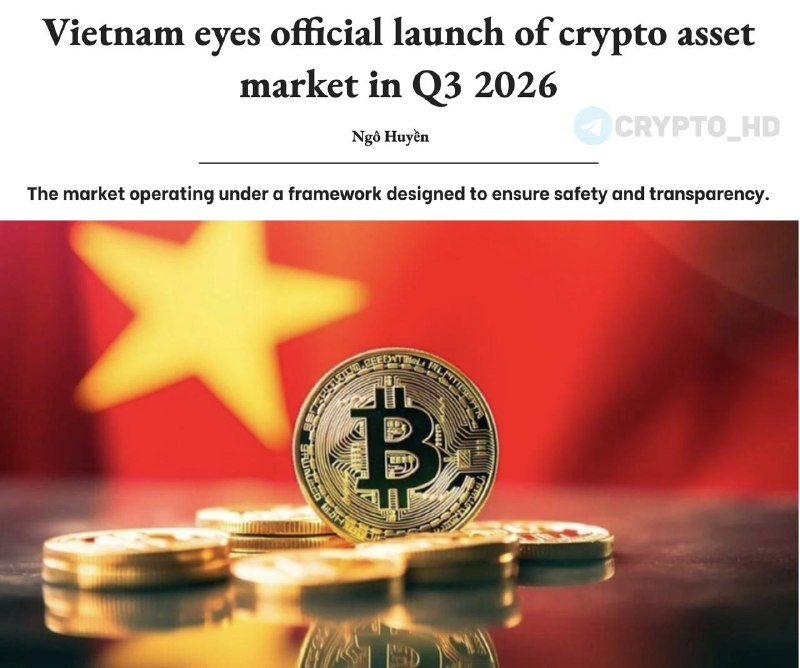
The announcement is not floating by itself. Vietnam’s national digital transformation strategy targets a digital economy of no less than 30% of GDP by 2030, and crypto licensing now looks like one of the structural beams under that target. The sequence matters: a ban on foreign exchanges operating without permission, then a dedicated tax regime for crypto activity, then legal scaffolding for domestic exchange licenses. Most guides treat licensing as the beginning. That’s only half right. Q3 2026 is the switch-on date. The runway was already poured.
Vietnam ranks in the global top five countries for grassroots crypto adoption. The Chainalysis Global Crypto Adoption Index has put it there year after year, even while the country sat in a legal grey zone. That is the uncomfortable part for regulators: the market already exists. A licensed structure simply drags informal volume into measurable on-chain and exchange flow. My take: BTC and ETH spot pairs in VND are the obvious first winners, while Coinbase (COIN) and other listed operators scan for partnership angles. Nearly 100 million people, top-five grassroots adoption, and VND rails moving from tolerated to taxed-and-licensed. That is not a footnote.
The regulation-pressure angle cuts in both directions. Binance, OKX, and Bybit cannot just keep treating Vietnam as an open inbound market if the ban on unlicensed foreign exchanges is enforced. They need a local entity, a Vietnamese partner, or some other compliant route. The tax regime will annoy casual traders. No mystery there. But it also gives funds and corporates a path they previously lacked. Smaller retail edge, bigger institutional pipe.
Four of the top six Asian crypto markets will operate under formal regulatory regimes by year-end 2026. Hong Kong already licenses spot BTC and ETH ETFs. Singapore tightened retail access while keeping the institutional channel open. Thailand approved its first spot Bitcoin ETF in 2025, according to the Thai Securities and Exchange Commission. Japan continues refining its stablecoin framework under the Financial Services Agency. Counter to the usual advice, Vietnam is not just “catching up” here. It may be arriving at the exact point when regional licensing starts to matter more than raw adoption rankings.
The 30%-of-GDP digital economy target should anchor the forward read. Hanoi is not flirting with crypto as a sandbox hobby. It is wiring digital assets into the same national push that covers fintech, e-commerce, and AI infrastructure. Why does this matter? Because state-level commitment tends to pull in the boring money first: exchanges looking at regional HQs, custodians hiring compliance teams, stablecoin issuers trying to court local banking partners. The first metric I would watch is simple: USDT and USDC volume in VND pairs after licensed venues open their books.
Timing is the sharp edge. Q3 2026 starts in roughly two months. The deputy minister’s “next few months” framing leaves room for licenses to land before the quarter is fully underway. Yes, this sounds like splitting hairs. It is not. That window overlaps with the post-halving liquidity cycle and what most desks expect to be a softer Federal Reserve stance into late 2026. A new licensed market opening into that backdrop can get priced quietly, then suddenly.
What this means
Vietnam’s licensed crypto market is an adoption-signal trade, not a macro one. Licensing exchanges in Q3 2026 adds a measurable demand layer to BTC and ETH. Not vibes. Compliant volume that institutional desks can actually underwrite. The directly exposed names are the global exchange operators: Binance, OKX, Bybit, and potentially Coinbase (COIN) if it finds the right partnership route. Tether and Circle will compete for the on-ramp role. Whoever owns VND liquidity owns the next 12 months of Vietnamese order flow.
Watch two markers first, then a third if the launch gets messy. The official licensing list will show which global players cut deals and which ones got shut out. VND-pair volume in the first 30 days will test the adoption thesis; anything above $100M daily would be hard to dismiss. Is that threshold too high? For a top-five grassroots market moving into licensed rails, no. Then watch the FATF and IMF response, because Vietnam’s framework still has to survive international AML scrutiny. If those pieces line up cleanly, Vietnam becomes the ASEAN template. That is where the bigger trade lives.