
















































US Strike Plans on Iran Could Test Bitcoin Safe-Haven Trade Within Days
The “Iran strike crypto market impact” refers to the price reaction across Bitcoin, Ethereum, spot Bitcoin ETFs, and crypto-linked equities when US or Israeli military action against Iran shifts global risk appetite, oil prices, and safe-haven demand. Israeli media reports that Washington is weighing a return to military strikes on Iran if next week’s talks collapse. That single line is enough to put the Iran strike crypto market impact thesis back on every trading desk’s whiteboard. Bitcoin has spent two years building a reputation as a digital safe haven during Middle East flare-ups, and the next 7 to 10 days will show whether that reputation holds when the headlines actually break. Traders who lived through January 2020 already know the muscle memory. Iran headline drops, BTC catches a bid, gold catches a bid, equities wobble. The pattern is so familiar at this point that it feels almost like a fire drill — the alarm rings, everyone walks to the same exit.
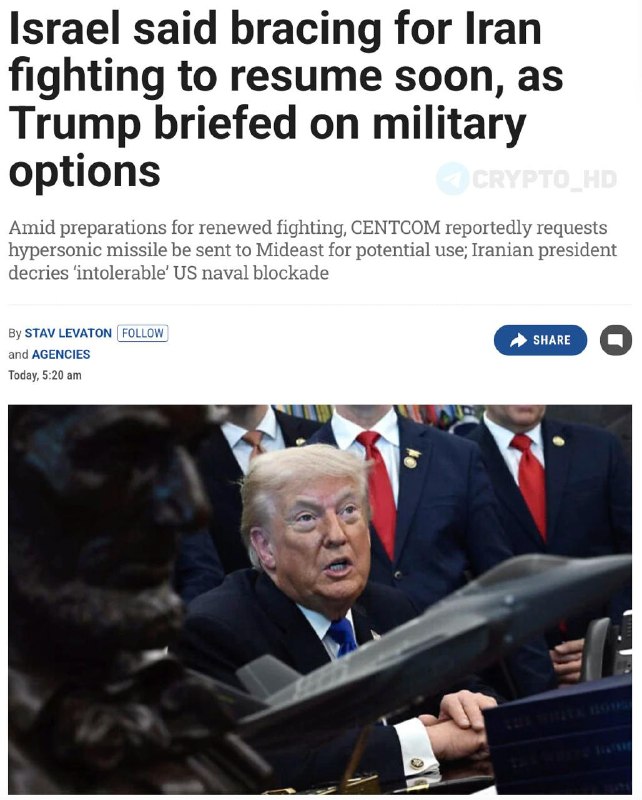
According to Israel’s Channel 12, cited by multiple Israeli outlets, US President Donald Trump has been briefed on fresh operational plans for strikes on Iran. The reported target list is not symbolic. It includes:
- Iranian energy infrastructure
- Gas processing facilities
- Iranian state assets
According to the same Israeli sources, Washington is also considering tightening pressure around the Strait of Hormuz, where a blockade is already in place. Israel itself is on heightened alert and is actively preparing for a possible resumption of hostilities should the US-Iran negotiations scheduled for early next week fall apart.
That is the entire factual base. No confirmed casualty count. No announced strike date. No on-the-record presidential decision. Markets, though, do not wait for confirmation — they price the tail. And the tail here is unusually fat. Energy infrastructure plus the Strait of Hormuz is the exact combination that historically moves oil first and risk assets second. According to the US Energy Information Administration, roughly 20% of global oil consumption transits the Strait of Hormuz daily. Think of Hormuz as the kitchen door of a restaurant that feeds a fifth of the planet. Block it for a few hours and dinner is late. Block it for a week and the whole menu changes. A serious disruption there is not a Bitcoin story, it is a macro story that drags Bitcoin along for the ride.
Here is the crypto angle most desks will run first: the Bitcoin safe-haven trade describes the recurring pattern in which BTC rises during the initial 24-72 hours of a Middle East geopolitical shock, behaving more like gold than like a Nasdaq tech proxy. During the January 2020 Soleimani strike, BTC ripped roughly 8% in 72 hours while the S&P 500 bled. After the April 2024 Iran-Israel direct exchange, BTC chopped sideways but gold broke out, and the correlation between BTC and gold tightened for weeks afterward. The pattern is not mechanical, but it has shown up enough times that it is now a standing playbook. If the strike happens during US hours with a clean energy-infrastructure target, expect BTC to test the upper end of its current range on the initial knee-jerk, with ETH lagging by 1 to 2 hours as it usually does on macro shocks.
The second angle is macro flow, and it cuts the other way. A real shooting war pushes oil up. Oil pushes headline inflation up. A Fed already in a slow-cut posture gets boxed in. That is bearish for the long end of risk assets — including the part of crypto that trades like a Nasdaq beta, which on a bad week is most of crypto outside BTC. COIN, MSTR, and the miner basket would feel that pressure first, because those are the names hedge funds short when they want crypto exposure without touching spot. Watch the BTC-Nasdaq 30-day correlation. If it stays above 0.5 into the weekend, the safe-haven narrative is fighting the risk-off narrative, and BTC ends up doing very little while alts get sold. It is the trading equivalent of two people pulling on the same rope from opposite ends — the rope barely moves, but everyone gets tired.
Spot Bitcoin ETF daily flows are the fastest-moving institutional signal of safe-haven demand currently available, with creation and redemption data published the same trading session. No surprise, then, that the spot Bitcoin ETF complex becomes the cleanest read. On the Soleimani week in 2020 there were no spot ETFs. Today there are eleven, with BlackRock’s IBIT and Fidelity’s FBTC absorbing the bulk of net creates, according to issuer disclosures and Farside Investors flow data. A geopolitical bid shows up as same-day net inflows, usually concentrated in IBIT, with the rest of the complex following a session later. If talks collapse and the headline hits during US trading hours, the Friday flow print is the tell. Anything north of $300 million in net creates on a single day, against a falling equity tape, is the market voting for the safe-haven thesis with real money.
That said, the Strait of Hormuz piece complicates the clean version of this trade. A blockade tightening is not a one-day event. It bleeds into shipping insurance rates, tanker routing, and eventually into US gasoline prices at the pump. Crypto’s reaction function to slow-burn oil shocks is messier than its reaction to a single dramatic strike. In 2022, when Brent crude ran from roughly $80 to $130 on the Russia-Ukraine shock, BTC initially popped on the safe-haven story, then sold off hard for three months as the Federal Reserve tightened into the inflation print. That is the bear case for anyone trying to position long here purely on geopolitics. Wars that print on the inflation line eventually print on the rates line, and rates are still the gravity that crypto fights.
There is a third angle worth flagging, even though it is quieter. Sanctions regimes that target Iran historically push some flow into stablecoins and into OTC venues that route around the dollar system. According to on-chain analytics from providers including Chainalysis and TRM Labs, USDT volume on the Tron network has spiked during every prior round of Iran sanctions tightening in the last three years. That is not a directional BTC trade, but it is a structural one for the stablecoin issuers and for the on-chain volume narrative that ETH bulls lean on. If Hormuz pressure escalates into broader secondary sanctions, expect another leg of stablecoin float growth, and expect the regulators in Washington to notice.
Worth noting what is not in the source. There is no confirmed strike date. There is no quoted US official on the record. According to Channel 12’s own framing, the report describes plans being briefed, not orders being issued. Markets that front-run unconfirmed reports tend to give back the move when the timeline slips. Anyone treating next week as a binary should size accordingly, because the most likely path is still messy diplomacy that drags into the following month, not a clean Friday-night strike.
What this means
For crypto markets, a US return to strikes on Iran would re-test Bitcoin’s role as a 24/7, non-sovereign hedge while pressuring high-beta crypto equities through a parallel rate-and-oil channel. The signal here is that the Middle East risk premium is back on the board, and Bitcoin will be tested again as a portable, 24/7, non-sovereign hedge. The honest read is that BTC’s safe-haven status is real but conditional. It works on day one and day two of a shock. It struggles on week three when oil-driven inflation feeds back into rate expectations. Treat it less like an umbrella you keep open all day and more like the one you grab on the way out the door — useful at the moment of the storm, less so when the rain turns into a flood that lasts a season.
The tickers most exposed by scenario break down as follows:
- Clean upside scenario (safe-haven bid): BTC spot, IBIT, FBTC, and gold-correlated names.
- Downside scenario (risk-off, rates pressure): COIN, MSTR, MARA, RIOT — the high-beta crypto equities, sold as a basket when the Nasdaq de-risks.
- Lagging tell: ETH, which sits in the middle and usually moves second.
Watch three things into next week:
- The US-Iran talks scheduled for early in the week. A confirmed breakdown is the trigger; a delay is the fade.
- Spot Bitcoin ETF daily flows on the first trading day after any escalation headline. Sustained net creates above $300 million per day is the institutional vote for the safe-haven trade.
- Brent crude and the BTC-gold 30-day correlation. If Brent breaks above $95 and BTC-gold correlation pushes above 0.4, the macro setup that worked in early 2020 is rebuilding in real time. If Brent runs but BTC-gold stays loose, the trade is broken and BTC is back to being a Nasdaq cousin, which means the next leg is decided by the FOMC calendar, not by Tehran.
Frequently Asked Questions
What is the “Iran strike crypto market impact” thesis?
It is the framework that links US or Israeli military action against Iran to specific crypto price moves through three channels: a Bitcoin safe-haven bid, an oil-driven inflation hit to rate-sensitive risk assets, and stablecoin flow shifts under tightening sanctions.
Does Bitcoin actually act as a safe haven during Middle East conflicts?
Conditionally, yes. According to historical price data, BTC rallied roughly 8% in 72 hours after the January 2020 Soleimani strike and tightened its correlation with gold after the April 2024 Iran-Israel exchange. The safe-haven bid typically fades by week three, though, when oil-driven inflation re-prices Fed expectations.
What did Israel’s Channel 12 actually report?
According to Channel 12, cited by multiple Israeli outlets, President Trump has been briefed on operational plans targeting Iranian energy infrastructure, gas facilities, and state assets, with additional pressure considered around the Strait of Hormuz. The report describes plans being briefed, not orders being issued.
Why does the Strait of Hormuz matter for Bitcoin?
According to the US Energy Information Administration, roughly 20% of global oil transits the Strait of Hormuz. A disruption there pushes Brent crude higher, feeds into headline inflation, and ultimately pressures the rate-sensitive part of crypto — which is most assets outside BTC.
Which crypto-linked tickers are most exposed if strikes occur?
BTC spot, IBIT, and FBTC are most exposed to the upside safe-haven scenario. COIN, MSTR, MARA, and RIOT are most exposed to the downside risk-off scenario, because they trade as a high-beta basket alongside the Nasdaq.
What spot Bitcoin ETF flow signal should traders watch?
Sustained daily net inflows above $300 million across the spot Bitcoin ETF complex — concentrated in IBIT and FBTC — against a falling equity tape would confirm the institutional safe-haven bid. Anything below that, with negative equity action, suggests risk-off is winning.
What happens to stablecoins during Iran sanctions tightening?
According to on-chain analytics providers including Chainalysis, USDT volume on the Tron network has expanded during every prior round of Iran sanctions tightening in the last three years. A new escalation would likely repeat that pattern and draw further regulatory attention in Washington.
What is the bear case for going long crypto on this geopolitical setup?
A prolonged oil shock pushes inflation higher, which boxes in a slow-cutting Fed and lifts real rates — the gravity that crypto fights. According to the 2022 precedent, BTC initially rallied on the Russia-Ukraine shock before selling off for three months as the Fed tightened.
What is the single most important trigger to watch next week?
The outcome of the US-Iran talks scheduled for early in the week. A confirmed breakdown is the trigger for the trade; a delay or extension is the fade.