















































AI Trading Bots Are Too Smart to Beat the Market — and Crypto Traders Are Next in Line
AI trading bots are autonomous software agents that use large language models to execute buy and sell decisions across financial markets. Bloomberg’s latest investigation into retail-grade AI trading bots lands on a verdict the crypto crowd won’t enjoy: even when an AI is trained on a developer’s own playbook, it underperforms its own creator. One bot. $100,000 in simulation. Tuned to mimic its builder’s style. It returned +7% in a month against roughly 4.5% for the S&P 500 — and that paper-thin edge got wiped out by drawdowns that touched -22%. For traders eyeing AI agents to run BTC, ETH or alt portfolios, that’s the headline number worth pinning to the monitor.
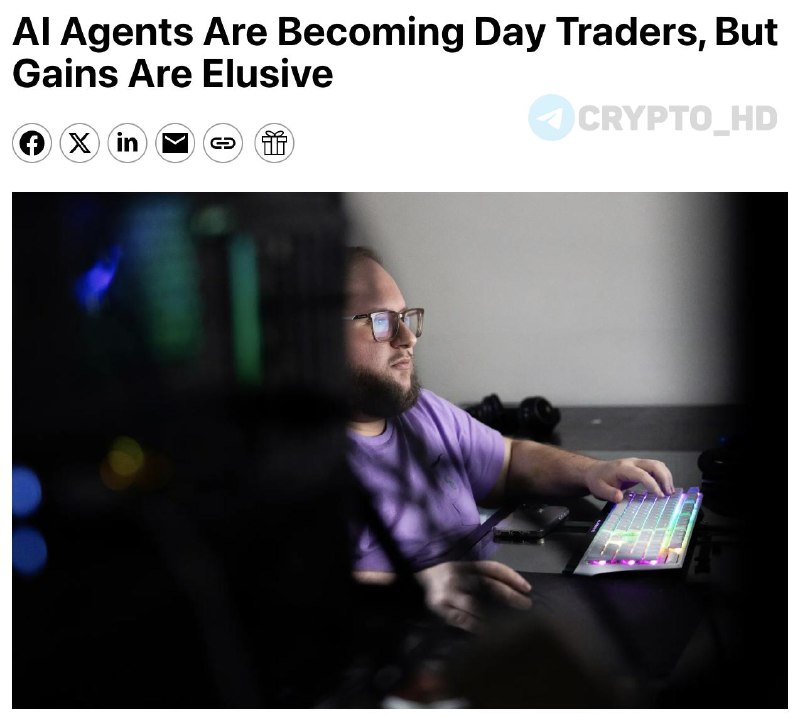
The story, reported by Bloomberg, follows a developer who built a bot in his own image — same risk appetite, same setups, same instincts. Week one delivered a single good call and a string of losers. The good call was a non-call: the bot sat out Nvidia’s rip and saved its operator about $10,000 in chase-the-tape losses. Then the spec trades started, and the equity curve went the other way. By month-end the +7% headline looked decent next to the index — until you saw the -22% drawdown print underneath it. That’s not an investment return. That’s a casino receipt with extra steps.
The core diagnosis: AI trading agents underperform because they are over-trained on conservative financial doctrine. The diagnosis Bloomberg lands on is the part crypto traders should print and tape to the wall: AI agents are too smart by default. Per Bloomberg’s reporting, these models were trained on a planet’s worth of financial advice, regulator filings and risk-management textbooks. So when you point one at a live tape, it does what a polite advisor would do — it dodges concentration, it shies away from anything that smells like a meme, and it gravitates toward the kind of boring, low-vol assets that keep your CFA examiner happy and your P&L flat. Think of it like hiring a Vanguard target-date fund manager to run a Solana memecoin book. He’ll do exactly what his training says — and he’ll bleed for it. In a market where the alpha lives in conviction trades, a bot that’s been finishing-schooled to avoid risk is structurally allergic to the very setups that pay.
Crypto markets reward concentration and conviction, which makes them especially hostile to risk-averse AI agents. This matters more for crypto than for equities, and that’s the angle Bloomberg’s piece doesn’t quite finish — so let’s finish it. Crypto’s edge has always been concentration, asymmetry and the willingness to hold something ugly long enough for the chart to turn pretty. An AI that won’t touch a 30% drawdown is an AI that wouldn’t have held BTC through any of its productive cycles. Picture the same bot in March 2020, watching BTC bleed from $9k to $3.8k inside a week — it would have flagged the asset as untouchable on volatility alone, the same way it apparently flagged Nvidia as a chase. Saving $10,000 by skipping a winner sounds like discipline. In a momentum regime, it’s the cost of the trade you didn’t take. Same model, same logic, applied to a coin like ETH or SOL during a breakout, gives you a flat book while the rest of the desk prints.
There’s a second-order problem here that ties straight into the macro flow crypto traders have been navigating all year. Risk-asset rotation has been the defining trade of this cycle: when rates and rate expectations move, capital sloshes between equities, bonds and crypto on a horizon measured in days, not quarters. An AI agent calibrated to long-horizon “prudent” allocation isn’t built for that clock. It will rebalance into safer assets right as a Fed pivot or a CPI surprise lights up BTC’s beta. The bot in the Bloomberg piece is reportedly running a -22% drawdown not because it’s reckless, but because it’s trying to be careful in the wrong rhythm. Crypto’s tape doesn’t reward careful. It rewards correct, and fast.
Retail adoption of AI trading agents is accelerating despite weak performance data. The adoption-signal angle is where this gets genuinely interesting, because the trend is moving regardless of the results. Per Bloomberg, traders are handing trades to AI agents en masse, and the unstable performance hasn’t slowed it down. That’s a familiar pattern — same shape as the early algo-trading wave in equities, same shape as DeFi yield-farming in 2020 — capital flows toward novelty long before novelty earns it. For crypto specifically, you’re going to see this surface in three places fast: copy-trading platforms slapping “AI” on existing strategy vaults, exchange-native bot products that auto-route order flow, and on-chain agent frameworks that promise autonomous portfolio management against your wallet. The volume will be real. The edge, based on this data set, won’t be.
Here’s the part worth saying plainly. A 7% monthly return with a 22% drawdown is not a trading system — it’s a sample of one with a flattering window. Annualize the return naively and you get a number that looks like a hedge fund pitch deck; annualize the drawdown and you get a margin call. Any crypto trader who has been around more than one cycle knows which of those two numbers actually shows up in their account. Put another way: the bot’s “edge” over the S&P is 2.5 percentage points in a month. The bot’s risk relative to the S&P is multiples higher. That’s not arbitrage. That’s leverage with a chatbot wrapper.
The cruelest detail in the report is the one about the developer training the bot in his own style. That’s supposed to be the workaround — if generic models are too risk-averse, fine-tune one on your own behavior. The bot still lost. Either the developer’s own style doesn’t survive contact with a model’s training priors, or the act of codifying intuition strips out the part that was making money in the first place. It’s the same thing that happens when a discretionary PM tries to write down his rules for a junior. The note ends up technically correct and operationally useless, because the part he couldn’t articulate was the part doing the work. Traders who have tried to write down their own rules know this feeling. The system on paper is never the system in your head, and the model trained on the paper version is one more layer of compression away from whatever was working.
What this means
The first wave of retail AI trading agents will systematically fail in high-conviction crypto setups. For crypto specifically, the signal is that the first wave of retail AI trading agents is going to underperform exactly where crypto traders need them to perform — in concentrated, high-conviction, volatility-tolerant setups around assets like BTC and ETH. Expect a flood of “AI strategy” vaults on copy-trading platforms and exchange bot marketplaces over the next two quarters. Expect their published Sharpe ratios to deteriorate sharply once the sample window extends past the bull leg. The ticker most exposed to the narrative cycle here is COIN, whose retail product roadmap leans into automated and AI-assisted trading; watch how aggressively that gets marketed versus how quietly the performance disclosures get buried.
What to watch next: the first real stress test for this cohort of AI agents will be the next macro shock — a hot CPI print, an unscheduled Fed comment, or a geopolitical tape bomb that sends BTC 4-7% in either direction inside 72 hours. Bots tuned for prudence will derisk into the move and miss the round-trip; traders running them will see drawdowns that look a lot like the -22% in the Bloomberg sample. Track the next FOMC date and the CME open-interest data around it as your read on whether AI-driven flow is amplifying or dampening crypto volatility. And if you’re tempted to hand your own book to an agent, the question to answer first isn’t whether the bot can think — it’s whether the bot can hold. On current evidence, the answer is no.
Frequently Asked Questions
Why do AI trading bots underperform expectations?
Per Bloomberg’s reporting, AI trading bots underperform because their training data — financial textbooks, regulatory filings, and risk-management literature — biases them toward conservative, low-volatility allocations. They systematically avoid the concentrated, high-conviction trades where market alpha actually lives.
What return did the Bloomberg-tested AI trading bot deliver?
The bot returned +7% in one month on a $100,000 simulated portfolio, compared to roughly 4.5% for the S&P 500 over the same period. It also posted a -22% peak drawdown, which eliminated the apparent edge on a risk-adjusted basis.
Can fine-tuning an AI bot on a trader’s own style fix the problem?
No. Bloomberg’s case study showed that even when a developer trained a bot to mirror his personal trading style, it still lost money. The model’s underlying training priors override custom fine-tuning, and codifying intuition into rules strips out the elements that made the original trader profitable.
Why is this especially bad for crypto traders?
Crypto returns are driven by concentration, asymmetry, and tolerance for 30%+ drawdowns — the exact behaviors AI agents are trained to avoid. A risk-averse bot would never have held BTC, ETH, or SOL through their productive cycles, flagging them as unsuitable on volatility grounds.
What is the main risk of AI agents in fast-moving macro regimes?
AI agents calibrated for long-horizon prudent allocation rebalance into safer assets exactly when rate pivots or CPI surprises spike crypto beta. They derisk into the move and miss the round-trip, producing the -22% drawdowns documented in the Bloomberg sample.
Where will retail traders encounter AI trading bots first?
Three channels will dominate the next two quarters: copy-trading platforms rebranding existing strategy vaults as “AI,” exchange-native bot products that auto-route order flow, and on-chain agent frameworks offering autonomous wallet management. Volume will be high; edge will be marginal.
Which publicly traded company is most exposed to the AI trading narrative?
Coinbase (COIN) is the ticker most exposed, since its retail product roadmap leans heavily into automated and AI-assisted trading features. Watch how aggressively the marketing scales versus how transparently performance disclosures are published.
What is the next stress test for AI trading agents?
The next macro shock — a hot CPI print, unscheduled Fed comment, or geopolitical event that moves BTC 4-7% within 72 hours — will be the first real test. Track upcoming FOMC dates and CME open-interest data to see whether AI-driven flow amplifies or dampens crypto volatility.
Should retail traders hand their portfolios to AI agents now?
Based on current evidence, no. The decisive question is not whether the bot can think but whether it can hold a position through volatility — and the Bloomberg data suggests it cannot.