
















































Russia Gold Export Ban Hits 100-Gram Limit — Bitcoin’s Reserve-Asset Case Just Got Louder
Russia’s gold export ban over 100 grams is a presidential decree, effective this week, that blocks the cross-border shipment of refined gold bars heavier than 100 grams from Russian territory, with narrow carve-outs for banks and EAEU shipments. Russia sits on the world’s fifth-largest official gold reserves. The new decree locks that physical metal inside the country. For crypto markets, the signal is sharper than the headline. When sovereigns start fencing off hard assets, Bitcoin’s “digital gold” pitch stops sounding like marketing copy and starts sounding like plumbing. Traders watching BTC consolidate near recent highs should treat this as one more brick in the de-dollarization wall.
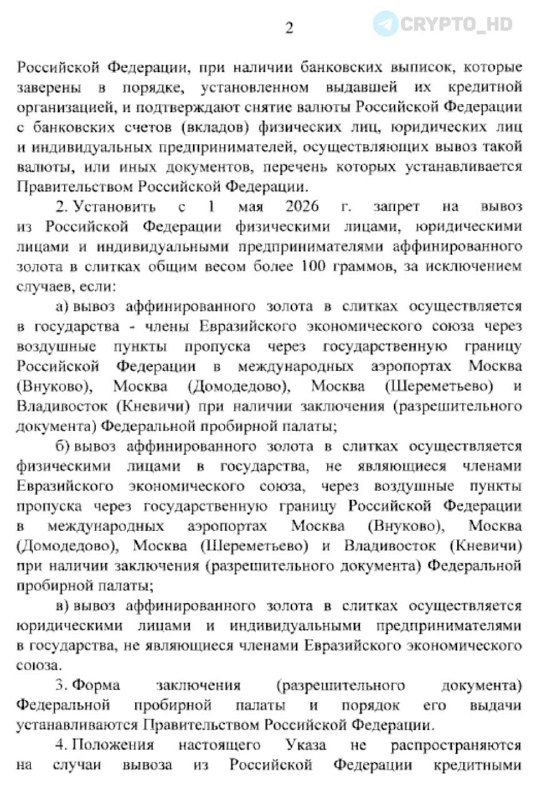
What the Russia Gold Export Ban Actually Says
The decree blocks all exports of refined gold bars above 100 grams, channels permitted shipments through four designated airports, and exempts credit institutions entirely. Per the presidential decree signed by President Putin, shipments to Eurasian Economic Union (EAEU) member states are still allowed — but only through four airports (Vnukovo, Domodedovo, Sheremetyevo, and Vladivostok/Knevichi) and only with a clearance document from the Federal Assay Chamber. Individuals can still carry gold to non-EAEU countries through the same four airports, again with Federal Assay Chamber permission. Legal entities and individual entrepreneurs get a looser regime for non-EAEU exports: the airport list and the assay-chamber approval are not explicitly required for them. Credit institutions sit fully outside the ban. Refined gold bars moved by banks are exempt from the decree’s restrictions entirely.
Read that last carve-out twice. Retail gets choked. Corporate gets narrowed. Banks walk free. That’s not an accident. It’s the architecture of a state that wants to keep monetary gold flowing through institutional rails it controls, while shutting the door on private capital flight in physical form. Think of it as the bullion version of what Greece did with cash withdrawal limits during the 2015 crisis — citizens metered, banks unblocked. This is what late-stage capital control looks like when a sanctioned economy is trying to keep its bullion at home.
Why This Matters for Bitcoin and Stablecoin Flow
The export ban accelerates the migration of Russian retail and corporate savings into non-sovereign digital assets, with Bitcoin and Tron-based USDT positioned as the primary beneficiaries. Here’s the macro flow angle, and it matters for risk assets. Russia has spent the last decade swapping dollar reserves for gold; per Bank of Russia disclosures, the central bank now holds well over 2,300 tonnes on the books. When the state starts treating bullion exports as a national-security item, it tells you the marginal Russian saver — corporate or individual — needs a different store of value. Some of that demand goes into the ruble. Some into yuan. And a measurable slice flows into crypto. On-chain analysts have been flagging persistent Russian-language activity on USDT (TRC-20) rails and growing OTC Bitcoin volume out of CIS desks for the better part of two years. A 100-gram cap on physical gold exports does not reverse that trend. It accelerates it.
The Portability Premium: Why Bitcoin’s Pitch Just Sharpened
Bitcoin’s structural advantage over physical gold is portability under capital controls — twelve seed words versus airport permits and federal stamps. The safe-haven angle is the louder one, and it cuts a different way. For years the BTC-versus-gold debate has been framed as a beauty contest between two non-sovereign assets. What this decree adds is a third variable: portability. Physical gold above 100 grams now needs an airport, a permit, and a stamp from a federal agency to leave Russian soil. A 100-gram bar is roughly the size of a smartphone — and now it travels worse than one. Bitcoin requires twelve words, memorized or split across continents. That’s not editorial flourish. That’s the literal operational difference, and it’s the kind of difference that gets re-priced into BTC over months, not minutes. The asset that cannot be confiscated at a border check has a structural premium when borders start checking.
The Sanctions Pattern: Russia Is Not an Outlier
Russia’s gold export ban fits a recurring sovereign playbook in which capital-controlled economies restrict bullion movement and inadvertently boost domestic crypto demand. Worth noting where this lands in the broader sanctions picture. Russia has been a net gold accumulator since 2014, and per Bank of Russia statements, the central bank resumed domestic gold purchases in 2022 after the Western reserve freeze made dollar and euro holdings legally radioactive. The export ban closes the loop: gold goes in, gold doesn’t come out, and the bank channel stays as the only legitimate outbound pipe. For Bitcoin holders, the relevant comparison is not Russia in isolation. It’s the pattern. China restricts gold imports when capital outflows spike. India taxes gold imports to defend the rupee. Turkey has cycled through both — Turks famously bought roughly 350 tonnes in a single year of lira collapse, while their state quietly leaned harder on bullion controls. Each time, retail bid for crypto in those corridors steps up. The Russian decree is the same playbook, executed in public, by a G20 reserve holder.
Regulatory Pressure: The Second-Order Risk for Crypto Infrastructure
Capital controls on physical assets historically tighten regulators’ grip on digital escape valves, creating a two-sided market for Russian-facing crypto firms: more demand, more friction. The regulation-pressure angle is more subtle but worth flagging for COIN and ETF holders. Capital controls on physical assets historically push regulators in the same jurisdictions to tighten the digital escape valve next. Per the Bank of Russia’s published frameworks, Russia’s domestic crypto regime is already a moving target. Mining is legal under a federal registry. Payments inside Russia remain restricted. Cross-border settlement in crypto is being piloted under Bank of Russia oversight. A gold export ban makes the digital-asset rules more, not less, contested. Anyone modeling the addressable market for licensed Russian-facing crypto infrastructure should mark today as a data point that pulls in two directions at once: more retail demand, more regulatory friction.
The Sovereign Adoption Signal Most Traders Will Under-Weight
Sovereign hoarding of gold is the closest real-world precedent for sovereign accumulation of Bitcoin as a reserve asset. The adoption-signal angle is the one most traders will under-weight, and probably shouldn’t. Sovereign behavior around gold is the closest real-world analog to sovereign behavior around Bitcoin reserves. The same logic that makes Russia hoard bullion at home is the logic that, on a long enough timeline, makes smaller states test BTC on their balance sheets. El Salvador already did it. Bhutan has been mining quietly into its sovereign wealth fund. The U.S. strategic Bitcoin reserve debate, however it resolves, sits in the same conceptual bucket. When one of the world’s largest gold holders publicly says “this asset is too important to let leave the country,” it raises the floor under every argument for treating BTC as a reserve-grade instrument.
What This Means
Physical gold’s portability premium has been marked down by state policy; Bitcoin’s portability premium has been marked up by the same act. The signal is straightforward: physical gold’s portability premium just got marked down, and Bitcoin’s portability premium just got marked up — at the margin, at the level of state policy, in a country that matters for global bullion flows. Expect the de-dollarization narrative to absorb this within days. Expect Russian-corridor stablecoin volume on Tron and TON to tick higher in the next two reporting windows. The ticker most directly exposed is BTC. But the second-order beneficiaries are the stablecoin rails — USDT in particular — that handle CIS cross-border flow, and any listed mining or infrastructure name with Russian-region exposure that hasn’t been sanctioned out of the trade.
What to Watch Next
Five concrete signals will determine whether the Russia gold export ban becomes a one-off capital control or the opening move of a global sovereign trend. First, Bank of Russia disclosures on gold reserve composition and any commentary on cross-border settlement experiments — those tend to drop on a quarterly cadence and will tell you whether the bank-channel carve-out is being used heavily. Second, on-chain: monitor Russian-language exchange OTC desks and Tron USDT issuance for a step-change in the next 30 days. A sustained uptick is the cleanest read on whether the export ban is rerouting savings into crypto. Third, watch the BTC-gold ratio. Bitcoin has spent 2026 oscillating against gold in a tight band; a decisive break higher in that ratio coinciding with more sovereign capital-control headlines is the trade most institutional desks will want confirmed before sizing up. Fourth, keep an eye on the next FOMC and any G7 commentary on Russian gold — Western policy responses to this decree will shape whether other reserve holders quietly follow Moscow’s template. And finally, the simplest tell: if any other sanctioned or sanctions-adjacent economy announces a similar bullion export limit within the next quarter, the de-dollarization-into-Bitcoin thesis stops being a thesis and starts being a trend with a chart.
FAQ: Russia Gold Export Ban Over 100g
What does Russia’s gold export ban over 100 grams actually prohibit?
The decree blocks exports of refined gold bars heavier than 100 grams from Russian territory. Banks are fully exempt, and EAEU shipments are allowed only through four designated airports with Federal Assay Chamber clearance.
When did the Russia gold export ban take effect?
The presidential decree signed by Vladimir Putin took effect this week. It applies immediately to all non-bank cross-border movement of refined gold bars above the 100-gram threshold.
Why did Russia ban gold exports above 100 grams?
Per the decree’s structure, the ban is designed to keep monetary gold flowing through institutional rails the state controls, while blocking private capital flight in physical form. It’s consistent with late-stage capital controls in a sanctioned economy.
How does the Russia gold export ban affect Bitcoin?
The ban strengthens Bitcoin’s “digital gold” thesis by highlighting BTC’s portability advantage — twelve seed words versus airports, permits, and federal stamps. Analysts expect increased Russian-corridor demand for BTC and Tron-based USDT.
How much gold does Russia hold in reserves?
Per Bank of Russia disclosures, the central bank holds well over 2,300 tonnes of gold, making Russia the world’s fifth-largest official gold reserve holder.
Which airports are allowed for gold exports under the new Russian decree?
Only four airports are permitted: Vnukovo, Domodedovo, Sheremetyevo (all Moscow), and Vladivostok (Knevichi). All shipments through these airports require Federal Assay Chamber clearance.
Are Russian banks affected by the gold export ban?
No. Credit institutions are fully exempt from the decree’s restrictions. Refined gold bars moved by banks can leave Russian territory without the airport or assay-chamber requirements.
Does the Russia gold export ban signal more sovereign Bitcoin adoption?
Indirectly, yes. When major gold holders treat bullion as too strategic to export, it strengthens the conceptual case for smaller states adding Bitcoin to their balance sheets — following precedents set by El Salvador and Bhutan.
What should crypto traders watch after the Russia gold export ban?
Watch Tron USDT issuance, Russian-language OTC desk volume, the BTC-gold ratio, and whether other sanctioned economies announce similar bullion export limits within the next quarter.