
















































Iran Ceasefire Reply to US Could Cool Bitcoin’s Safe-Haven Bid This Week
Iran’s ceasefire reply to the United States is a formal counter-proposal delivered through Pakistani intermediaries on April 30, 2026, marking the first concrete de-escalation signal after weeks of renewed-strike speculation. Per Axios, Tehran routed amendments to the latest war ceasefire agreement back to Washington via Islamabad rather than rejecting the framework outright. For crypto, this matters. The iran us ceasefire crypto market impact has been one of the few macro variables actually moving Bitcoin’s correlation profile in 2026. If the channel holds, expect the geopolitical premium baked into BTC’s recent bid to bleed off fast.
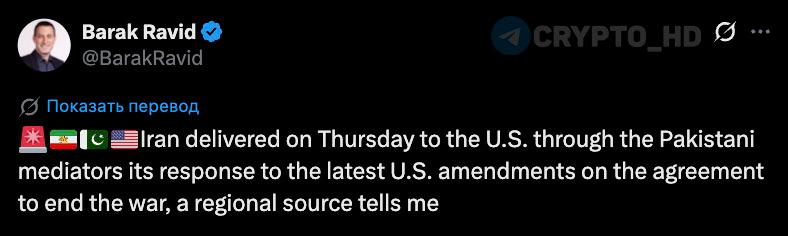
Here’s what the wire actually shows. Tehran did not reject and did not accept — it sent back amendments through Islamabad, the same back-channel route that carried the prior round. Axios framed last week as one where strikes could resume. The fact that paper is moving instead of missiles is itself the story. No public text of the Iranian counter has surfaced. Neither side has confirmed a meeting date. So we are trading the process, not a deal.
Bitcoin’s safe-haven response to Middle East escalation is a documented pattern of 4% to 8% rallies within 72 hours, followed by a slow unwind as tensions cool. Looking at price data tracked since the January 2020 Soleimani strike, BTC’s behavior during Middle East flare-ups has been pretty consistent. Think of it like an air conditioner kicking on during a heatwave — it runs hard at first, then cycles down once the room cools. The April 2026 tape fits the pattern. BTC rallied into the “strikes possible” headlines and has been holding the bid largely on that risk premium. A live diplomatic channel via Pakistan removes the binary tail. Traders who bought the war hedge will be the first sellers if the back-channel produces a meeting date this week. Watch for a 3% to 5% give-back on BTC if Axios or Reuters reports a confirmed venue.
The macro flow angle cuts the other way: lower Middle East risk usually means softer crude, softer crude means a calmer inflation print, and that gives the Federal Reserve more room to stay dovish into the next FOMC. That is a tailwind for risk assets broadly — not just Bitcoin. ETH and the high-beta L2 basket tend to outperform BTC when the trade flips from “geopolitical hedge” to “rates-down, risk-on.” If you held BTC into the war scare, the rotation worth thinking about is BTC into ETH and the majors as the headline risk fades.
Worth noting how thin the official record actually is. Per Axios, the only confirmed facts are the Pakistani channel and the existence of Iran’s reply — nothing on substance. No quote from a US official. No Iranian foreign ministry statement. No readout from Islamabad. That is a feature, not a bug — back-channels work because they are quiet — but it also means the market is pricing a process it cannot verify. It’s a bit like trading a company’s earnings beat from a leaked summary you never get to read in full. Any leak about the actual amendments could move the tape harder than the confirmation of the reply itself.
The regulatory read-through from a ceasefire amendment is limited: there is no direct SEC, CFTC, or ETF impact, but a durable de-escalation reduces the political case for new oil sanctions and sanctioned-state crypto enforcement. The one second-order effect to keep on the radar: a calmer Tehran lowers the case for sanctioned-state crypto rails getting fresh attention from Treasury. Looking at recent enforcement patterns, OFAC has been the regulator that matters for this story, not the SEC. A calmer Tehran takes some heat off that file.
The next 72 hours present a binary setup: confirmation of a meeting date compresses BTC’s war premium, while a leaked unacceptable counter snaps the strike-risk narrative back hard. If a meeting date hits the wire, BTC has more room to fall than to rally — the war premium is already in. If the amendments leak and look unacceptable to Washington, the strike-risk narrative snaps back hard. The same 4% to 8% historical pop becomes the base case again. This is a binary setup wearing the costume of a slow-news week.
What this means
Bitcoin’s geopolitical bid is on borrowed time as long as the Pakistani back-channel between Iran and the US remains open. The signal is straightforward. Iran is negotiating, not posturing for a strike. The affected tickers are BTC first, then the ETH/SOL high-beta complex on the rotation trade. Coinbase (COIN) and the ETF basket are not directly in this story, but they ride the same risk-on tape if the de-escalation narrative gets a confirming headline. If you are long BTC purely as a war hedge, this is the week to think about whether that thesis still pays.
Watch next: any Axios, Reuters, or Al Jazeera report naming a venue or date for the next round — that is the headline that compresses the safe-haven premium fastest. On the technical side, the level that matters is whatever local high BTC printed during the “strikes possible” run. A clean rejection there on a de-escalation headline would confirm the unwind. Cross-reference with WTI crude — if oil breaks lower on the same news cycle, the macro and safe-haven angles are reinforcing each other, and the BTC give-back gets sharper. The next FOMC and the following CPI print are the macro waypoints where this geopolitical fade either becomes a clean rotation into risk or gets overwritten by a fresh Middle East shock. For now, the tape is one Pakistani envelope ahead of the market.
FAQ
What did Iran send to the US on April 30, 2026?
Per Axios, Iran delivered a formal response with amendments to the latest war ceasefire agreement, routed through Pakistani intermediaries. Tehran did not reject the framework and did not accept it outright.
How does the Iran-US ceasefire affect Bitcoin’s price?
A confirmed de-escalation removes the geopolitical risk premium currently supporting BTC, which historically gives back 3% to 5% on confirmed diplomatic progress. The flip side: a breakdown in talks has produced 4% to 8% rallies within 72 hours since the January 2020 Soleimani strike.
Which crypto assets benefit most if Middle East tensions ease?
ETH and high-beta Layer 2 tokens tend to outperform BTC when the macro narrative shifts from “geopolitical hedge” to “rates-down, risk-on.” Bitcoin loses its safe-haven bid first. Altcoins gain on the broader risk-on rotation.
Is there an SEC or ETF impact from the ceasefire?
No. The ceasefire amendment has no direct SEC, CFTC, or spot Bitcoin ETF read-through. The relevant regulator for this story is OFAC, which oversees sanctions enforcement on Iran-linked crypto rails.
What headlines should traders watch this week?
Any Axios, Reuters, or Al Jazeera report naming a venue or date for the next negotiation round will compress BTC’s safe-haven premium fastest. Cross-reference WTI crude price action — a simultaneous oil break lower confirms the de-escalation trade.