
















































Coldcard Mk3 Hack: 594 BTC Stolen, Hardware Wallet Security Under Fire
A flaw in the Coldcard Mk3 hardware wallet allowed attackers to steal 594.5 BTC from about 500 single-signature wallets on July 30. The bitcoin was worth roughly $38 million. That is the hard number. My take: the more troubling detail is what the case says about self-custody. Keeping private keys offline does little good if the wallet generates weak keys in the first place.
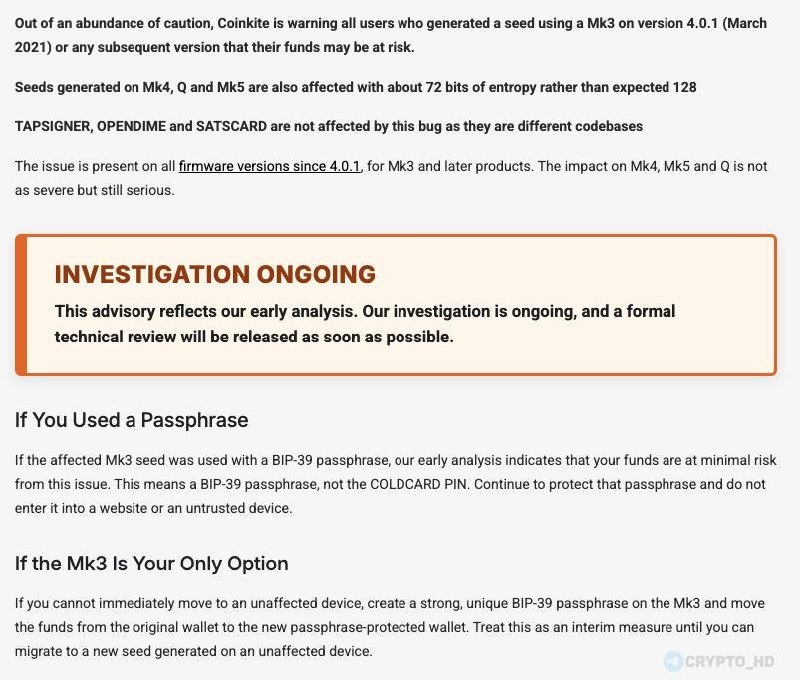
The attackers targeted Mk3 devices running firmware versions 4.0.1 through 5.0.3, released from March 2021 onward. According to the initial report, the wallet generated some seed phrases with around 72 bits of entropy—not the usual 128-bit minimum. Why does that matter? Because the gap gave attackers a realistic way to reconstruct private keys offline. They did not need to break into every device. In some setups, the random number generator apparently bypassed the hardware true random number generator (TRNG). It relied instead on more predictable inputs, including button presses during setup. Coldcard’s Mk4, Q, and Mk5 models appear unaffected. This particular flaw also poses little risk to people who added a BIP-39 passphrase, used multisig, or generated their seed with dice.
The timing is lousy for Bitcoin. Institutional interest has grown, while supporters still sell BTC as secure, unconfiscable “digital gold.” I’ll be honest: a $38 million theft tied to a respected hardware wallet makes that pitch harder to deliver with a straight face. Most defenses will start by noting that nobody breached the Bitcoin network. That is true, but only half the story. The distinction will feel pretty hollow to someone who lost their savings because the device meant to protect them created a weak seed.
BTC’s price may ignore the news initially. Markets do that. Over time, though, some holders could move funds from self-custody to regulated exchanges, particularly if seed management already made them nervous. The impulse makes sense, although it merely exchanges one risk model for another. More bitcoin sitting on exchanges could invite closer scrutiny of custodial practices. Compliance costs or user fees could rise. A quick sale of much of the stolen 594.5 BTC might also create a brief wave of selling, with a sharper sting while sentiment remains shaky and BTC sits near its recent $61,400 support level.
The theft revives an old crypto argument: how much responsibility can ordinary users reasonably handle? “Not your keys, not your coin” is easy to say. Doing it safely is not. Creating the keys is one problem; storing and recovering them are separate ones. In this case, users could follow the instructions exactly and still be exposed to a flaw they had no realistic chance of finding. To me, that changes the usual blame-the-user conversation.
Regulators who favor centralized custody will point to this case. Most users cannot audit entropy sources or firmware behavior, much less seed-generation code, and pretending otherwise is silly. Counter to the usual advice, handing control to a custodian may look rational to some holders after an incident like this. Agencies such as the SEC have already influenced staking services and exchange policies. If people lose faith in hardware wallets, institutions and wealthy holders may turn to insured, regulated custodians despite surrendering direct control. That could affect where BTC and ETH are stored. It could also change how quickly large balances move through the market. But concentration is not safety: placing more assets in the hands of fewer companies introduces a different and very familiar risk.
What this means
The Coldcard Mk3 exploit is a serious failure. Full stop. It does not mean every hardware wallet is unsafe, but it does show that slick hardware and a trusted name cannot compensate for poor seed generation. Cryptography leaves almost no room for “almost secure.” People who created single-signature wallets with the affected Mk3 firmware and did not add a passphrase face the most immediate danger. The broader fallout? Much less certain. Investors now have to decide whom they trust more: a device manufacturer or a regulated custodian. They may choose themselves instead.
That uncertainty may hit newer buyers hardest. Bitcoin can still resist confiscation when users generate and store their keys properly, but I think “when done properly” now carries far more weight. Experienced users may switch to multisig or generate seeds with dice. Some will add a BIP-39 passphrase; others may accept less independence in return for insured custody. Yes, that sounds like a retreat from self-custody. In practical terms, it may be the trade some people prefer. Both routes carry risk. What changes is who gets the chance to make the costly mistake.
Investors should watch how Coldcard and other wallet makers react. Useful responses would include technical accounts of what went wrong and firmware fixes. Plain instructions for moving affected funds matter too. Is that enough? Not by itself, because the market response will still hinge on confidence. BTC remains the main ticker to watch, and a sustained fall below $60,000 could indicate that the anxiety has spread beyond Mk3 owners. Statements from regulators could matter as well, particularly if agencies cite the theft while pressing for new custody rules.
The best market clue will be where the money goes over the next few weeks. In my view, wallet flows will say more than confident commentary. A clear shift from self-custodied wallets to exchanges or regulated custodians would suggest that some holders now see the risks differently. Until that movement appears, predictions of lasting market damage are guesswork. The theft itself is concrete: about 500 wallets were drained because a security device may have generated private keys that were much easier to predict than their owners had been led to believe.