
















































Garrett Jin ETH losses expose Bitcoin OG basis trade risk
Bubblemaps says Garrett Jin could have made another $70,000,000 if he had stayed out of ETH. I’ll be honest: that is the part I keep coming back to. The BTC trade worked. The ETH trade did the damage.
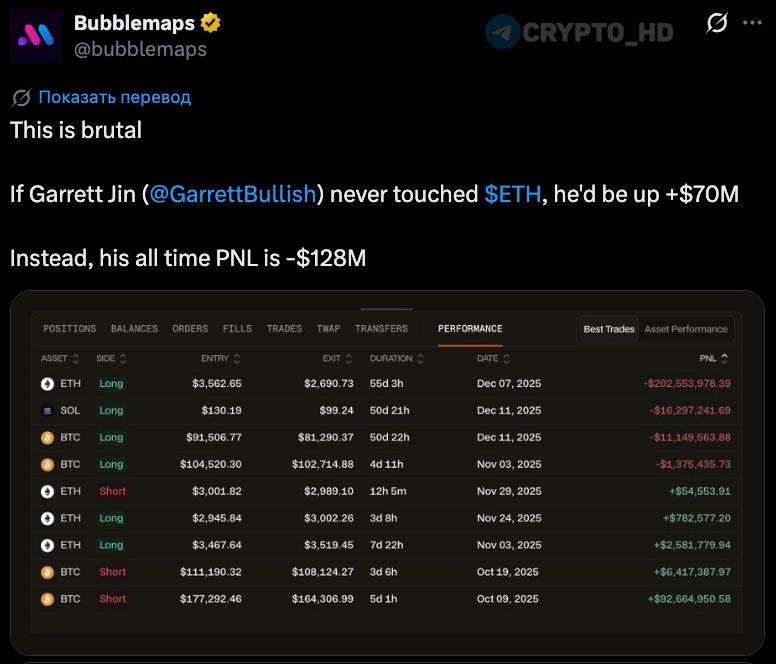
The alleged Bitcoin OG whale reportedly made about $100 million shorting BTC, lost more than $200 million on ETH longs, and ended with lifetime PNL of -$128 million. Not close. Not subtle. It is what happens when one side of a trade is right and the other side is much more wrong.
Bubblemaps identifies Garrett Jin as the former head of BitForex. It also says on-chain detectives believe he is the Bitcoin OG whale. The post then claims this Bitcoin OG may have insider links to the US government or Trump family, while referring back to earlier Bitcoin OG positions. My take: this is where the story gets loud before it gets proven. The claim is large, and the figures quoted here do not prove it. The cleaner story is still the trading math: BTC shorts paid. ETH longs did not.
This is less about a famous wallet and more about the BTC/ETH spread. If a book makes roughly $100 million from shorting BTC but loses more than $200 million holding ETH long, the pain came from relative exposure. Most guides say crypto trades as one risk bucket. That is only half right. ETH often acts like the higher beta coin when liquidity tightens, while BTC, at times, trades more like a macro asset. In March 2023, during the banking stress, BTC moved from about $20,000 on March 10 to above $28,000 by March 19 while traders debated whether Bitcoin was acting like a risk hedge or a liquidity hedge. Why does this matter? Because a move like that can ruin a cross-crypto book quickly.
The safe haven angle matters, but not in the lazy “Bitcoin is digital gold” sense. The reported BTC shorts made about $100 million, while the ETH longs lost more than $200 million. That says something simple: “crypto exposure” is not one trade. BTC can attract flows during political stress and banking panic. Sanctions talk can do it too. ETH carries a different risk stack: protocol changes, staking mechanics, DeFi leverage, and thinner liquidity when risk appetite dries up. After the Soleimani strike on January 3, 2020, BTC moved from roughly $6,900 to more than $8,000 within days while gold also rose. That does not make BTC gold. It does help explain why macro traders do not treat BTC and ETH as the same asset.
Macro flow probably hurt the book badly. If Jin’s alleged Bitcoin OG wallet was short BTC and long ETH, the bet was that ETH would outperform BTC, or at least soften the BTC short. Tough setup. Real yields, dollar strength, ETF flows, leverage, and basis positioning can pull the two assets apart. Counter to the usual advice, the hedge can become the problem. On June 15, 2022, the Federal Reserve raised rates by 75 basis points, and crypto was already being hit by deleveraging. In that market, ETH longs can bleed faster than BTC shorts can make up for it.
Bubblemaps does not provide liquidation prices, entries, margin venues, wallet addresses, or trade dates for each position. So the read has to stay narrow. The reported numbers are $70,000,000 in missed upside, lifetime PNL of -$128 million, about $100 million gained on BTC shorts, and more than $200 million lost on ETH longs. Is this enough to reverse-engineer the whole book? No. It is enough for a market lesson.
For ETH traders, this is a nasty signal. A large account can call BTC correctly and still lose a fortune if the ETH leg is too large or badly timed. ETH upside depends on staking demand and Layer 2 activity. ETF demand matters. So does plain old risk appetite. Sure. But when leverage turns, ETH can stop looking like settlement infrastructure and start looking like a crowded growth trade. In Bubblemaps’ version of the book, that is where most of the damage came from.
For BTC traders, the story cuts both ways. The roughly $100 million BTC short profit suggests the Bitcoin OG was not simply long crypto because of the nickname. We should be careful here, though: a profitable short does not mean the trader understood the whole market better than everyone else. Still, shorting BTC has its own danger, especially when ETF inflows and CME basis start lining up with safe haven talk. Spot Bitcoin ETFs began trading in the US on January 11, 2024, making BTC easier for many institutions to buy than ETH. That difference still matters for trading desks in 2026.
The alleged US government or Trump family link is the loudest part of the Bubblemaps post. It is also the part investors should treat with the most caution. Bubblemaps says on-chain detectives believe Garrett Jin may have insider links, but it does not prove the link, name a government official, or point to a specific transaction tied to the US government or Trump family. Yes, this is less exciting than the headline. It is also the part that matters. For markets, the immediate issue is simpler: if a high-profile wallet gets pulled into a political story, BTC and ETH liquidity can move before anyone knows what happened.
What this means
This is a hard lesson in crypto positioning: “crypto exposure” is not enough. The BTC/ETH spread can make or break the book. In the Bubblemaps account, a successful BTC short was overwhelmed by ETH longs that lost more than $200 million. BTC and ETH are the assets in focus, but the warning applies to any leveraged BTC/ETH pair. A book can show about $100 million in profitable BTC shorts and still land at -$128 million lifetime PNL. Brutal, but possible.
Traders should watch the BTC/ETH ratio, not only spot BTC or spot ETH. I would put the ratio above the headline wallet drama, at least for actual trading decisions. The next date to circle is the June 10, 2026 FOMC decision, along with CME BTC futures open interest and ETH funding rates going into that week. For price action, the question is whether ETH can regain strength against BTC after a reported long-side loss of more than $200 million in this Bubblemaps account. If it cannot, attention stays on BTC dominance, Bitcoin OG positioning, and whether large wallets keep treating ETH as the weaker leg.