
















































Michael Saylor: US Market Closed, Bitcoin Keeps Building
Michael Saylor pointed out that the US stock market is closed today for a holiday. Bitcoin is not. That is the whole tension. Stocks obey the NYSE calendar. Bitcoin keeps trading, for better and worse, and anyone holding BTC has to live with that little machine running in the background.
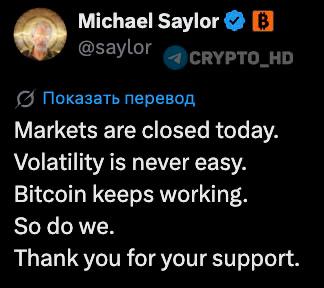
The MicroStrategy chairman posted this today: “US stock market is closed today (holiday). Volatility is always difficult. BTC continues to work. We too. Thank you for your support.” Short post. Sharp contrast. Wall Street has opening bells, closing bells, weekends, and holidays. Bitcoin keeps printing blocks. My take: this is exactly the kind of sentence Saylor likes because it sounds obvious after he says it.
That always open setup is one reason people keep treating Bitcoin as a possible safe haven when regular markets get strange or go offline. But safe haven is a slippery phrase. Most Bitcoin bulls use it too casually. If US equities are shut and something major happens, investors have fewer immediate choices. Bitcoin is still there. I would not turn that into “Bitcoin is always safe.” It is not. March 2020 made that obvious. As COVID panic hit global markets, BTC sold off hard, stayed tradable, and later recovered. The useful part was not calm. It was access. You could still buy, sell, hedge, panic, or make a bad decision at 2 a.m.
Saylor’s line about volatility being difficult also matters. I’ll be honest: it is the most human part of the post. Inflation worries, rate expectations, and geopolitics have been pushing risk assets around for years. When US markets close, equity price discovery pauses. Crypto does not get that pause. Why does this matter? Because if a major jobs number, central bank headline, or geopolitical shock hits during a holiday, Bitcoin can become one of the first places traders react. Sometimes that gives you a useful signal. Sometimes it is just noise with a price chart attached. Saylor has his own reason to care: MicroStrategy has built its identity around Bitcoin as a treasury asset, not as a trade that fits neatly inside market hours.
What this means
Saylor’s holiday reminder shows the odd gap between traditional finance and crypto. One has business hours. The other runs all day, every day. For traders, Bitcoin has one clear advantage: liquidity when the New York Stock Exchange is dark. The downside is blunt. There is nowhere to hide from volatility. Counter to the usual advice, “wait until markets reopen” does not really work when BTC is already repricing the story in public.
Investors should watch how BTC trades on future US market holidays and during long weekends. Does it react to news outside US trading hours? Do those moves hold once equities reopen? The $60,000 area is still worth watching as support. If Bitcoin stays above it during market closures, buyers may still be willing to step in without the usual equity market cues. Is this over-reading one Saylor post? Maybe. But the CME Bitcoin futures reaction after the holiday ends can still show how larger traders adjusted after spot crypto did most of the talking.
FAQ: Michael Saylor, US Market Closures, and Bitcoin
What did Michael Saylor say about the US market being closed?
Michael Saylor, chairman of MicroStrategy, wrote: “US stock market is closed today (holiday). Volatility is always difficult. BTC continues to work. We too. Thank you for your support.” His point was simple: the stock market can close for a holiday, but Bitcoin keeps running.
Why does Bitcoin’s 24/7 operation matter for investors?
Bitcoin trades around the clock. That gives investors liquidity when stock and bond markets are closed. It also means prices can move sharply at the worst possible time. No pause button.
Can Bitcoin act as a safe haven asset during traditional market closures?
It can, but the claim needs caution. Bitcoin is accessible when other markets are closed, which can help during uncertainty. Yes, this sounds like a safe haven argument. The correction is important: it can also drop fast, so “safe haven” is not always the right label.
How does Bitcoin’s continuous trading affect market volatility?
Because Bitcoin never closes, it can react to news immediately. That can make price discovery faster. It can also make the market feel jumpier than assets that stop trading overnight or during holidays.
Why does Michael Saylor’s support for Bitcoin as a corporate treasury asset matter?
Saylor has argued for years that Bitcoin belongs on corporate balance sheets. His latest post fits that view: BTC is an asset that keeps operating outside normal market hours. I read it less as a casual market comment and more as a reminder of the whole MicroStrategy thesis.
What should investors monitor regarding Bitcoin during traditional market holidays?
Watch BTC price action during US holidays. Watch how it reacts to global news outside regular trading hours. Watch support areas such as $60,000. Skip the grand theory if the chart does not confirm it.
How can CME Bitcoin futures data be relevant after a US market holiday?
When CME Bitcoin futures reopen after a holiday, they can show how institutional traders are pricing the move that happened while spot crypto kept trading. The spot market talks first; CME can show whether bigger traders agree.
Does Bitcoin’s continuous operation amplify movements in other open markets?
It can. When equity markets are closed, traders who want to react may turn to crypto, which can make Bitcoin moves sharper than they would be on a normal trading day. That is not always insight. Sometimes it is just thin holiday liquidity doing what thin holiday liquidity does.
What happened to Bitcoin during the COVID-19 pandemic when global markets seized up?
In March 2020, Bitcoin fell hard with other risk assets as COVID fears hit markets. It stayed tradable through the chaos and later recovered strongly. We tried to call that “digital gold” in real time; the market had other ideas first.
What is the “macro flow” that Michael Saylor’s message touches on?
Macro flow means the big forces moving markets: inflation, interest rates, central bank policy, and geopolitical risk. Saylor’s post nods to that backdrop without spelling it out. That is part of why the holiday line lands.