
















































US Government ETH, BTC Transfers to Coinbase Rattle Traders
Government crypto transfers usually mean seized coins are moving from state wallets to an exchange. Sometimes a sale follows. In the last 24 hours, the US government moved 30,007 ETH, worth about $53 million, and 4,600 BTC, worth about $290 million, to Coinbase Prime wallets. That is about $343 million in crypto sitting near a major exchange rail. Traders notice that fast. My take: this does not prove a sale is happening today. Still, it puts fresh supply risk directly in front of BTC and ETH.
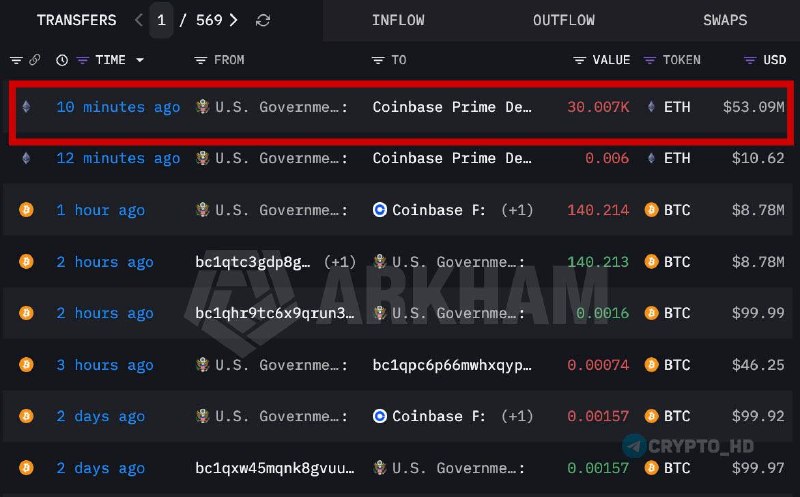
When seized assets move from US government wallets to centralized exchanges, traders tend to see it as sale prep. First came the 30,007 ETH transfer to Coinbase Prime. Then wallet trackers flagged the larger move: 4,600 BTC also landed at Coinbase Prime from government linked wallets. Most guides say exchange transfers equal selling. That’s only half right. The transfer is not the sale, but the pattern is familiar enough that traders react before execution details arrive. Nobody wants to be the last trader pretending a $343 million seller might not matter.
Rates, inflation, and Fed policy could make these transfers sting more than usual. Awkward timing. The market is already trading around the macro flow story: interest rates and inflation first, then the Federal Reserve’s next move on quantitative tightening. Add $343 million in BTC and ETH that could be sold, and the tape gets nervous. Why does this matter? Because past sales of seized BTC have come with short dips as traders tried to front-run the extra supply. The dollar amount matters. The venue matters more. Exchange wallets make people uneasy because coins can be sold quickly. ETH may feel more pressure than BTC because its market is smaller and has seen less institutional accumulation.
Government crypto sales are also a reminder that regulators still have real power over digital assets. I’ll be honest: this is the part crypto traders sometimes underplay. The regulation angle is not theoretical. The US government can seize crypto, move it on-chain, and sell it through a regulated venue like Coinbase Prime. Anyone can watch the coins move in public. Some people will call that proof crypto has real value. Traders will read it more bluntly: a state actor can drop supply into the market with little warning. Coinbase is also a public company, COIN, so the whole process sits closer to traditional finance than many crypto diehards would like.
What this means
The transfers suggest the US government may be preparing to sell seized crypto, which could pressure BTC and ETH in the short term. The market will likely treat these moves as a liquidation signal unless the coins leave Coinbase Prime without being sold. BTC traders should watch the $61.4K support level. A clean break below it would make the downside case easier to buy. ETH could be more exposed because its market cap is smaller, so a large sale can hit liquidity harder. Counter to the usual advice, Coinbase Prime may actually reduce execution chaos while still hurting price. Cleaner does not mean invisible. Buyers still have to absorb the supply.
Traders should watch Coinbase Prime flows, order book depth, and the next macro data releases. Start with Coinbase Prime activity: whether the coins sit, move again, or begin showing up as sell pressure. Then check order book depth. The government rarely gives the market a clean sale calendar, so wallet behavior becomes the clue. Is this overkill? For $343 million in BTC and ETH, no. The next FOMC meeting and inflation data matter too. A strong macro backdrop could absorb some of the selling. A weak tape could turn the same transfer into a sharper move. Yes, this cuts against the neat “watch the wallet, ignore the noise” view. In my read, if BTC and ETH lose major support levels over the next few days, traders will probably blame this new supply first.