
















































Trump’s Late Stock Disclosure: A Crypto Market Conflict of Interest?
Former President Trump’s late disclosure of 327 stock purchases, made one day before a major tariff pause rally, looks bad. Very bad. And I’ll be honest: the $200 fine is the part that makes the whole thing feel unserious. This is not just a paperwork story. The trades were hidden from public view while a policy move from the same official helped push markets sharply higher. Why does that matter? Because timing is the whole trust problem here. Investors do not need a proven crime to start asking who knew what, when they knew it, and whether the disclosure system is built for anything tougher than polite compliance. Crypto regulators and lawmakers now have fresh material for fights over conflicts, disclosures, market fairness, and political access.
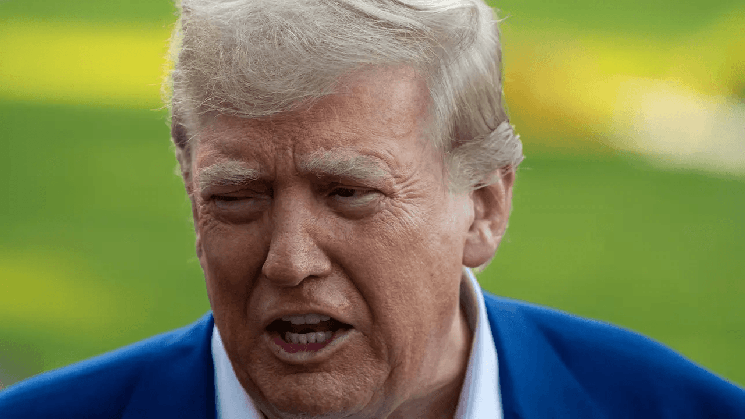
The trades appeared in a 927-page financial disclosure report filed with the Office of Government Ethics this week, according to NBC News reporters Steve Kopack and Gabe Gutierrez. They were not easy to find. They were scattered through the filing. Senior officials are supposed to report securities transactions within 45 days using 278-T forms. Trump did not file those forms for the April 2025 trades, or for most of his 2025 transactions. So the April 8 buying spree stayed private for more than 14 months. The penalty was $200. That almost sounds made up. Most ethics explainers say disclosure rules create transparency. That’s only half right. Transparency that arrives 14 months late is more like archaeology. An OGE reviewer noted it in the filing: “The filer paid late filing fees related to transactions not previously reported on 278-Ts.”
The 327 purchases included Apple, Microsoft, Nvidia, Amazon, and Alphabet, with each position listed at up to $250,000. The filing also listed many other companies. Federal disclosures use value ranges instead of exact amounts, so the full purchase total is not clear, though it appears to be below the $12.8 million ceiling. The next day, April 9, 2025, Trump announced a pause on many of his “Liberation Day” tariffs. Markets jumped. The S&P 500 closed up 9.5%, one of its biggest one day gains ever, and the same large technology stocks listed in his accounts helped drive the rebound. The White House says all presidential assets are in fully discretionary accounts run by independent third parties. No agency has accused Trump of trading on inside information. Still, the timing is hard to shrug off. My take: that last sentence is doing a lot of work. Craig Holman of Public Citizen put it plainly: “It is critical that the public and the press have a full accounting of the financial holdings, investments and stock transactions of senior public officials.”
A $200 late fee for a 14-month delay on trades worth millions is not much of a deterrent. It is barely a parking ticket. In a market context, it is worse than that: it is a pricing signal. Delay disclosure, pay a small fee, move on. Counter to the usual advice, the key issue is not whether every trade can be tied to a direct policy benefit. The bigger issue is whether the public can see the trades while the information still matters. Crypto is already under pressure from the SEC, the CFTC, and lawmakers who want stricter digital asset disclosure rules. Now they have another example to cite. If stock trades by public officials can stay hidden this long, it becomes easier to argue for tighter controls on less regulated crypto markets. That could affect spot Bitcoin ETF approvals and staking rules. Exchange compliance too. Coinbase (COIN), for example, has moved with regulatory headlines and recently traded around $200.
The filing also lands in the middle of a messy story about Trump’s finances and his administration’s approach to markets. His 2025 disclosures reported at least $1.4 billion in crypto earnings, mostly from memecoin royalties and World Liberty Financial token sales. Add that to policy pushes like digital government payments and “Trump Accounts,” a children’s savings program that accepts publicly traded stock donations, and the conflicts question becomes harder to dodge. Is this just a stock-market ethics story with crypto bolted on? No. The crypto angle matters because public officials can now hold, promote, regulate, and politically benefit from assets that trade 24/7 across global venues. When the person setting tariff policy also holds hundreds of tariff-sensitive stocks, disclosure timing is not a clerical detail. It is the public’s main way to see possible conflicts.
Some investors may look at this and lose more trust in traditional markets. A few may move toward crypto because it feels outside the system. I would be careful with that leap. Yes, this slightly contradicts the usual Bitcoin-as-escape narrative. Bear with me. Bitcoin (BTC) is often sold as a hedge against political instability, but it still trades like a risk asset much of the time. During one recent bout of market uncertainty, BTC fell 3% to $61.4K. That is not a moral judgment. It is price behavior.
What this means
This episode points to a simple problem: the rules around political power and personal investing look too weak for the money at stake. A $200 penalty for a 14-month delay on trades worth millions tells officials, whether anyone means it to or not, that late disclosure is cheap. We have seen this pattern before in ethics debates: the formal rule exists, but the punishment is so small that the rule becomes a courtesy. For crypto investors, the likely result is more pressure on exchanges and token issuers. DeFi projects may get dragged into the same conversation, even when the facts are not identical. Lawmakers may also use this case when pushing for wider disclosure rules tied to digital assets. Watch for more ethics language from Congress, especially around public officials who own large crypto positions or assets linked to companies affected by federal policy.
The effect on individual crypto prices may be indirect at first. Sentiment is the bigger channel. If investors think public markets are tilted, some may look for alternatives. Others may just cut risk everywhere. Which reaction wins? Probably both, depending on the week. The SEC and CFTC are worth watching over the next few months, especially if they mention conflicts of interest, public official disclosures, or crypto holdings. New legislation or enforcement tied to this kind of political-financial overlap could change how federal law treats digital assets. That would matter for Ethereum (ETH), major tokens, and publicly traded crypto companies. Skip the easy take. The real story is not only one late filing. It is how cheap late disclosure still appears to be.