
















































Morgan Stanley Ethereum Solana ETF filings point to bigger institutional interest
Morgan Stanley’s updated SEC filings for Ethereum and Solana ETFs, with tickers and and a 0.14% commission, are a pretty clear sign that institutional crypto interest has moved past the Bitcoin-only phase. My take: this is the kind of boring paperwork that actually matters. If these funds launch, ETH and SOL could land in front of investors who want exposure without touching tokens, wallets, exchanges, or private keys. James Seyffart reported the update, and the timing is hard to ignore.
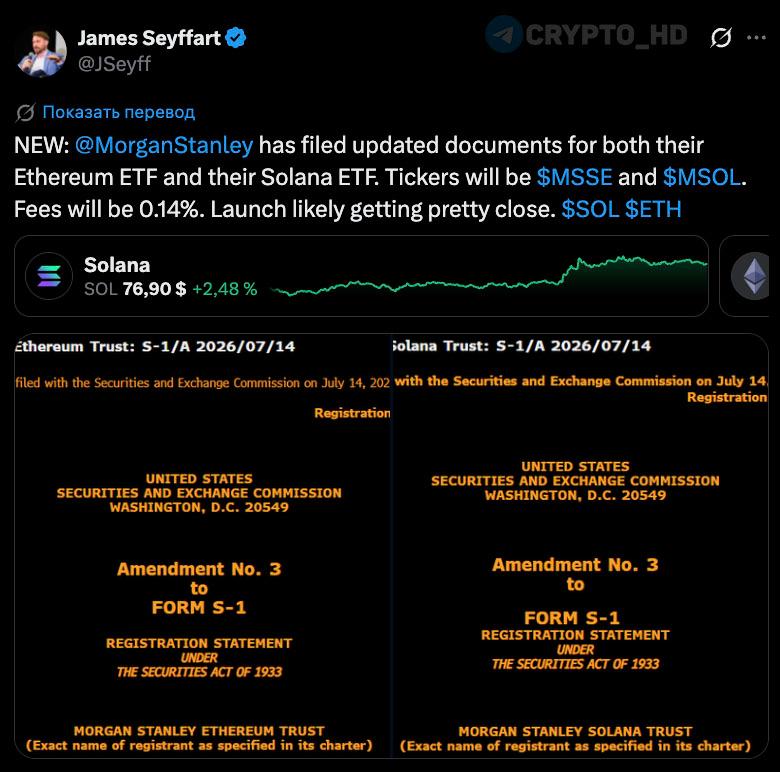
According to Seyffart, Morgan Stanley submitted updated applications to the SEC for Ethereum and Solana exchange-traded funds. The proposed tickers are and, respectively, and the fee is 0.14%. That is low. Very low. Most crypto ETF chatter focuses on approval odds. That’s only half right. Pricing tells you how aggressively a product is being positioned, and 0.14% does not feel casual. It feels ready.
The filing also says something about how Wall Street now sees Ethereum and Solana. They are not just speculative tokens drifting outside the financial system. At least for firms like Morgan Stanley, they are assets that can be packaged, tracked, sold, benchmarked, and placed inside normal brokerage accounts. Does that make them safe? No. Crypto can still move brutally fast, and anyone who forgets that usually gets reminded at the worst possible time. But access matters, and ETFs make access easier.
Bitcoin already proved that point. Spot BTC ETFs were approved earlier this year, and the inflows helped push Bitcoin past its old $69,000 high to more than $73,000 in March. ETH is trading around $3,800, while SOL has moved past $170. If Ethereum and Solana ETFs get similar treatment, they could pull in investors who have been waiting for a regulated wrapper before buying either asset. I’ll be honest: this is not mainly about retail traders smashing buy on a headline. It is about advisors, managed portfolios, pension-style allocations, institutional accounts, and platforms that often cannot, or will not, hold crypto directly.
The filing also puts more pressure on the SEC. The agency has been slow with crypto products, especially anything outside Bitcoin. Counter to the usual line, though, the post-Bitcoin ETF world makes that caution harder to explain cleanly. Morgan Stanley pushing Ethereum and Solana products with a 0.14% fee forces the SEC to show how it treats large digital assets beyond BTC. The fee matters too. If these funds launch at that price, other issuers may need to cut their own fees. Investors would like that. Higher-fee crypto products probably would not.
The SEC’s decision could set the tone for altcoin ETFs. Approval would give other issuers a stronger case for similar products. A delay or rejection would tell the market that Bitcoin is still being treated as the exception. Either way, traders will read the response closely. Why does this matter? Because ETF approval is not just a product decision; it becomes a market signal.
What this means
Morgan Stanley’s filing shows institutional interest in Ethereum and Solana becoming more practical. Less talk, more paperwork. Major financial firms seem to be moving these assets out of the “interesting but awkward” category and into products clients can buy through channels they already use. The 0.14% fee matters because it suggests these ETFs are built to compete from day one. Simple as that.
If the funds launch, ETH and SOL could see another wave of inflows. That does not guarantee higher prices. Yes, this slightly undercuts the bullish read above, but it has to be said: ETF demand can support a market without magically removing volatility. Bitcoin’s ETF reaction still gives traders a reason to care. ETH could try to move back toward its all-time high of $4,891.70, while SOL could test levels above its current range if new demand arrives.
The next thing to watch is the SEC’s response. Approval language, delay notices, requests for more changes, or even awkward silence around timing will give traders a clearer read. ETH and SOL could react fast to any real signal. Is this overkill to track closely? For assets this sensitive to regulatory headlines, no. The wider altcoin market matters as well, because if Ethereum and Solana ETFs are approved, other large-cap crypto assets will almost certainly line up behind them. The key dates are the SEC’s statutory response deadlines, since those narrow the window for any possible launch.