
















































Murad’s Meme Coin Portfolio Drop Puts His “Supercycle” Theory Under Pressure
Murad, a former Goldman Sachs analyst and co-founder of the crypto fund Adaptive Capital, has watched his public portfolio fall 83.5%, from about $67 million last July to roughly $11 million today. He still has not sold a single meme coin. That part sticks. I keep coming back to it because the loss itself is not the whole story; crypto has plenty of ugly charts. The stranger part is the refusal to cut anything. His “meme coin supercycle” bet has stopped looking like a tidy market thesis and started looking like a live stress test: can online communities hold token prices together when liquidity dries up and sentiment turns sour?
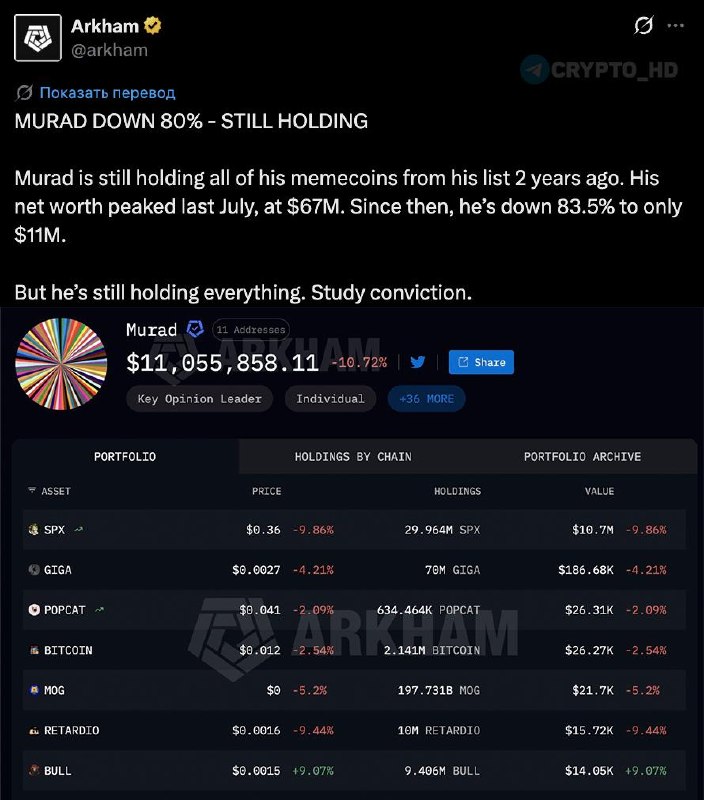
Murad’s meme coin portfolio has taken the sort of hit that makes even jaded traders stop scrolling. It peaked near $67 million last July. Now it is around $11 million. That is an 83.5% drop, and according to his public comments, he has not sold any of the tokens. I’ll be honest: that is either remarkable conviction or a very expensive refusal to blink. Maybe both. Murad has argued that meme coins are not just jokes with charts attached. In his view, the strongest tokens pull value from community loyalty rather than revenue, cash flow, or normal business metrics. Most guides frame that as irrational speculation. That is only half right. Communities can move markets, but they do not magically remove downside.
The market has not helped him. Money moved away from risky assets, and crypto felt it quickly. The Federal Reserve’s tougher stance on interest rates, plus stubborn inflation worries, pushed investors toward preservation instead of speculation. Bitcoin struggled to break above the $61.4K resistance level for much of Q3 2023, even while parts of traditional markets looked healthier. Why does this matter? Because meme coins usually need easy liquidity and traders willing to take big swings. When that disappears, the tone changes fast. Murad’s portfolio is full of community driven tokens, so it was always exposed to that shift. Communities can keep attention alive for a while. They cannot print liquidity. Many altcoins have dropped 50% to 70% since their 2021 highs, and meme coins have been hit too.
Regulation adds another headache, and this one is less dramatic but more persistent. The SEC and CFTC have focused mostly on larger crypto assets, exchanges, and staking products, while meme coins still sit in a gray area. My take: that gray area is not neutral. Institutions tend to avoid assets when the rules are unclear, and retail traders get jumpy when crackdowns or delistings start to feel plausible. The legal fights around crypto exchanges and staking services have already hurt sentiment. In early March 2023, for example, BTC dropped 4% after news of increased SEC scrutiny on staking products. Meme coins are more exposed than Bitcoin or large-cap exchange tokens because their value is mostly speculative. No product. No regulated cash flow. No obvious utility to lean on when the chart starts bleeding.
What this means
Murad’s drawdown puts real pressure on the “meme coin supercycle” idea. Community strength may matter, but this episode suggests it may not be enough when rates stay high, liquidity tightens, and traders stop chasing the riskiest assets. Yes, this slightly contradicts the pro-community argument above. Bear with me. A strong community can support attention, distribution, and narrative speed; it still cannot fully replace capital inflows. Holding through an 83.5% loss shows serious conviction. It also shows how punishing the downside can be. Meme coins can rip higher in bull markets, but the same lack of fundamentals that makes them exciting on the way up can make them brutal on the way down. Dogecoin (DOGE) and Shiba Inu (SHIB) still have large communities, yet both have seen major corrections from their all-time highs. Murad’s portfolio is not some strange one-off. It is a sharper version of a familiar pattern.
Anyone watching meme coins should keep an eye on the next Federal Open Market Committee meetings. If the Fed stays hawkish, risk assets could remain under pressure. Bitcoin matters too. A sustained move below support levels such as $25,000 would likely pull the broader altcoin market lower. Is this overkill for a meme coin portfolio? No. In this corner of crypto, macro pressure can become price pressure fast. CME data can offer a cleaner read on institutional interest in crypto derivatives than the usual social media noise. Comments from the SEC or CFTC are also worth watching. A new statement on token classification could move this market quickly, especially in a sector where confidence is doing so much of the work.
FAQ
What is Murad’s “meme coin supercycle” theory?
Murad’s “meme coin supercycle” theory says a meme coin’s value comes mainly from the strength and activity of its community, rather than traditional business fundamentals or utility. My read: that makes community the asset, not just the audience.
How much has Murad’s portfolio declined?
According to public records, Murad’s meme coin portfolio has fallen 83.5%, from about $67 million in July to around $11 million today.
Has Murad sold any of his meme coins?
No. Even after the steep decline, Murad has publicly said he has not sold any of his meme coin holdings. That is the key fact.
What factors contributed to the decline in Murad’s portfolio?
The decline has been linked to tighter macro conditions, including the Federal Reserve’s hawkish rate stance and persistent inflation concerns. It also reflects a move away from speculative crypto assets.
How does regulatory uncertainty affect meme coins?
Unclear rules from agencies such as the SEC and CFTC can keep institutions away and make retail traders more cautious. Meme coins are especially vulnerable because their prices depend so much on speculation and sentiment.
What does Murad’s experience suggest about the “meme coin supercycle” theory?
It suggests that community strength may not be enough to protect meme coin prices during long downturns or tough macro conditions. Counter to the usual hype, loyalty does not always equal liquidity. That directly challenges the main claim behind the theory.
What should investors monitor regarding meme coins?
Investors should watch FOMC meetings and Bitcoin support levels. They should also track CME crypto derivatives data and any new SEC or CFTC comments on token classification.